

The next chapter of India’s residential energy market will not be defined by backup power alone. As rooftop solar adoption grows, households increasingly need systems that can do more than switch on during an outage: they must make better use of the electricity generated during the day, store surplus energy and manage power intelligently when the grid is unavailable.
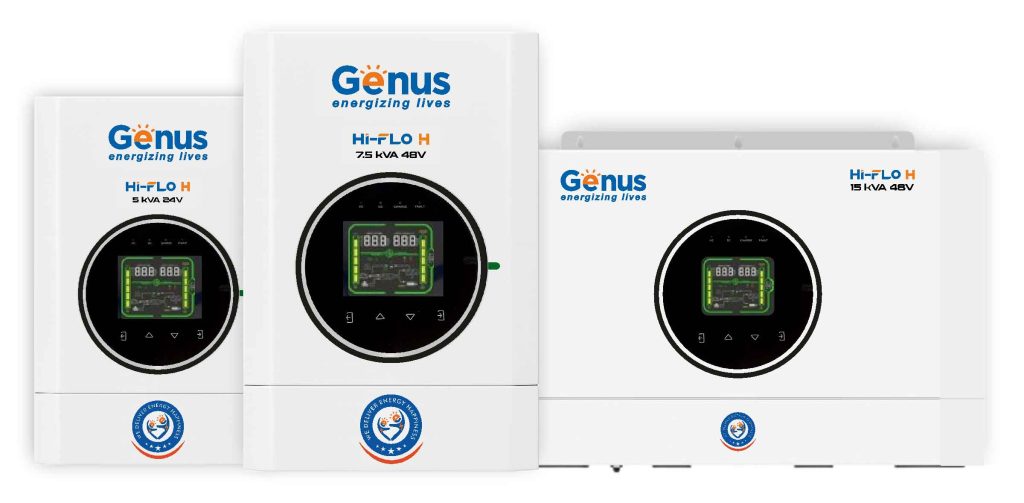
For Genus Innovation Ltd., this shift is creating an opportunity to build on its established inverter and battery business while expanding into hybrid solar inverters, lithium-based storage and smarter energy management. Its portfolio includes the Hi-Flo hybrid solar inverter, which coordinates solar, battery and grid power, and the MaxiLion range of integrated lithium inverter systems. The company also manufactures lithium batteries with its own battery management system (BMS), according to the interview.
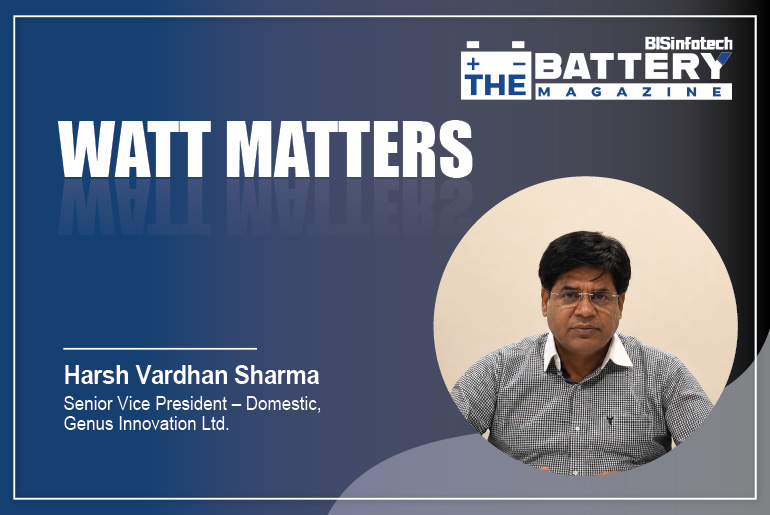
At Battery Show India 2026, Shweta Kumari, Sub-Editor at The Battery Magazine spoke with Harsh Vardhan Sharma, Senior Vice President – Domestic, Genus Innovation Ltd., about the company’s product launches, the growing role of hybrid inverters, battery quality and its plans for smarter power management. From household-scale solar storage to the possibilities of real-time electricity tariffs, the conversation explores how Genus is preparing for a market in which energy efficiency and intelligent control may become as important as reliable backup.
What products did Genus Innovation showcase at Battery Show India 2026, and how was the response from visitors?
We have received a tremendous response, beyond our expectations. We are showcasing some of our most exciting products, including hybrid inverters, energy storage systems (ESS) and lithium batteries.
I believe hybrid inverters represent the future of this industry. Customers are familiar with conventional grid-tied inverters, but these systems generally cannot provide backup during a power cut unless they are specifically designed to do so. A hybrid inverter, on the other hand, can manage solar generation, battery storage and grid electricity together.
It not only provides backup when the grid supply is unavailable but also helps maximise the utilisation of solar energy during the day.
Our hybrid inverters also offer smart load management, allowing users to prioritise essential loads over non-essential ones during a power outage. This gives customers greater control over how their available backup power is used.
We are also showcasing our lithium batteries, which we manufacture at our facility in Jaipur. Our battery management system is developed in-house, and we use Grade A cells to support reliability, performance and efficient energy utilisation.
Which products are the key highlights of your showcase, particularly for residential customers?
One of our key highlights is the 2.5 kVA hybrid inverter. It is designed for household applications and can support up to 3 kW of solar panels, with the ability to supply a 2 kW load during a power outage, subject to the system configuration.
We are also showcasing our 7.5 kVA hybrid inverter, which is designed for higher household power requirements.
It can support heavier loads, including air conditioners, depending on the installation and load configuration.
Alongside these inverters, we have displayed two lithium battery models: a 25.6 V battery and a 51.2 V battery. The higher-voltage battery is suitable for compatible, higher-capacity inverter systems.
Our objective is to offer customers a range of solutions that can be matched to their electricity consumption, solar installation and backup requirements.
Genus has an established energy storage portfolio. What distinguishes your newer ESS products from conventional power backup systems?
We have a broad range of ESS products, with multiple models designed for different customer requirements.
One of our newer offerings is the MaxiLion Air, a compact integrated lithium inverter system designed for wall mounting. We are also showcasing the MaxiLion One 1000 MPPT, which incorporates a Maximum Power Point Tracking (MPPT) solar charge controller and supports solar panel connectivity.
These products are designed to make power backup and solar utilisation simpler for customers. Unlike conventional battery-based systems that require regular maintenance, our lithium-based solutions offer a more convenient experience, with no acid-related maintenance or routine water topping.
The idea is to provide a modern, intelligent power solution that is easier to install and maintain while making better use of available solar energy.
What will be Genus Innovation’s primary technology and business focus over the next two to three years?
The industry is evolving. Traditionally, power backup products were primarily used because of frequent power cuts. Going forward, the market will increasingly be driven by energy efficiency, better technology and the need to make more effective use of electricity.
Lithium batteries and high-frequency inverters will be important parts of this transition, and we are working to strengthen our offerings in these areas.
Our focus is to continue developing products that respond to changing customer requirements and help us remain competitive as the industry evolves.
Is Genus exploring battery chemistries beyond lithium-ion, such as sodium-ion, to prepare for future market requirements?
There is a lot of development taking place in alternative battery chemistries, including sodium-ion. We are also exploring these developments and looking at potential collaborations with international companies.
Technology is evolving rapidly, and we want to ensure that we remain abreast of new developments. Our approach is to evaluate emerging technologies and explore opportunities that could help us strengthen our product portfolio in the future.
The objective is to remain technologically prepared as the market develops and customer requirements change.
As renewable energy and storage adoption accelerate, how does Genus view the future of the BESS market?
There is significant potential for battery energy storage in India. As renewable energy expands, storage will become increasingly important for making better use of the electricity generated.
At present, our business is primarily focused on the domestic market, and we are continuing to develop our capabilities in this area. The wider energy storage industry is evolving, and we recognise the opportunities that will emerge as the market matures.
For us, the priority is to strengthen our products and capabilities while understanding how customer requirements develop. We see storage as an important part of the industry’s future, and we will continue to evaluate the opportunities that align with our business.
What are the biggest challenges facing Indian battery manufacturers, particularly in the residential lithium battery market?
One of the major challenges is the lack of consistent quality across the market. There are products being sold without customers necessarily understanding the difference between Grade A cells and lower-quality cells, or the importance of a properly designed battery management system.
Some products compete primarily on price, even when quality and performance may be compromised. This creates a challenge for manufacturers that invest in better components and quality control.
The concern is that if customers purchase substandard products and experience poor performance, they may lose confidence in the entire product category. That can affect the industry’s long-term growth.
We need a market in which product quality, customer awareness and sustainable demand develop alongside government support.
Looking towards 2030, what can customers expect from Genus in terms of smarter energy management?
We are working towards smart inverter solutions that can respond to real-time electricity tariffs.
As real-time or more dynamic tariff structures develop in India, there will be opportunities for inverters to manage electricity consumption more intelligently. For example, when grid electricity becomes more expensive, the system could reduce reliance on the grid and shift to solar power, where available, or use stored energy from the battery.
During the daytime, the system could prioritise solar energy. At night, when solar generation is unavailable, it could use battery storage to supply the load, depending on the available charge and the user’s settings.
This is the kind of intelligent energy management we believe will become increasingly important. We are working towards solutions that can automatically manage power sources according to availability, customer requirements and electricity costs.
Our vision is to make energy use smarter and more efficient, while helping customers get greater value from their solar and storage systems.
 Electrify your feed! Click here to join our Whatsapp group and to get the latest updates, expert insights, and innovations driving India’s energy storage revolution.