

For years, battery backup in Indian homes has largely meant one familiar combination: an inverter paired with a lead-acid battery. But as households increasingly explore solar power and lithium-ion storage, and businesses seek more reliable ways to manage electricity, the expectations from backup systems are changing. At Renewable Energy India Expo 2026, Servotech Renewable Power System Limited presented a portfolio that reflects this shift—from compact lithium-ion batteries designed for everyday applications to a commercial battery energy storage system (BESS) rated at 240 kWh.
The company’s showcase highlighted a growing emphasis on battery intelligence, scalable configurations and domestic manufacturing. Its smaller battery systems are designed to address applications ranging from household backup to specialised uses, while its commercial BESS points towards a broader role for storage in managing energy demand and supporting solar integration. Servotech’s wider portfolio also spans solar inverters, EV charging infrastructure and other power solutions, bringing generation, storage and electricity use into the same conversation.
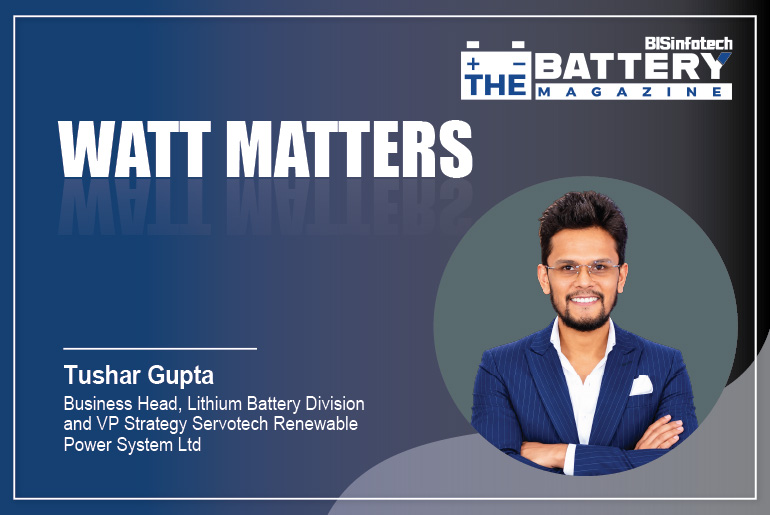
At the expo, Shweta from The Battery Magazine spoke with Tushar Gupta from Servotech Renewable about the company’s latest battery technologies, the importance of intelligent battery management, its focus on Indian manufacturing and the innovations it hopes to bring to market next.
How has Day 1 of REI Expo 2026 been for Servotech?
Day 1 has been excellent. The response has been fantastic, and the footfall we are seeing is very encouraging. In previous editions of REI, this kind of crowd would generally arrive on the second or third day. This year, the strong response from the very first day has been remarkable.
We have also brought some exciting products to the exhibition. Our focus is on presenting solutions that address the changing requirements of the market, particularly in lithium-ion batteries and energy storage. It is encouraging to see visitors taking an interest in these technologies and exploring how they can be used across different applications.
What are the key lithium-ion battery products Servotech is showcasing this year?
We are showcasing several lithium-ion battery solutions for different requirements. One of them is a 1.28 kWh lithium-ion battery designed as a replacement for conventional lead-acid batteries used in homes. It is part of our effort to provide customers with an alternative to traditional backup systems. Moreover, we’re also showcasing our 2.56 kWh and 5.12 kWh batteries.
We have also come up with our latest 8.04 kWh, 314 Ah battery that has been a growing interest in this category, particularly in states such as Uttar Pradesh, Bihar, West Bengal and across the Northeast, as well as in Himachal Pradesh and Tamil Nadu.
Beyond household backup, these batteries can serve specialised applications. They can be used for backup requirements in ambulances and in applications associated with Indian Railways and the defence sector, subject to the relevant system and application requirements.
The aim is to offer battery solutions for a range of needs rather than restrict ourselves to a single market segment.
You mentioned that these are smart batteries. What makes their battery management systems different?
The batteries we are showcasing incorporate smart battery management systems (BMS). The purpose is to give us better visibility into what is happening inside the battery.
Battery management is important because the system needs to monitor internal operating conditions and help identify potential issues. With intelligent monitoring, servicing and troubleshooting can become easier because the team has better information about the battery’s condition.
For us, the focus is not simply on supplying a battery. It is also about making the battery easier to monitor and maintain throughout its use. A smart BMS supports this approach by providing information that can help with service and maintenance.
How do your 2.56 kWh and 5.12 kWh batteries address different storage requirements?
One of the features we are highlighting in these batteries is the ability to configure multiple battery units together. According to the configuration we are demonstrating, up to 15 units can be connected, with one battery acting as the master and the others operating as additional units.
This type of arrangement can provide flexibility when a customer needs to expand the system’s storage capacity. Instead of being limited to one standalone battery, the configuration can be adapted to the requirement.
We see this flexibility as an important differentiator in the market. The exact number of units and the permitted connection arrangement depend on the product’s specifications and system configuration.
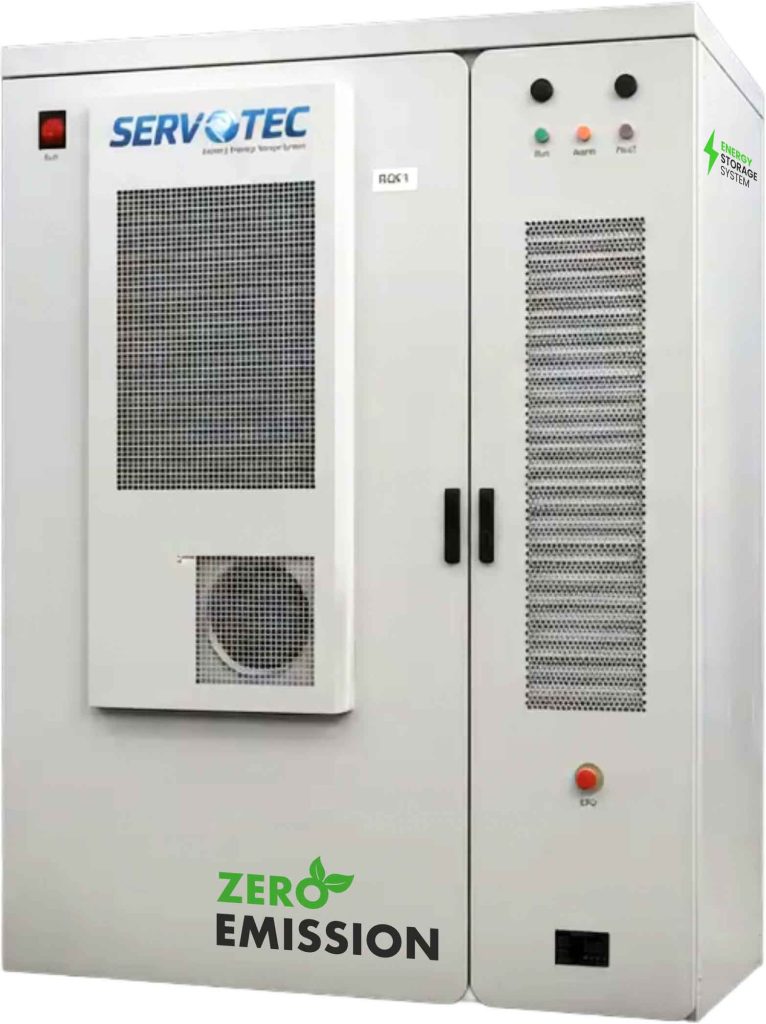
You are also showcasing a 240 kWh battery energy storage system. Could you explain its key features?
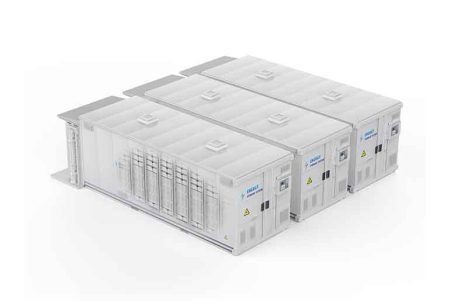
This is one of the major products we are presenting at the exhibition. It is a 240 kWh battery energy storage system, and our focus is on Indian manufacturing.
The battery modules are made in India. The power conversion system (PCS), air-conditioning unit and fire-extinguishing system are also presented as Indian-made components. We want to demonstrate our ability to bring the different elements of an energy storage system together through domestic manufacturing.
The system has a nominal configuration of 768 V and 314 Ah, with a two-ton air-conditioning module for thermal management. The battery arrangement combines multiple modules to achieve the required voltage and energy capacity.
For us, this is an important step in demonstrating a more comprehensive energy storage offering. A commercial BESS is not just a collection of battery cells; it brings together battery modules, power conversion, thermal management, safety provisions and system integration.
How important is the Make in India approach to Servotech’s battery and energy storage strategy?
It is an important part of what we are working towards. With the 240 kWh BESS we are showcasing, we want visitors to see the extent of domestic manufacturing involved in the system—from the battery modules to the PCS, air-conditioning and fire-extinguishing components.
The objective is to develop products that are suitable for the Indian market while strengthening our manufacturing capabilities. We want customers and industry partners to see the facilities, technologies and processes behind these products.
For us, manufacturing is not just about assembling a finished product. It is about building the capabilities needed to develop reliable solutions and continue improving them. We invite people to visit our factory and see the infrastructure and manufacturing processes for themselves.
What new technologies or product developments can we expect from Servotech over the coming year?
We are working on several new initiatives that are currently at the research and development (R&D) and new product development (NPD) stages.
We also have patents, as reflected in our public filings. We are working towards bringing these patented technologies into our products and launching them in the market.
Innovation is important because we want to keep improving our offerings and create products that stand apart from competing solutions. Our work is not limited to the products currently on display, we are also investing effort in technologies that we hope to introduce in the future.
As these initiatives progress, we expect them to contribute to the next stage of our product development.
What are the major challenges in the battery and energy storage industry, and how does Servotech plan to address them?
Challenges will come and go. What matters is that a business must continue to operate, remain sustainable and adapt to changing circumstances. Our focus is on developing products that support our vision and mission: to produce green and to live green. That is the principle guiding our work.
For us, the objective is to keep moving forward, develop solutions for the market and build a business that can sustain itself over the long term. We believe that staying focused on our purpose and continuing to develop our products are important parts of that journey.
What message would you like to share with the readers of The Battery Magazine?
I would encourage readers to come and see our products for themselves and understand what we are developing and explore the solutions we are bringing to the market.
We would also welcome people to our factory. They can see the manufacturing infrastructure and the facilities we are using to develop these products. We believe that seeing the products and the manufacturing processes firsthand gives people a better understanding of our work. We look forward to engaging with customers, partners and industry stakeholders as we continue developing our solutions.
 Electrify your feed! Click here to join our Whatsapp group and to get the latest updates, expert insights, and innovations driving India’s energy storage revolution.