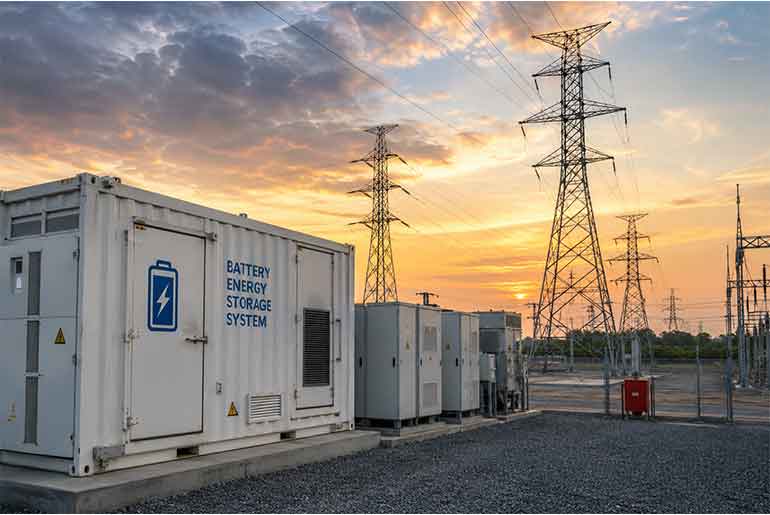
Gujarat Electricity Regulatory Commission (GERC) has released draft BESS regulations aimed at building a comprehensive framework for battery storage deployment across Gujarat as the state prepares for a massive rise in renewable energy integration and grid flexibility requirements.
The proposed “Grid Interactive Battery Energy Storage System Regulations, 2026” mark one of the most detailed state-level regulatory frameworks for battery storage in India so far. Through the draft rules, GERC is trying to officially integrate BESS into Gujarat’s electricity ecosystem by defining how battery systems will be planned, developed, connected, operated, scheduled and monetised within the power grid.
In simple terms, the regulations are being introduced because Gujarat’s renewable energy capacity is growing very rapidly, especially in solar and wind energy. Since renewable energy generation changes throughout the day depending on sunlight and wind conditions, battery storage systems are now becoming necessary to store excess electricity and release it later during high demand periods.
The draft GERC BESS regulations are therefore designed to make battery storage a central part of Gujarat’s future power infrastructure.
According to the draft document, the main objectives of the regulations include:
- improving grid flexibility and reliability
- supporting renewable energy integration
- enabling large-scale deployment of battery storage
- strengthening grid stability and security
- supporting Energy Storage Obligation (ESO) targets
- creating business models for battery storage developers
allowing BESS participation in electricity markets and ancillary services.
One of the biggest highlights of the draft framework is that GERC has officially recognised battery storage systems as “controllable and dispatchable” grid resources. This means BESS projects will not simply act as backup systems, but will actively participate in power system operations by both drawing electricity from the grid and injecting electricity back into the grid whenever required.
The regulations define Battery Energy Storage Systems as electrochemical devices capable of absorbing electricity from generation sources or the grid, storing it in chemical form and later discharging it as electricity.
The draft framework applies to:
- generating companies
- transmission licensees
- distribution companies
- standalone BESS developers
- captive generating plants
- prosumers and consumers
- storage aggregators
renewable energy developers.
GERC has proposed that all BESS projects connected to Gujarat’s intra-state transmission or distribution network must be registered with Gujarat Energy Development Agency (GEDA). However, separate registration will not be required if the battery system is already integrated within a renewable energy project and included in the project approval documentation.
The regulations also introduce multiple deployment and ownership models for BESS. According to the draft, battery storage projects can be developed by:
- generating companies
- transmission utilities
- distribution companies
- independent power producers
- renewable developers
- storage service providers
- consumers and prosumers
aggregators.
GERC has further proposed several business models for battery storage deployment, including:
- standalone grid-connected battery systems
- co-located storage with renewable projects
- battery systems integrated into transmission and distribution infrastructure
- battery-backed net metering systems
- EV charging and battery swapping integration
- vehicle-to-grid (V2G) and grid-to-vehicle (G2V) services.
The draft regulations state that standalone battery storage projects can also operate under:
- merchant market models
- bilateral contracts
- ancillary service contracts
- capacity support arrangements.
One of the most important operational provisions in the draft rules is the proposal that battery storage systems should preferably be procured through competitive bidding under Section 63 of the Electricity Act. The regulations also state that tariffs may be discovered through availability-based fixed charges depending on performance parameters such as charging rate, discharging rate, efficiency and ramp rate.
GERC has proposed a minimum project size of 1 MW with at least two hours of storage duration for utility-scale BESS projects connected at 11 kV or above. However, this requirement will not apply to battery systems installed at distribution transformer level, captive projects or consumer-level storage systems.
The regulations also explain how battery systems will be integrated into generation, transmission and distribution planning.
For renewable energy projects, co-located battery storage systems can be used for:
- firming renewable power
- smoothing fluctuations
- improving dispatchability
- reducing deviations
- participating in electricity markets.
Transmission-linked battery systems may be used for:
- congestion management
- delaying transmission infrastructure expansion
- supporting renewable integration
- grid reliability enhancement
- contingency management.
Distribution-linked BESS projects may help DISCOMs in:
- peak demand management
- voltage regulation
- reducing network losses
- renewable energy balancing
- deviation charge management.
Another major aspect of the draft GERC BESS regulations is the detailed operational framework for scheduling, dispatch and energy accounting.
The State Load Despatch Centre (SLDC) will be responsible for scheduling and dispatching all grid-connected battery storage systems. Charging of batteries will be treated as electricity drawal, while discharging will be treated as electricity injection into the grid.
The regulations also allow battery systems to provide ancillary services such as:
- frequency regulation
- voltage support
- reserve management
- ramping support
- fast response grid balancing services.
Importantly, GERC has also proposed a multi-use revenue framework where standalone BESS projects may earn revenues from multiple services simultaneously, including:
- energy arbitrage
- ancillary services
- peak demand management
- congestion management.
The commission has clarified that in situations involving competing operational requirements, grid security and reliability will receive the highest priority.
The draft regulations also include detailed provisions related to:
- technical standards
- battery safety
- cybersecurity protocols
- environmental compliance
- battery disposal norms
- real-time operational data sharing with SLDC.
Under the proposed framework, battery waste management and end-of-life disposal must comply with India’s Battery Waste Management Rules, 2022. The responsibility for safe disposal will remain with the BESS owner.
GERC has additionally proposed allowing consumers and prosumers to install battery storage systems under net metering, group net metering and virtual net metering arrangements. Aggregators will also be allowed to combine multiple distributed battery systems to provide grid services and participate in electricity markets.
Overall, the draft GERC BESS regulations indicate that Gujarat is preparing for large-scale battery energy storage deployment as renewable energy penetration rises across the state. The regulations are expected to create clearer rules for developers, investors, utilities and consumers while helping Gujarat strengthen grid stability, renewable integration and energy storage infrastructure over the coming years.
 Electrify your feed! Click here to join our Whatsapp group and to get the latest updates, expert insights, and innovations driving India’s energy storage revolution.