At first glance, India’s solar manufacturing story looks nothing short of extraordinary. Gigafactories are rising across states, rooftop solar installations are accelerating and the country’s ambition to become a global clean energy powerhouse seems stronger than ever. From Gujarat and Rajasthan to Tamil Nadu and Telangana, solar panels carrying “Made in India” labels are rapidly becoming part of the nation’s industrial identity.
But beneath this remarkable expansion lies a quieter and far more important question — one that could define the future of India’s solar ambitions.
India built the panels. But who will build the cells?
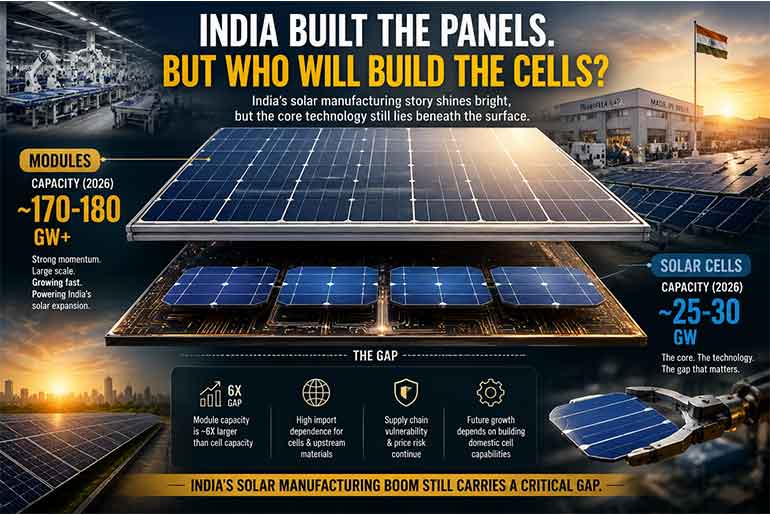
The question matters because while India has successfully expanded its solar module manufacturing capacity to nearly 170–180 GW by 2026, domestic solar cell manufacturing still remains in the range of only 25–30 GW. The gap is impossible to ignore. In simple terms, India has become exceptionally good at assembling solar panels, but the technological heart inside many of those panels still depends heavily on imported solar cells and upstream components.
And that changes the conversation entirely.
This is no longer just about solar panels. It is about supply chains, industrial depth, technology control and energy security.
The Great Manufacturing Imbalance
India’s rise in solar module manufacturing has been rapid and impressive. According to data from the Ministry of New and Renewable Energy (MNRE) and PIB, the country’s module manufacturing capacity has expanded dramatically over the past few years, supported by policies such as the Approved List of Models and Manufacturers (ALMM), Production Linked Incentive (PLI) schemes and rising domestic solar demand.
But solar cell manufacturing has not grown at the same pace.
That imbalance reveals an important reality about the solar industry: manufacturing a solar module and manufacturing a solar cell are two very different things.
A solar module is essentially the final assembled product — the visible panel installed on rooftops and solar parks. Solar cells, however, are the core electricity-generating units placed inside those panels. Manufacturing them requires advanced technology, high-precision engineering, sophisticated equipment and far deeper industrial capabilities.
In many ways, solar cells are the real technological engine of the solar industry.
And that is exactly where the challenge begins.
Why Did Module Manufacturing Expand So Quickly?
The answer is surprisingly practical. Module assembly is comparatively easier, faster and less capital-intensive. Companies can import solar cells, assemble modules domestically and quickly enter the market. For a rapidly growing solar economy like India, this became the fastest route toward scaling domestic manufacturing.
Solar cell manufacturing, on the other hand, is far more complex. As It requires:
- high-purity materials,
- technologically advanced production lines,
- precision engineering,
- controlled manufacturing environments,
- and significantly higher investments.
The challenge becomes even greater as the industry shifts toward advanced N-type technologies such as TOPCon and HJT. These next-generation solar cells demand deeper technical expertise and more sophisticated production ecosystems.
As a result, many companies initially chose the easier path: build module assembly capacity first and rely on imported solar cells. And for a while, that model worked. India rapidly expanded its domestic solar deployment while simultaneously creating a large module manufacturing ecosystem. But now, as the country pushes for deeper self-reliance and energy security, the limitations of that approach are becoming more visible.
The China Factor
No discussion around solar cell manufacturing is complete without understanding China’s role in the global solar supply chain.
China did not simply build solar panel factories. It built an entire manufacturing ecosystem.
Today, China dominates a significant portion of the global solar value chain — from polysilicon and wafers to solar cells, modules and even manufacturing equipment. According to global energy and manufacturing reports from organizations such as the International Energy Agency (IEA), China controls over 80% of several key segments of global solar manufacturing.
That level of integration gives China enormous advantages:
- lower production costs,
- faster scaling,
- stronger supply chain control,
- and better pricing power.
India, meanwhile, still remains heavily dependent on imports for wafers, polysilicon and several upstream materials required for solar cell manufacturing.
This is why the current manufacturing gap matters so deeply.
A solar panel may carry an Indian label, but the technology heart inside it often still comes from elsewhere.
Why Solar Cell Manufacturing Matters Now and this is most concerned topic for now:
For policymakers, the issue goes far beyond manufacturing statistics.
Solar cell manufacturing is directly connected to: energy security, industrial resilience, trade dependency, and future competitiveness. As the global tensions are rising, becoming self-dependent is the priority now which we can not overlook.
 Electrify your feed! Click here to join our Whatsapp group and to get the latest updates, expert insights, and innovations driving India’s energy storage revolution.