
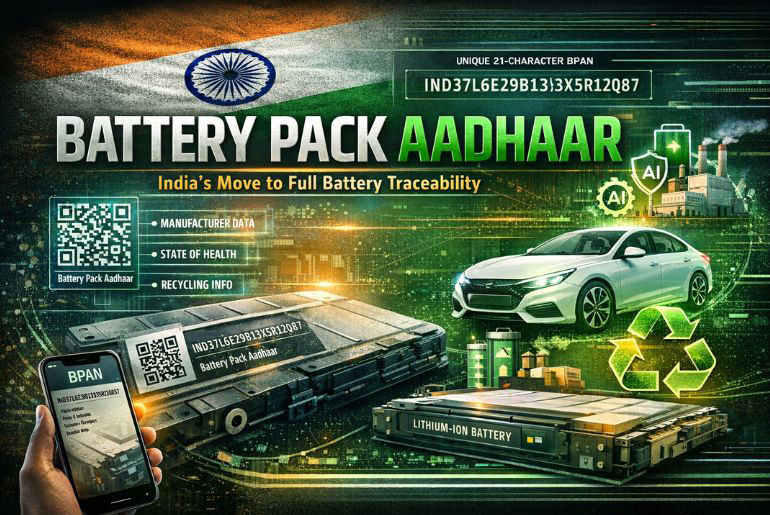
India is preparing for a fundamental transformation in how batteries are tracked, regulated, and recycled, with the release of draft guidelines for the Battery Pack Aadhaar system. The framework introduces a unique digital identity for every electric vehicle and large industrial battery pack, laying the foundation for end-to-end lifecycle traceability across India’s rapidly expanding battery ecosystem.
The draft guidelines, developed under the Office of the Principal Scientific Advisor to the Government of India and aligned with the Battery Waste Management Rules, 2022, propose the introduction of a 21-character Battery Pack Aadhaar Number (BPAN). This number will function as a permanent digital identity for a battery pack from manufacturing through usage, repurposing, and recycling.
A Digital Backbone for India’s Battery Ecosystem
At the core of the framework is a three-layer identification system:
- a physically marked alphanumeric BPAN,
- a QR code containing key static data, and
- a secure central server holding dynamic lifecycle data.
Unlike conventional labelling systems, Battery Pack Aadhaar is designed as a living digital record, not a static tag. Each BPAN encodes detailed information about the battery’s origin, chemistry, configuration, safety class, and carbon footprint, while dynamic data such as State of Health (SoH), battery status, thermal events, and end-of-life treatment are continuously updated throughout the battery’s operational life.
The framework mandates that battery producers or importers assign and upload BPAN data for every eligible battery pack introduced into the Indian market, including self-use batteries. Any significant change to a battery such as repurposing or recycling will require the issuance of a new BPAN, ensuring traceability across multiple life cycles.
Why EV Batteries Are the First Priority
The guidelines clearly recognise that electric vehicles account for nearly 80–90% of India’s lithium-ion battery demand, far exceeding industrial applications. As a result, EV batteries are proposed as the first priority segment for Battery Pack Aadhaar implementation, while industrial batteries above 2 kWh capacity are included in scope.
By routing the framework through the Automotive Industry Standards (AIS) process, the government aims to ensure technical validation, stakeholder consultation, and national regulatory uniformity before full-scale rollout.
Static, Dynamic and Carbon Footprint Data
- Battery Pack Aadhaar introduces a structured classification of battery data:
- Static data includes manufacturer identity, battery chemistry, capacity, voltage, cell origin, safety classification, and material composition.
- Dynamic data captures real-world performance parameters such as SoH, operational status, disassembly method, circularity outcome, and timestamps.
- Carbon footprint data tracks emissions across raw material acquisition, manufacturing, distribution, and end-of-life recycling stages.
- This granular data structure directly supports safety monitoring, second-life battery markets, and compliant recycling, while improving transparency across the value chain.
Enabling Circular Economy and Policy Enforcement
One of the most significant implications of Battery Pack Aadhaar is its role as a common digital spine for India’s emerging battery regulations. The system is designed to support:
- Extended Producer Responsibility (EPR) enforcement,
- verification of domestic value addition under the ACC PLI scheme,
- improved auditability for recyclers and regulators,
- and future alignment with global battery passport frameworks, including the EU Battery Regulation.
- By keeping a large share of information accessible offline via BPAN and QR codes, while limiting server-based data to high-value lifecycle events, the framework balances regulatory ambition with cost-effective, large-scale implementation.
A Structural Shift, Not Just a Label
Battery Pack Aadhaar is not positioned as another compliance layer, but as India’s first nationwide battery identity and data architecture. If implemented effectively, it could reshape battery manufacturing accountability, eliminate counterfeit batteries, unlock efficient recycling, and strengthen consumer trust while preparing India’s EV ecosystem for the next decade of scale.
In a market racing toward electrification, Battery Pack Aadhaar marks India’s shift from volume-driven growth to traceability-driven maturity.
 Electrify your feed! Click here to join our Whatsapp group and to get the latest updates, expert insights, and innovations driving India’s energy storage revolution.