Close Menu
The Battery MagazineThe Battery Magazine
  • Just In
  • Batteries
    • Battery Manufacturing (BESS)
    • Battery Materials & Chemistries
    • Battery Recycling
    • C&I Storage
  • Solar
  • Renewable energy
    • Wind Energy
    • Hydropower
    • Green Hydrogen
    • Bioenergy
  • Tenders
    • Energy Storage
    • Solar Energy
    • Wind Energy
  • Policy
    • Storage
    • Solar
    • Wind
    • EV
    • Transmission
  • EV
    • EV Batteries
    • EV Charging Infrastructure
    • Electric Mobility Trends
  • Grid
    • Transmission & Distribution
    • Grid Infrastructure
    • Power Generation
    • Power Equipments
  • Exclusive
    • Cover Story
    • Watt Matters
    • Perspective
    • Articles
  • More
    • E-Mag
    • Events
    • Contact Us
Facebook LinkedIn WhatsApp
The Battery MagazineThe Battery Magazine
  • Just In
  • Batteries
    • Battery Manufacturing (BESS)
    • Battery Materials & Chemistries
    • Battery Recycling
    • C&I Storage
  • Solar
  • Renewable energy
    • Wind Energy
    • Hydropower
    • Green Hydrogen
    • Bioenergy
  • Tenders
    • Energy Storage
    • Solar Energy
    • Wind Energy
  • Policy
    • Storage
    • Solar
    • Wind
    • EV
    • Transmission
  • EV
    • EV Batteries
    • EV Charging Infrastructure
    • Electric Mobility Trends
  • Grid
    • Transmission & Distribution
    • Grid Infrastructure
    • Power Generation
    • Power Equipments
  • Exclusive
    • Cover Story
    • Watt Matters
    • Perspective
    • Articles
  • More
    • E-Mag
    • Events
    • Contact Us
LinkedIn Facebook WhatsApp YouTube
The Battery MagazineThe Battery Magazine
Home » Renewable energy » India’s Nuclear Push Gains Momentum as Domestic Reactors Emerge as Fast-Track Choice
Renewable energy

India’s Nuclear Push Gains Momentum as Domestic Reactors Emerge as Fast-Track Choice

Shivangi GuptaBy Shivangi GuptaAugust 24, 20263 Mins Read
Facebook Twitter LinkedIn WhatsApp
India’s Nuclear Push Gains Momentum as Domestic Reactors Emerge as Fast-Track Choice

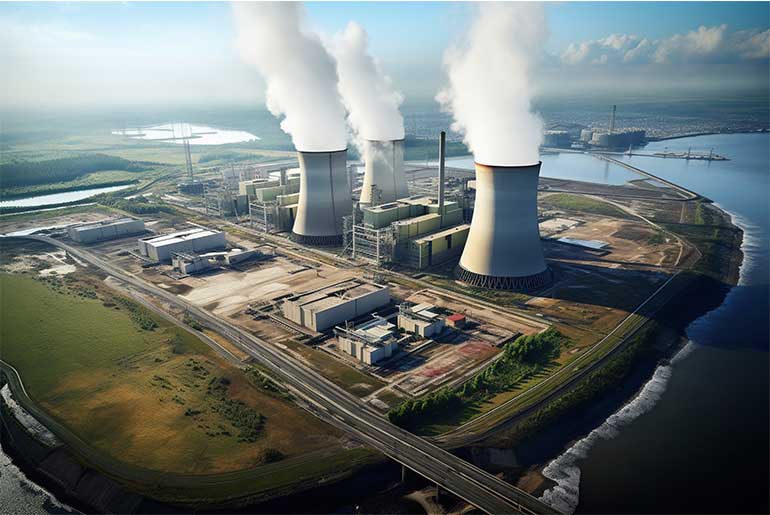
India’s leading industrial groups and power utilities are turning to domestically designed nuclear reactors as they look to accelerate projects and avoid the delays, cost overruns and regulatory hurdles that have historically slowed the country’s nuclear expansion.

Companies including Adani Group, Jindal Steel Ltd. and state-owned NTPC Ltd. are expected to initially favour India’s indigenous 700-megawatt pressurised heavy water reactor (PHWR) technology. Industry executives say the proven design, established regulatory framework and largely domestic supply chain could help reduce project timelines and execution risks.

“We have the advantage of a 700-megawatt design that is already standardised and operational,” said Vivek Sharma, business head at Adani Atomic Energy, at the BNEF Summit in New Delhi. He highlighted the technology’s fully domestic supply chain as a major advantage.

The shift comes as India opens its nuclear sector to private investment. The government is targeting a dramatic increase in nuclear generation capacity—from around 8.8 GW today to 100 GW by 2047—as part of its long-term strategy to strengthen energy security and reduce carbon emissions.

Nuclear power currently accounts for only about 3% of India’s electricity generation. Construction delays and rising project costs have historically constrained the sector, making faster deployment a key priority for both policymakers and industry.

Domestic technology seen as lower-risk option

Jindal Steel is also leaning toward indigenous reactors for its initial nuclear projects. Naveen Ahlawat, president and head of decarbonization at Jindal Steel, said the company’s first two reactors would most likely be 700-MW domestic units.

The company is nevertheless evaluating alternative technologies and potential partnerships with international players, including Russia’s Rosatom and France’s EDF. Jindal Steel has set an ambitious target of developing 18 GW of nuclear capacity by 2047.

For NTPC, indigenous nuclear technology is similarly central to its expansion plans. The state-owned power major aims to build 30 GW of nuclear capacity by 2047, supporting its broader effort to reduce dependence on coal.

NTPC’s first nuclear project through its joint venture with Nuclear Power Corporation of India Ltd. will feature four indigenous reactor units. According to NTPC Director Projects K. Shanmugha Sundaram, around 80% of the company’s planned nuclear capacity is expected to use large pressurised water and heavy water reactor technologies.

He also described Indian heavy-water reactor technology as the most cost-competitive option available to the company at present.

Private sector investment accelerates

India’s nuclear ambitions are attracting major private-sector commitments. Gautam Adani has announced plans for 10 GW of nuclear capacity, while Reliance Industries Ltd., led by Mukesh Ambani, has signed a preliminary agreement to invest ₹2 trillion in nuclear projects in Maharashtra.

Prime Minister Narendra Modi has also set an aggressive near-term target, saying in his Independence Day address on August 15 that India aims to begin five new reactors within the next six to seven years.

With private companies entering the sector and domestic reactor technology offering an established engineering and supply-chain base, India is betting that standardised indigenous designs can provide a faster and more economical path to its nuclear expansion goals.

For the battery and energy-storage industry, the development is also significant: a larger nuclear fleet could provide a growing source of low-carbon, round-the-clock electricity, complementing renewable energy and potentially strengthening India’s broader clean-energy ecosystem.

whatsapp icon Electrify your feed! Click here to join our Whatsapp group and to get the latest updates, expert insights, and innovations driving India’s energy storage revolution.
clean energy clean energy transition energy storage Energy Storage Solutions India News NTPC nuclear power renewable energy
Shivangi Gupta
  • Website

Shivangi Gupta is a journalist passionate about writing and delivering accurate, clear, and informative news stories across a wide range of topics.

Keep Reading

Resource Adequacy in India: Can Storage Keep the Grid Reliable?

Trinity Cleantech Develops Bioethanol Generator With Built-In EV Charging

Trinity Cleantech Develops Bioethanol Generator With Built-In EV Charging

Insolation Green Energy Secures ₹2.90/kWh Solar Projects Worth 99 MW in Maharashtra

Insolation Green Energy Secures ₹2.90/kWh Solar Projects Worth 99 MW in Maharashtra

Leave A Reply Cancel Reply

twelve + 6 =

Renewable energy
Insolation Green Energy Secures ₹2.90/kWh Solar Projects Worth 99 MW in Maharashtra

Insolation Green Energy Secures ₹2.90/kWh Solar Projects Worth 99 MW in Maharashtra

August 24, 2026
Vena Group Exits India Renewable Energy Market With Sale to Inox Clean Energy

Vena Group Exits India Renewable Energy Market With Sale to Inox Clean Energy

August 24, 2026
₹839 Crore Transmission Project to Strengthen Power Evacuation from Himachal Hydro Plants

REC Subsidiary Advances ₹839 Crore Transmission Project for Himachal Hydro Power

August 24, 2026
MNRE Offers Four-Month Relief to Renewable Projects Delayed by West Asia Crisis

MNRE Offers Four-Month Relief to Renewable Projects Delayed by West Asia Crisis

August 24, 2026
Batteries
Tata Power Commissions 190.5 MW Solar-Storage Project to Deliver Firm Renewable Power in Rajasthan

Tata Power Commissions 190.5 MW Solar-Storage Project to Deliver Firm Renewable Power in Rajasthan

August 24, 2026
India Needs $500 Billion by 2030 to Power Clean Energy Transition: MNRE

India Needs $500 Billion by 2030 to Power Clean Energy Transition: MNRE

August 24, 2026
Uttar Pradesh and Japan’s Yamanashi Team Up to Advance Green Hydrogen Pilot Project

Uttar Pradesh and Japan’s Yamanashi Team Up to Advance Green Hydrogen Pilot Project

August 24, 2026
SECI Awards 1,500 MW FDRE Tender to Waaree, NTPC REL and ACME Solar at ₹5.99–₹6/kWh

SECI Awards 1,500 MW FDRE Tender to Waaree, NTPC REL and ACME Solar at ₹5.99–₹6/kWh

August 24, 2026

Subscribe for Updates

Get the latest news about energy storage in your inbox.

    © 2026 Thebatterymagazine.com.
    • Home
    • About Us
    • Contact Us
    • Privacy Policy
    • Terms of Service

    Type above and press Enter to search. Press Esc to cancel.