The electric mobility revolution in India is advancing significantly, making electric vehicle (EV) battery companies in India the most important participants in both the clean energy and automotive transitions of the nation. There is a sudden increase in the number of EV adoption consumers as the government is also introducing number of incentives, and an increasing amount of initiatives to localise supply chains. EV battery companies in India are ramping up production and making considerable investments in advanced chemistry R&D to develop extensive local supply chains. As India strides towards achieving its clean energy goals, the importance of EV Battery Companies is growing gradually .
According to a recent report from Bloomberg, this EV battery demand is projected to further increase 17-fold by 2030, also bringing the cost of battery storage down. India has a vast potential for large-scale battery manufacturing, and industry reports state that India’s annual battery market could surpass US$ 15 bn by 2030.
The growth of demand-side incentives, developing supportive infrastructure, and government policies toward the industry is having an explosive effect on the electric vehicle (EV) market (e.g., EV battery companies). According to a report from the Central Electricity Authority (CEA), the total EV batteries demand in the Indian market will be about 256.3 GWh by the year 2032, compared to the estimated demand of 17.7 GWh in 2025. This growth in demand for batteries has been attributed to the increased need for energy storage due to increased renewable energy generation, as well as increased use of electric vehicles.
Government Programs and Policy Support
The government of India has introduced a few EV related policies for giving India’s electric vehicle battery industry a big boost. Through the Production Linked Incentive Scheme, they want to build 50 GWh of advanced battery manufacturing capacity right here in the country. This will help Battery Manufacturing Companies in India rely less on imports and make more batteries at home.
The PM E-DRIVE Scheme is a total game-changer for how you’ll experience electric travel in the coming years. With a massive ₹10,900 crore budget, the government isn’t just talking about change—they are building it. Specifically, ₹2,000 crore is dedicated purely to setting up the infrastructure we need, like widespread public charging stations and convenient battery-swapping points. This move is designed to take the stress out of owning an EV and is a huge boost for EV battery companies in India. By making charging as easy as finding a petrol pump, this scheme helps EV battery companies in India to introduce more of their technology on the road. For anyone looking at the future of transport, these efforts by EV battery companies in India are making “range anxiety” a thing of the past.
Key highlights:
• 100% subsidy for government premises
• 70–80% subsidy for public and highway infrastructure
• Support for battery swapping stations and charging stations
This infrastructure push directly supports EV adoption, which in turn boosts demand for EV battery companies in India.
Why EV Batteries are the Critical Pillar
An Electric car’s battery can cost around 30- 40 percent of the total Electric Vehicle cost, impacting how far the car can travel on a single charge and how long it takes to recharge, as well as also keeping safety and performancein mind. That’s where the Indian battery Companies for electric vehicles play a crucial role in creating the electric vehicle ecosystems by being both manufacturers and technical leaders in the developing industry. Additionally, the growing demand for electric vehicles means that manufacturers are developing new ways of battery production that are more efficient, have longer lifespans, and are much safer than previous batteries without facing any fire risks.
The Power List: Leading EV Battery Companies in India
There are a few major Titans who are at the Forefront of this energy indepence through conversions from assembly to cell localization. Understanding the future of transportation will involve evaluating key automotive battery manufacturers in India and their innovation.
Ola Electric: The Vertical Integration Leader
Ola Electric is unique among EV battery companies in India because of its aggressive “sole focus” on vertical integration.
- The Technology: They are the first to successfully develop the 4680 Bharat Cell (NMC) and have recently unveiled the 46100 LFP Gen 1 cell. Their Krishnagiri Gigafactory is already operating at ~2.5 GWh capacity and scaling toward 6 GWh. By handling everything from electrode production to final cell assembly in-house, they are drastically reducing the “ICE-to-EV” price gap.
Exide Energy (Nexcharge): The Scalable Giant
A household name in power, Exide has evolved into one of the most technologically diverse EV battery companies in India.
- The Technology: Through its subsidiary Exide Energy Solutions, the company is commercializing a 6 GWh Li-ion cell plant in Bengaluru (Phase 1) by late FY26. They utilize SVOLT technology to produce both NMC and LFP chemistries. A major win for them is their partnership with Hyundai and Kia, positioning them as a primary supplier for high-performance passenger vehicles.
Reliance New Energy: The Innovation Disruptor
Reliance is positioning itself as the most forward-looking player among EV battery companies in India by betting on “beyond-lithium” tech.
- The Technology: They are the primary driver of Sodium-Ion (Na-ion) technology in India, thanks to their acquisition of Faradion. With a planned 40 GWh initial capacity at their Jamnagar complex, Reliance is building a “cradle-to-grave” ecosystem that includes BESS (Battery Energy Storage Systems) and liquid metal batteries for grid-scale storage.
Amara Raja Energy & Mobility: The Giga-Corridor Pioneer
Amara Raja is securing its spot among the top EV battery companies in India by building a massive manufacturing footprint in Telangana.
- The Technology: Their “Giga Corridor” project focuses on Advanced Chemistry Cells (ACC), specifically targeting NMC and LFP formats to reduce import reliance. They recently inaugurated a major battery pack plant and are on track to commercialize cell production by late 2026, targeting the 2-wheeler and 3-wheeler segments where thermal stability is key.
Tata Agratas: The Captive Powerhouse
Agratas, a Tata Group venture, serves as the backbone for the country’s most successful EV fleet (Tata Motors).
- The Technology: They are currently in the “production-ready” phase for their 20 GWh gigafactory in Sanand, Gujarat. Their main focus is providing high-cycle-life LFP cells for the domestic market and high-performance NMC cells for JLR (Jaguar Land Rover) globally. As one of the top EV battery companies in India, they benefit from the entire Tata ecosystem, from mining to the final vehicle.
Key Technologies Shaping the EV Revolution in 2026
• Lithium Iron Phosphate (LFP): The current “gold standard” for the Indian market due to its superior thermal stability and comparative lower cost. Most EV battery companies in India have made LFP the spine of their e-2W and e-3W portfolios.
• Nickel Manganese Cobalt (NMC): NMC is reserved for high-performance passenger vehicles and long-range commercial fleets where energy density is paramount.
• Sodium-ion (The 2026 Commercial Breakout): Sodium-ion was once treated as a laboratory promise, has reached industrial reality this year. With cost parity to LFP projected by 2027 and excellent performance at extreme temperatures (retaining >90% capacity at –20°C), it is the strategic complement for entry-level EVs.
• Solid-state (The Future Horizon): While widespread adoption is expected toward 2028–2030, premier EV battery companies in India are already establishing R&D pilots to eliminate flammable liquid electrolytes, promising a “fire-proof” future.
Market Forecast and Growth Outlook
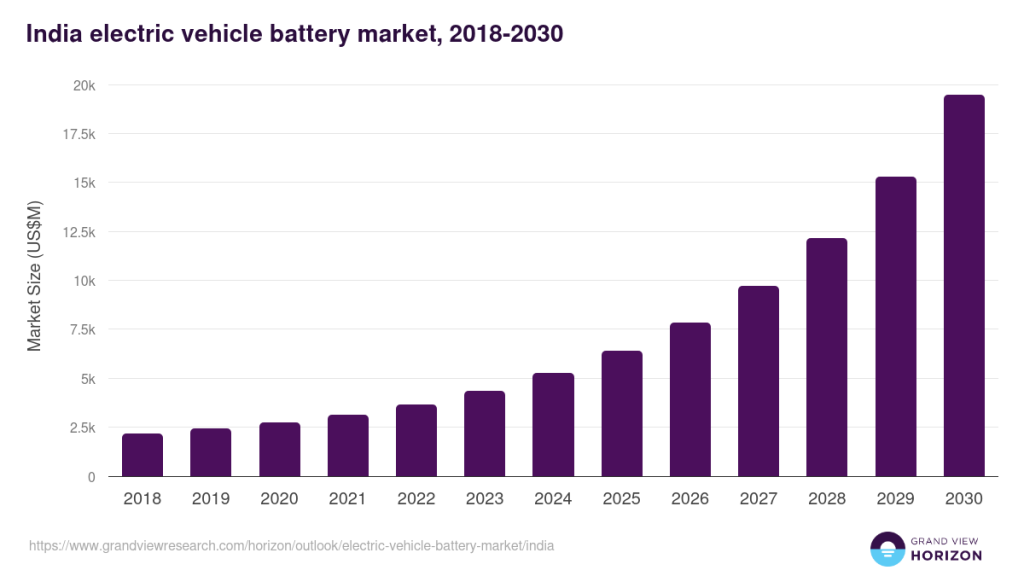
According to a report from Grand View Horizon the EV Battery Market in India is expected to reach a projected revenue of US$ 19,473.2 million by 2030. A compound annual growth rate of 24.9% is expected of India electric vehicle battery market from 2025 to 2030.
EV adoption:
- Two-wheelers → up to 70–80% electrification
- Three-wheelers → near 100% electrification
This growth trajectory ensures that EV battery companies in India will see sustained demand across automotive and energy storage sectors.
The future is looking incredibly bright for EV battery companies in India, fueled by unwavering government backing, a rapidly growing network of charging stations, upcoming new battery technologies and battery chemistries and a massive surge in electric vehicle sales. By building world-class gigafactories and focusing on “made-in-India” technology, EV battery companies in India are quickly becoming major power players on the global stage. As the country pushes for cleaner air and true energy independence, EV battery companies in India will do much more than just powering local cars; they are on track to become top-tier suppliers for the entire world (India for the World). This shift ensures that EV battery companies in India remain at the very heart of the global green revolution. Ultimately, the success of EV battery companies in India will be the defining factor in the journey towards a sustainable, zero-emission future.
 Electrify your feed! Click here to join our Whatsapp group and to get the latest updates, expert insights, and innovations driving India’s energy storage revolution.