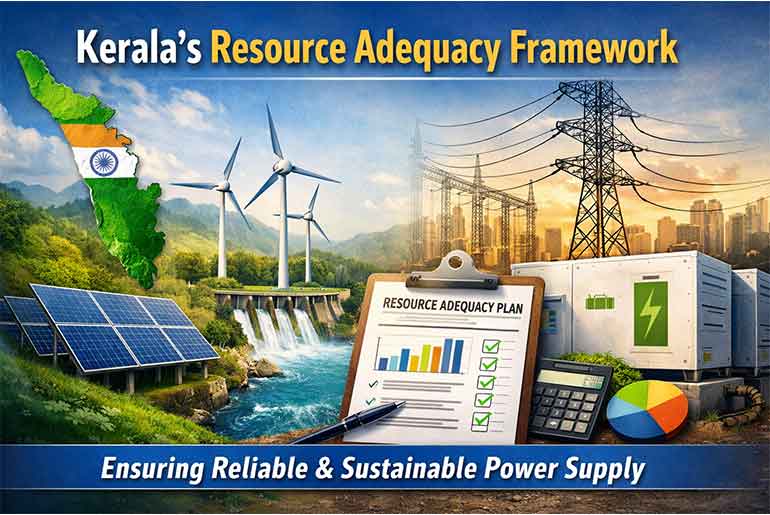
The Kerala State Electricity Regulatory Commission (KSERC) has issued draft regulations to strengthen long-term electricity planning in the state. The proposed rules, titled “Kerala State Electricity Regulatory Commission (Framework for Resource Adequacy) Regulations, 2026”, aim to ensure that Kerala always has enough power to meet rising demand in a reliable, affordable, and sustainable manner.
The draft has been released for public consultation, and stakeholders can submit comments and suggestions before finalization.
Why These Regulations Are Important
Kerala is witnessing steady economic growth, increasing electrification, and higher renewable energy penetration. At the same time, the state relies heavily on power imports from outside. With growing renewable energy like solar and wind — which are variable in nature — maintaining grid stability has become more complex.
To address this, the Commission is introducing a structured Resource Adequacy (RA) framework. Resource adequacy means ensuring that enough generation capacity is available at all times — including peak demand hours — so that there are no power shortages.
The regulations are framed in line with:
- The Electricity (Amendment) Rules, 2022
- Guidelines for Resource Adequacy Planning Framework for India issued in June 2023
- Model regulations framed by the Forum of Regulators
Key Highlights of the Draft Regulations
1. 10-Year Long-Term Planning
Distribution licensees in Kerala will be required to prepare a Long-Term Distribution Resource Adequacy Plan (LT-DRAP) covering a 10-year period.
They must:
- Forecast electricity demand (both peak and energy requirement)
- Assess existing generation capacity
- Identify additional capacity needed
- Ensure compliance with reliability standards
In addition, a Short-Term Plan (ST-DRAP) will be prepared for one-year operational planning.
2. Advanced Demand Forecasting
The draft mandates the use of modern and scientific tools for demand forecasting, including:
- CAGR methods
- Trend analysis
- ARIMA models
- AI and machine learning techniques
- Econometric and time-series methods
Distribution companies must also consider the impact of:
- Electric vehicles
- Data centres
- Demand-side management
- Open access
- Rooftop solar
- National Hydrogen Mission
- Energy storage systems
- Changes in consumption patterns
This ensures planning is realistic and future-ready.
3. Planning Reserve Margin (PRM)
A key concept introduced is the Planning Reserve Margin (PRM). This means keeping extra capacity beyond expected peak demand to avoid blackouts.
The Resource Adequacy Requirement (RAR) must match the distribution company’s share of national peak demand plus the required reserve margin.
Only firm contracted capacities — long-term, medium-term, and short-term — will count toward meeting this requirement.
4. Contract Mix Requirement
To maintain stability, distribution licensees must maintain a balanced power procurement mix:
- 75–80% through long-term contracts
- 10–20% through medium-term contracts
- Remaining through short-term contracts
Power purchases from exchanges (like Day-Ahead Market) will not count toward resource adequacy compliance.
This ensures reliability and reduces over-dependence on short-term market volatility.
5. Strong Focus on Renewable Integration and Storage
The draft recognizes the growing share of renewable energy and its intermittent nature. Therefore, it mandates:
- Capacity credit calculation for renewable sources
- Inclusion of energy storage systems
- Consideration of demand response programs
- Optimization modelling for least-cost generation mix
Battery storage and pumped storage projects (PSP) are specifically acknowledged as critical for balancing renewable power.
6. Reliability Standards: LOLP and NENS
To maintain grid reliability, the framework introduces measurable standards:
- Loss of Load Probability (LOLP)
- Normalized Energy Not Served (NENS)
These metrics will determine how much reserve capacity is needed to avoid supply shortfalls.
7. Strict Timelines and Compliance
The regulations lay down clear annual timelines:
- Demand forecast submission by April 30
- State-level aggregation by May 31
- National-level adequacy report by July 31
- Final approval by December 31
If there is a shortfall in resource adequacy, penalties may be imposed.
8. Transparency and Data Sharing
Distribution companies and the State Load Despatch Centre (SLDC) must:
- Maintain at least 10 years of data
- Share generation and demand data
- Publish power procurement details online
- Use authenticated and realistic data
- If unrealistic data is submitted, penalties will apply.
Public Consultation and Next Steps
Stakeholders can submit objections and suggestions within 21 days of publication. An online public hearing is scheduled, and registered participants will be notified of the hearing details.
Once finalized, the regulations will apply across the entire state of Kerala and will come into force upon notification in the Official Gazette
 Electrify your feed! Click here to join our Whatsapp group and to get the latest updates, expert insights, and innovations driving India’s energy storage revolution.