
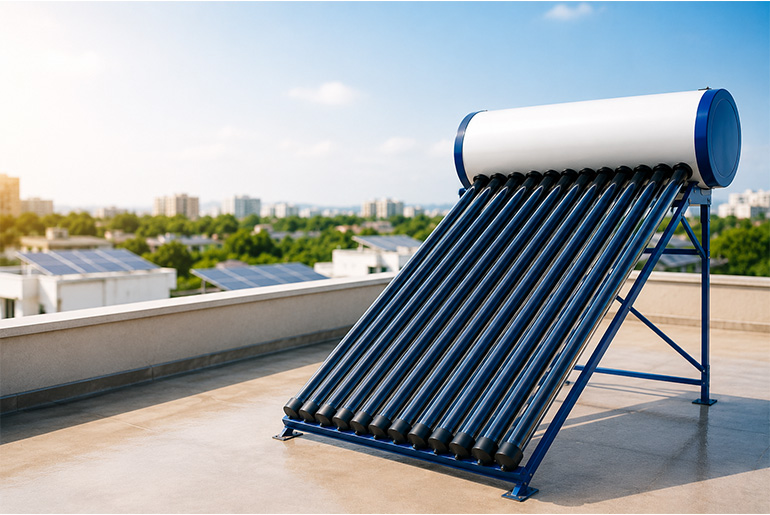
The Ministry of New and Renewable Energy (MNRE) has clarified that standalone Glass Evacuated Solar Collector Tubes will not fall under the ambit of the Solar Thermal Systems, Devices and Components (Quality Control) Order, 2024, providing much-needed clarity to manufacturers and other stakeholders in the solar thermal industry.
In an Office Memorandum dated June 19, 2026, MNRE clarified that the scope of the Quality Control Order (QCO), notified on October 8, 2024, is limited to three specific categories of solar thermal products. These are solar flat plate collectors for solar water heating systems, all glass evacuated tubes solar water heating systems and storage water tanks for evacuated tube solar water heating systems. Glass Evacuated Solar Collector Tubes as standalone items are not covered under the QCO as clearly stated by the Ministry.
The clarification comes in response to industry queries regarding whether individual evacuated collector tubes would require compliance under the Quality Control Order.
The Solar Thermal Systems, Devices and Components (Quality Control) Order, 2024 has been issued under the Bureau of Indian Standards (BIS) Act, 2016. As per QCO, all the covered products shall conform to the relevant Indian Standards and shall bear a valid BIS Standard Mark before they could be manufactured, sold, imported or distributed in the country.
Industry stakeholders had sought greater clarity on the applicability of the order to individual components used in solar water heating systems. With the latest clarification, manufacturers of standalone glass evacuated collector tubes now have certainty that these products remain outside the scope of the current quality control framework.
The Bureau of Indian Standards (BIS) continues to remain the designated certification and enforcement authority for products covered under the QCO and is responsible for market surveillance to ensure compliance.
The latest clarification is expected to provide regulatory certainty to solar thermal manufacturers while ensuring that compliance requirements remain focused on complete systems and notified components. The move is also likely to ease concerns among component suppliers and support smoother operations across the solar thermal value chain.
 Electrify your feed! Click here to join our Whatsapp group and to get the latest updates, expert insights, and innovations driving India’s energy storage revolution.