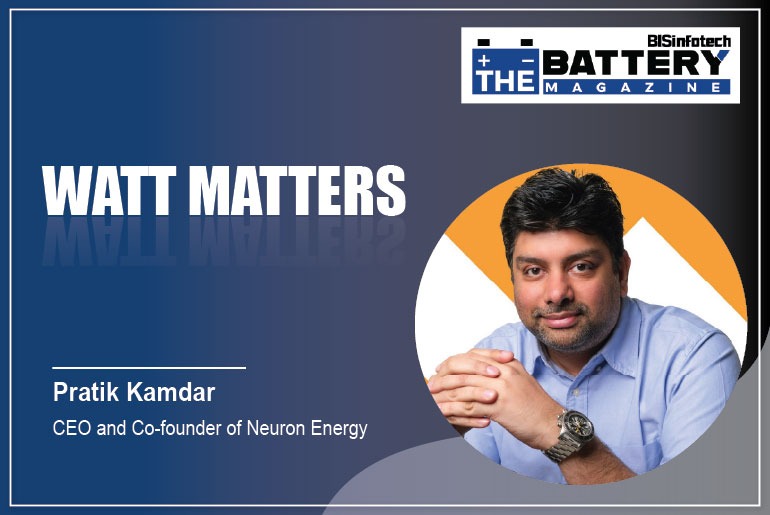
In the bustling lanes of India’s clean mobility revolution, some stories don’t begin with glossy EV launches or billion-dollar announcements. They begin with a small team, a modest investment, and a conviction that the future must be cleaner, smarter, and homegrown. Neuron Energy is one such story.
Founded in 2018 by Pratik Kamdar and Raj Shah, Neuron started humbly—with lead-acid batteries for e-rickshaws and golf carts—at a time when India’s EV ecosystem was barely a blip on the radar. Today, the company stands as a symbol of India’s lithium-ion leap, producing nearly 3,000 advanced batteries every month and exploring frontiers from Battery-as-a-Service for fleets to innovations in drones, agricultural machinery, and surveillance systems.
In this exclusive conversation with Shweta, Sub-Editor of The Battery Magazine, Pratik Kamdar, CEO and Co-founder of Neuron Energy, reflects on this journey—from navigating raw material challenges to pioneering battery leasing models, from diversifying into storage to reimagining applications beyond mobility. He also shares candid insights into global supply chain headwinds, India’s policy landscape, and why he believes two- and three-wheelers will remain the beating heart of India’s EV revolution.
Let’s dive into how Neuron Energy is not just keeping pace with change, but shaping the contours of India’s electrified tomorrow.
1. Could you walk us through Neuron Energy’s founding story—what motivated you and your co-founders to launch the company, and how did that vision align with India’s clean energy priorities at the time?
When Raj Shah and Pratik Kamdar founded Neuron Energy in 2018, India’s EV industry was still at an early stage. There were only a few thousand electric two-wheelers on the roads, but the signs of change were clear with rising fuel prices, growing environmental awareness, and strong government support for clean mobility. We wanted to contribute to that shift by creating something reliable and home-grown.
With an initial investment of around ₹4 crore, we started with lead-acid batteries for e-rickshaws, two-wheelers, and golf carts. This helped us understand the market, gain customer trust, and build a foundation. But we always knew lithium-ion was the future, offering better efficiency, safety, and lifespan. By 2020, we made the pivot, and today we produce nearly 3,000 lithium-ion two-wheeler batteries every month, with an order book of about ₹100 crore. This growth aligns perfectly with India’s clean mobility goals and the Make in India mission.
2. Since its inception, Neuron has significantly evolved its product portfolio—from lead-acid beginnings to smart lithium-ion batteries and energy storage solutions. How has your R&D, manufacturing, and distribution network expanded to support this diversification?
As I mentioned earlier, we started with lead-acid batteries but quickly moved into lithium-ion as the market matured. To support this transition, we built an in-house R&D team focused on innovation and safety, and partnered with suppliers for advanced cells. On the manufacturing side, we invested in facilities that can scale efficiently without compromising quality. At the same time, we established a wide distribution network across India to ensure accessibility and reliable service. This integrated approach now allows us to seamlessly scale from EV batteries to large energy storage solutions.
3. Battery leasing—or Battery-as-a-Service—has been a growing trend for scalable mobility. How is Neuron leveraging this model to enable cost-effective solutions for businesses and fleet operators, and what have been the key milestones in this journey?
Battery-as-a-Service is a real game-changer for fleets and businesses because it takes away the biggest barrier—high upfront battery costs. Instead of purchasing, operators can simply lease batteries from us, which makes EV adoption far more affordable and predictable. We’ve designed the model around convenience, offering both swapping and charging options depending on what best fits a fleet’s operations. Our initial pilots with logistics players gave us valuable feedback and the confidence to scale. Since then, we’ve expanded to partner with last-mile operators and begun setting up swap stations in Tier-2 and Tier-3 towns, where affordability and access make an even bigger difference. Every milestone has reinforced our belief that Battery-as-a-Service will play a central role in driving mass EV adoption in India.
4. In your view, how do current trends in India’s two- and three-wheeler EV segments compare with global developments—especially in terms of adoption rates, range expectations, and business models like battery leasing or swapping?
India’s electric two- and three-wheeler adoption is witnessing rapid growth, fueled by a combination of cost savings, supportive government policies, and innovative business models tailored to local needs. While global EV markets often emphasize long range and high-end features, Indian consumers and fleet operators prioritize affordability, operational flexibility, and quick turnaround. That’s where battery leasing and swapping models have emerged as game-changers lowering upfront costs, reducing charging time, and making EV ownership viable for delivery services, ride-hailing, and small businesses. These models are gaining traction in India at a faster pace than many other global markets, reflecting the country’s distinct mobility demands and the need for scalable, practical solutions. The focus here is less about pushing technological extremes and more about delivering dependable, cost-effective access to clean transportation.
However, even as adoption rises, the industry is now navigating new challenges. Recent supply shortages in EV components, sales performance across OEMs, and geopolitical developments are adding headwinds. In particular, the 25% tariff imposed by the U.S. on auto components could significantly disrupt global supply chains especially for emerging markets like India that are becoming increasingly important in the global EV ecosystem. For Indian battery players and component manufacturers, this move could strain existing partnerships, raise production costs, and potentially slow the momentum of EV growth. In light of this, it’s crucial for India to accelerate its domestic manufacturing capabilities and diversify export markets. Strengthening India’s position as a reliable, cost-competitive alternative supply base will be key to ensuring long-term resilience. Despite these hurdles, the broader outlook remains positive. With the right investments and policy direction, India’s clean-tech and EV sectors are well-positioned to overcome short-term disruptions and continue their upward trajectory.

5. You hinted at EV batteries powering innovation in areas like logistics drones, agricultural equipment, and surveillance systems. Could you elaborate on how Neuron is exploring or participating in such applications?
Yes, we see EV batteries going well beyond two- and three-wheelers, and that’s something we’re actively exploring. For instance, we’re testing our batteries in drones that can support logistics and agricultural applications, whether it’s delivering packages in hard-to-reach areas or helping farmers with crop monitoring. We’re also working on solutions for e-tractors and other agri-equipment, which can make rural operations more efficient and sustainable. On the industrial side, surveillance systems powered by reliable lithium-ion packs are another area of interest. These applications not only open new markets for us but also bring clean energy into sectors like agriculture and logistics, where cost savings and reliability can have a big impact. It’s about extending our expertise to drive innovation across ecosystems.
6. Raw material sourcing, cost pressures, and battery recycling remain critical challenges. How is Neuron navigating these—especially the dependency on components like cells and BMS from China—and what steps are you taking toward cost-efficiency and sustainable scaling?
Well, that is a challenge the whole industry is facing, and we have chosen to approach it step by step. At present, some components, such as cells and BMS, are still sourced from China, but we are actively working on localising more of the supply chain in India. It will not happen overnight, but the direction is clear. On costs, scale makes a real difference, and we are expanding capacity and streamlining processes so that every battery we produce is more efficient than the last. Sustainability is equally important. We are already exploring partnerships for recycling and second-life applications, because batteries should not end up as waste. For us, affordability and responsibility must go hand in hand if EV adoption is to grow meaningfully in India.
7. Looking ahead five years, how do you foresee the evolution of India’s battery tech and EV ecosystem? Which policy interventions or incentives would most accelerate adoption—especially among consumers and fleet operators?
Looking ahead five years, I think India’s EV landscape will look very different from today. The biggest growth will come from two-wheelers, three-wheelers, and small commercial vehicles, as they impact the largest number of people and businesses. On the technology side, batteries will advance with safer chemistries, higher energy density, and a stronger recycling ecosystem to ensure resources are used responsibly. But technology alone won’t drive adoption—policy support will be key. Encouraging local cell manufacturing can reduce import dependence, rationalising GST can make EVs more affordable, and targeted incentives for fleets can accelerate uptake. Once fleets make the switch, consumers naturally follow, and that’s when the ecosystem scales meaningfully.
 Electrify your feed! Click here to join our Whatsapp group and to get the latest updates, expert insights, and innovations driving India’s energy storage revolution.