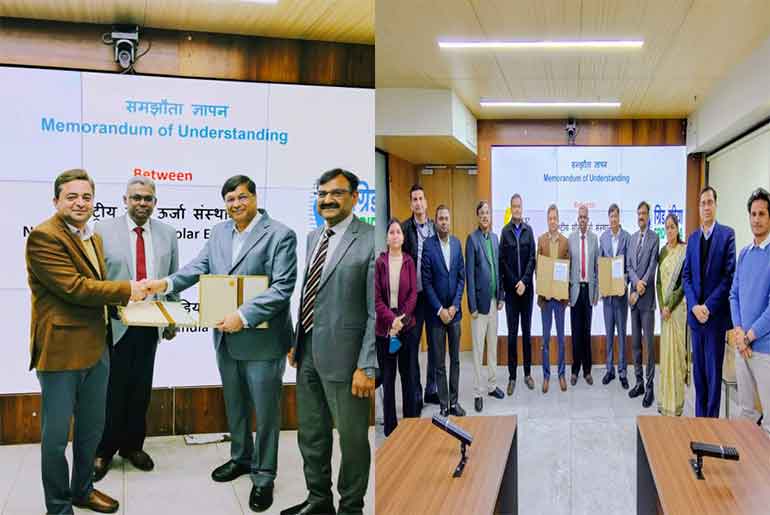
The National Institute of Solar Energy (NISE) and Grid Controller of India Limited have signed a Memorandum of Understanding (MoU) to jointly undertake a landmark research project aimed at strengthening solar power forecasting for India’s electricity grid.
The primary goal of the collaboration is to develop and implement Hybrid Day-Ahead and Intra-Day Solar Forecasts for large-scale solar parks across India. The outcome of this project aims to provide enhanced reliability and stability of the electrical grid and facilitate large numbers of new renewable energy sources to integrate into the grid system seamlessly.
MoU Signing and Participants
The MoU was formally signed by Prof. Mohammad Rihan, Director General, NISE, and Shri Manoj Kumar Agrawal, Executive Director, National Load Despatch Centre (NLDC). The signing took place in the presence of Shri Samir Chandra Saxena, Chairman and Managing Director, GRID-India.
Senior officials from both institutions were present, including Shri Rajiv Porwal, Director (System Operation), Ms. S. Usha, Director (Market Operation), Shri Vivek Pandey, Chief General Manager, and Dr. Anish Malan, Deputy Director, NISE.
Industry Collaboration with Renewable Developers
This project will be conducted in partnership with several of the world’s foremost renewable energy companies, including Adani Green Energy Limited; NTPC Green Energy Limited; and Tata Power Renewable Energy Limited;, ReNew; and Serentica Renewables.
These developers will provide access to large utility-scale solar parks across India for real-time deployment, testing, and validation of the forecasting models.
Next-Generation Hybrid Solar Forecasting Framework
The project aims to develop an advanced hybrid solar forecasting framework that integrates:
- Numerical Weather Prediction (NWP) models
- Satellite-based data
- Real-time All-Sky Imager (ASI) based nowcasting
The system will generate high-frequency probabilistic forecasts (P50/P90) ranging from a few minutes up to 48 hours ahead, significantly improving short-term solar generation predictability.
Benefits for Grid Operations and Market Stability
Improved forecasting accuracy is expected to:
- Reduce risks related to the Deviation Settlement Mechanism (DSM)
- Enhance scheduling and dispatch reliability
- Support system operators in managing variability from large solar installations
- Improve operational confidence for renewable energy developers
- Strengthening India’s Renewable Integration Capabilities
In order to develop predictive models that can be integrated into India’s future energy system, the NIES, the Ministry of Power, and GRID-India have signed a Memorandum of Understanding for developing home-grown data-driven forecasting capabilities to support future solar integration and to facilitate uploading large amounts of solar energy into the electrical infrastructure of India.
 Electrify your feed! Click here to join our Whatsapp group and to get the latest updates, expert insights, and innovations driving India’s energy storage revolution.