In a move that marks the coming-of-age of India’s electric mobility sector, the Ministry of Road Transport and Highways (MoRTH) has unveiled a landmark digital framework. By proposing a 21-character Battery-Aadhaar—officially called the Battery Pack Aadhaar Number (BPAN)—the government is doing far more than tracking hardware. It is giving electric vehicle batteries a “Digital DNA”.
This initiative represents a fundamental shift in how batteries are viewed. Instead of being treated as disposable components, they are now recognised as traceable, high-value assets. As India advances toward its vision of becoming a $30 trillion economy by 2047, the Battery-Aadhaar is set to become the common digital spine supporting the nation’s energy transition.
The 21-Character Revolution
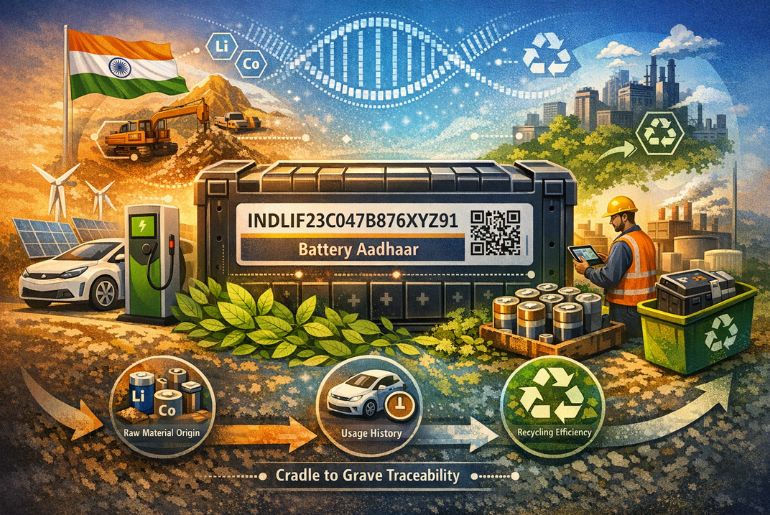
Under the proposed Battery-Aadhaar framework, every producer or importer will be required to assign a unique 21-character alphanumeric code to each battery pack. This is not just another serial number. It is a complete digital identity that records both “static data”, such as chemical composition and manufacturing origin, and “dynamic data”, which tracks the battery’s real-time State of Health (SoH) across its entire lifecycle.
The Battery-Aadhaar must be clearly visible and placed in a location where it cannot be destroyed or degraded over time. This design choice ensures that even after an electric vehicle reaches the end of its road life, the battery remains a clearly identifiable asset, ready to enter the next stage of its journey.
From Cradle to Grave: The Traceability Mandate
One of the most powerful aspects of the Battery-Aadhaar is its end-to-end traceability. From the moment critical raw materials such as lithium, cobalt, or nickel are extracted, to second-life applications or final disposal, every key milestone will be digitally recorded.
For the first time, India’s battery ecosystem will have transparent visibility into:
- Raw Material Origin: Supporting verification of domestic value addition under ACC-PLI schemes.
- Usage History: Allowing fair and data-backed valuation for second-hand EV buyers.
- Recycling Efficiency: Ensuring that 80–90% of lithium-ion demand—largely driven by EVs—does not end up in landfills.
If a battery is repurposed or recycled, the guidelines clearly state that any change in its attributes must result in the issuance of a new Battery-Aadhaar. This preserves the integrity of the digital trail and helps prevent the circulation of sub-standard or grey-market recycled cells.
Why Prioritize EV Batteries?
Although the guidelines recommend applying the Battery-Aadhaar to industrial batteries above 2 kWh, the EV segment has been given priority—and for good reason. Electric vehicles account for the bulk of lithium-ion battery demand in India. Given the scale, safety considerations, and regulatory relevance of vehicle batteries, focusing on EVs delivers the greatest impact across the ecosystem.
Implementation will follow the Automotive Industry Standard (AIS) route. This guarantees that the Battery-Aadhaar adheres to current safety standards like AIS-156 and AIS-038, instead of functioning independently. By engaging organizations such as ARAI, in addition to battery producers and recyclers, the government is making certain that the framework is feasible, expandable, and ready for implementation on the shop floor.
The Economic Upside: Unlocking Second-Life Value
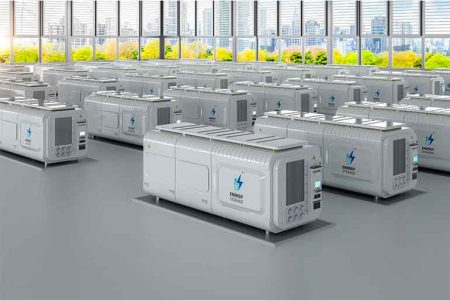
For CXOs and decision-makers in manufacturing, the Battery-Aadhaar serves as a robust instrument for asset assessment. Currently, insufficient data hampers trust in second-life batteries used for stationary energy storage. The Battery-Aadhaar modifies that scenario.
Armed with confirmed State of Health information, power plants and residential consumers can reliably acquire used EV batteries, understanding precisely the amount of functional life left. This “Digital Passport” method closely resembles international frameworks such as Europe’s Battery Passport, but is customized for India’s specific needs. It strikes a careful balance—minimising data burden while maximising safety and trust.
Conclusion: A Sustainable Foundation
With the speed of electrification increasing, the Battery-Aadhaar guarantees that India’s transition is both swift and conscientious. Assigning a distinct digital identity to each battery pack, the government is establishing a basis for accountability, transparency, and circularity.
Whether it’s a rural village’s two-wheeler battery or a large industrial energy storage system, the Battery-Aadhaar guarantees that every watt-hour is monitored and appreciated. More than a regulatory mandate, it is a cornerstone of the circular economy.
As manufacturers prepare for this shift, the Battery-Aadhaar will clearly separate the leaders of the new energy era from those still operating under linear models of the past. The age of the anonymous battery is over. The era of the Battery-Aadhaar has begun.
 Electrify your feed!