India has an incredible energy opportunity. The Indian government has announced a target of 500 GW of non-fossil-based electricity generation capacity by 2030, marking a significant step towards the world’s transition to renewable energy sources and creating a means to store large amounts of intermittent solar and wind energy. However, achieving this goal will depend on a key bottleneck: the development of reliable, scalable, and secure energy-storage systems for all regions of India. If India cannot develop domestic solutions for energy storage, it will continue to rely on conventional thermal (coal-based) power generation systems and inhibit the potential for creating the ‘always-available’ clean electricity system we need.
The current strategy, led by the government’s Production-Linked Incentive (PLI) scheme for Advanced Chemistry Cell (ACC) Battery Storage, has heavily focused on lithium-ion battery technology. Yet, a deeper look reveals a dangerous national dependency that some of the country’s biggest conglomerates are now seeking to bypass entirely. This is the Great Indian Battery Divide: the strategic tension between doubling down on the global standard (lithium) and making a bold, timely pivot toward an alternative, indigenous energy solution based on the sixth most abundant element on Earth—sodium. The ultimate goal is to establish a secure indigenous energy solution that reduces geopolitical risk.
The Lithium Frontier: Dominance and Dependence
Lithium-ion Battery technology is the leader and most prominent technology in the energy environment today. The ability for Lithium-ion battery systems to provide high energy density means they have become the primary battery choice for ALL EV applications (two-wheelers to automobiles) and also represent the most widely used battery for short-to-medium grid storage (primarily between 2-4 hours of duration).
Through the PLI-ACC scheme, Indian Corporations; Reliance New Energy Battery Storage, Ola Cell Technologies, and the Rajesh Exports, which now operate as ACC Energy Storage, have all been selected to establish gigafactories. The intent behind this significant initiative is to drive localization of cell manufacturing and reduce India’s high dependence on imported batteries.
The Geopolitical Trap
Although India has made considerable domestic manufacturing investments to produce lithium-ion batteries and other critical technology, the primary challenge continues to be the high level of import dependency on lithium-ion batteries and other essential component parts (90% for all critical minerals). While the Production Linked Incentive programme provides support for domestic battery assembly, there continues to be a significant level of dependency on raw material imports.
Lithium, cobalt, nickel, and high-grade graphite the building blocks of a high energy density system are all scarce in India. The global supply chain for these minerals is concentrated in a few geopolitical hot spots. The lack of security of raw materials poses a major threat to future energy transitions (i.e., an existential threat). Price increases caused by disruptions to supply chains, trade wars, and geopolitical tensions may slow or halt EV adoption and create significant economic barriers to the deployment of grid-scale energy storage. The core issue is that a strategy built solely on lithium-ion means India is exchanging its dependence on imported crude oil for an equal, if not greater, dependence on imported battery metals. Securing a true indigenous energy solution is critical for national interest. This technological shift is fundamentally about achieving an indigenous energy solution.
Sodium-Ion’s Promise: An Indigenous Energy Solution
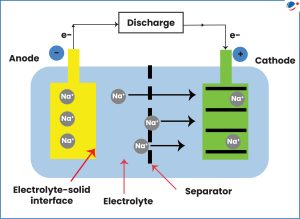
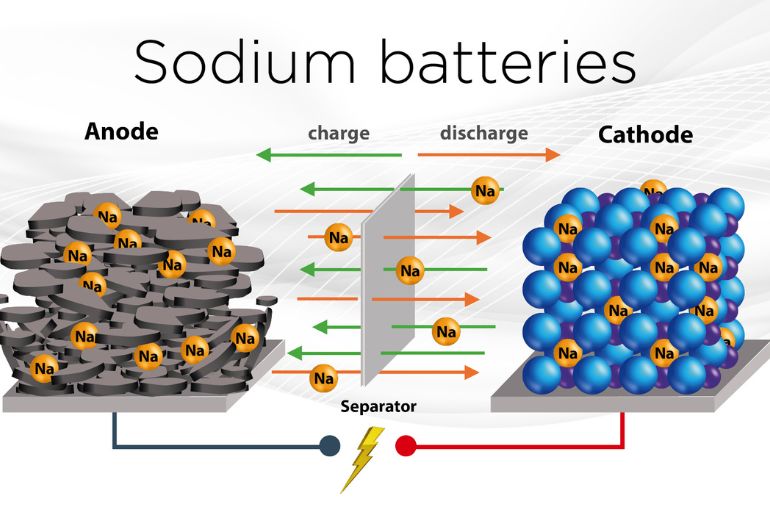
Sodium-ion battery (SIB) Technology is going to be the solution for the Great Indian Battery Divide. SIBs are not a revolutionary invention, but rather a chemistry that is very close to being commercially viable and could provide an ideal alternative to lithium batteries particularly for large-scale (grid-based) applications, such as powering electric vehicles that have a lower range. It represents a potential indigenous energy solution that India can truly own.
Abundance and Cost
The most significant advantage of sodium-ion is its use of abundant raw materials. Sodium is everywhere, most easily sourced from common salt, of which India is the world’s third-largest producer. Critically, SIBs eliminate the need for costly and geopolitically sensitive materials like lithium, cobalt, and nickel. This material abundance is what makes SIBs a genuine indigenous energy solution.
Industry experts and developers like Macsen Labs, who are setting up a sodium-ion battery cell pilot line by 2026, suggest that the cost of SIB cathode material can be dramatically lower than lithium-based materials. This translates to SIBs potentially achieving costs 15-20% lower than comparable lithium-ion cells by 2030, making it a viable and attractive indigenous energy solution for mass-scale deployment.
Safety and Scalability
SIBs can be completely discharged to zero volts, which makes them inherently safer for transport and storage than lithium-ion cells, which pose a fire risk if over-discharged. Furthermore, SIBs can often utilise existing lithium-ion manufacturing infrastructure with only minor modifications, which significantly accelerates the path to mass production. This scalable, low-cost approach creates a robust indigenous energy solution.
The single biggest champion of the sodium-ion battery push in India is Reliance Industries Limited. In 2021, Reliance acquired UK-based Faradion, a world leader in sodium-ion technology. Reliance’s plan is to leverage Faradion’s patented technology to build integrated, end-to-end giga-scale manufacturing in Jamnagar, Gujarat. This strategic move secures an internal, indigenous energy solution for their vast new energy ecosystem and is a powerful signal of the industry’s belief in this alternative chemistry. Mukesh Ambani has explicitly stated the technology will secure India’s energy storage requirements, underscoring its role as an indigenous energy solution.
While SIBs currently offer a lower energy density system compared to high-end Nickel-Manganese-Cobalt (NMC) lithium batteries, they are rapidly catching up to the performance of LFP (Lithium Iron Phosphate) cells. Their performance characteristics—long life cycle, wide operating temperature range, and fast charge/discharge—make them perfectly suited for grid-scale stationary energy storage, which is the most pressing need for India’s 500 GW renewable target. They offer a stable indigenous energy solution for the grid.
The Long-Duration Alternatives: VRFB and Flow Batteries
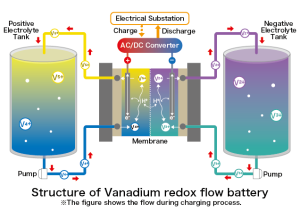
While the debate often focuses on the high energy density of lithium vs. the low-cost abundance of sodium, another class of technology is proving essential for the grid: Long-Duration Energy Storage (LDES). LDES typically means batteries that can discharge power for 6 to 12 hours or more, helping to manage seasonal shifts and the “dark periods” when the sun doesn’t shine.
The key player here is the Vanadium Redox Flow Battery (VRFB). Flow batteries store energy in liquid electrolytes contained in external tanks, meaning the power and energy capacity can be scaled independently. They are exceptionally long-lasting and non-flammable.
In a landmark step for LDES in India, the National Thermal Power Corporation (NTPC) recently commissioned the country’s first MWh-scale VRFB system of 3 MWh capacity at its research centre (NETRA). This project demonstrates the potential for an alternative, indigenous energy solution focused on long-duration needs. This strategic testing is crucial for defining the role of non-lithium technologies as a complementary indigenous energy solution. The goal of this research is to prove this long-life cycle technology as a robust indigenous energy solution.
Policy and The Diversified Portfolio Approach
The current policy framework, dominated by the PLI-ACC scheme, is successful in kickstarting domestic manufacturing. A new industry white paper shows an example of how Lithium-Ion Battery chemistries can benefit from preferential pricing under the Basic Customs Duty (BCD) of five percent (5%) while other Battery Technologies such as Sodium-Ion are facing more than double that (15%). This practice of charging higher taxes for technologies other than Lithium-Ion Battery chemistries is discouraging investment in non-lithium Battery chemistries.
To fully realise the vision of an indigenous energy solution and to secure India’s green transition, policy support must be extended and diversified:
- Dedicated PLI for Non-Lithium Chemistries: A specific PLI or incentive scheme tailored for sodium-ion battery cells and flow batteries is needed. The lower cost and energy density of SIBs make them less competitive against the current PLI criteria designed for lithium-based cells, even though they represent a far more strategic, indigenous energy solution (18) for grid stability. Correcting the BCD disparity is a necessary first step towards making SIBs a priority indigenous energy solution.
- R&D and Pilot Project Funding: Dedicated public funding for research institutions (like JNCASR, which recently developed a superfast-charging SIB prototype) and startups like Indi Energy, which focuses on SIB components, is essential to foster a true indigenous energy solution.
- Requirements for Electric Grid Storage: Electric utilities and renewable energy developers must have an increased amount of Electric Storage Requirements (ESR) to meet our increasing demand for Electric Storage (e.g., long-duration) and develop markets for VRFB and SIB technologies that are best suited for these applications and that encourage them to be promoted as the solution for local energy generation. This move will secure India’s future as a global player in developing a sustainable indigenous energy solution.
Conclusion: The Path to Energy Sovereignty
The Great Indian Battery Divide is a challenge that must be addressed not with a single-technology bet but with a strategic, diversified portfolio. The sheer scale of India’s energy challenge needing an estimated 61 GW/218 GWh of energy storage by 2030 to support 500 GW of clean power demands innovation, speed, and, above all, self-reliance. This mandate necessitates the rapid adoption of a reliable indigenous energy solution.
Lithium-ion batteries will continue to serve the high energy density needs of the EV sector, especially passenger vehicles. However, the true long-term indigenous energy solution for grid security and cost-effective decarbonisation lies with sodium. Reliance’s Faradion acquisition, Macsen Labs’ pilot line, and NTPC’s VRFB project are not just commercial or research ventures; they are strategic national moves to secure India’s energy future.
By actively supporting and incentivising both the mass production of lithium-ion under the PLI and the accelerated commercialisation of alternatives like the sodium-ion battery and VRFB, India can achieve genuine energy sovereignty. It can leapfrog the current geopolitical constraints of the lithium supply chain and establish itself not just as a consumer, but as a global leader in the next generation of energy storage. The future grid requires a multi-technology approach, and in the abundance of its own salt reserves, India holds the key to its own clean power destiny, making the sodium-ion push the most promising indigenous energy solution for a net-zero future.
 Electrify your feed! Click here to join our Whatsapp group and to get the latest updates, expert insights, and innovations driving India’s energy storage revolution.