If you’ve ever sat in traffic and watched a silent electric scooter zip past, or if you’re currently reading this on your smartphone that hasn’t needed another charge all day, you are already part of a massive, invisible energy shift. But there is a secret behind that battery icon on your screen. For years, the “heart” of our modern world—the lithium-ion Battery—has mostly been a traveler, flying across oceans from factories in China or Korea to reach us. Today, that story is changing. But now gradually we have to adapt ourselves with the construction of lithium-ion Battery plants in our Home – India. As soon as we will be able to achieve this milestone – then only we will pave a way forward for India’s Import depence on Minerals and leading us to become Creators and not just Consumers.
Think about it: until very recently, India was importing nearly 90% of its cells. We were building the cars and the phones, but we weren’t building the “soul” of the machine. Now, we are in the middle of what experts call a “Giga-moment.” We aren’t just building small workshops; we are erecting massive, sprawling Gigafactories that are destined to redefine our economy. If you are a business owner looking at fleet costs, or just someone waiting for the price of an electric SUV to drop, the growth of lithium-ion battery plants in India is the single most important trend to watch this decade.
The Great Indian Gigafactory Race
So, who is actually moving the earth? If we look at the map of India today, specific hubs are emerging as the “Battery Belts” of the nation. Take a trip to Krishnagiri in Tamil Nadu, and you’ll see the sheer ambition of Ola Electric. They aren’t just making scooters anymore; they are deep into the chemistry of the “Bharat Cell.” By the end of 2026, their Gigafactory is scaling toward a staggering 20 GWh capacity. What makes this special for us is their focus on the 4680 form factor—a larger, more efficient cell that promises to pack more energy into less space.
But Ola isn’t alone in this sprint. Over in Jamnagar, Gujarat, Reliance New Energy is building a modular ecosystem that feels like something out of a sci-fi movie. Their goal isn’t just to build a factory but a 100 GWh annual capacity beast by the end of the decade. As of mid-2026, their first 40 GWh phase is coming online. For the B2B world, this is a game-changer because Reliance is looking at the entire value chain—from raw materials to the finished battery pack. This kind of “vertical integration” is exactly what helps drive down costs for the end-user.
Then we have the “heritage” players who are proving that old ones can teach the world new tricks. Exide Energy and Amara Raja, names we’ve associated with lead-acid batteries for decades, are pivoting hard. Exide’s 6 GWh plant in Bengaluru is officially hitting its commercial stride, while Tata (under their Agratas brand) is transforming Sanand in Gujarat into a battery powerhouse with a 20 GWh initial capacity. When you see a Tata EV on the road tomorrow, there is a very high chance the power source was born in a facility that didn’t even exist a few years ago.
The “Price Parity” Breakthrough
We often hear that EVs are “too expensive.” But have you noticed the shift lately? In 2026, we hit a “holy grail” moment in the industry. For the first time, locally produced NMC (Nickel Manganese Cobalt) cells reached a price of roughly $95/kWh. When you factor in the saved logistics costs and the GST benefits of local production, these cells are finally competing neck-and-neck with imports.
This price drop isn’t an accident. It is the result of the government’s $2.1 billion (₹18,100 crore) PLI scheme for Advanced Chemistry Cells. We’ve already seen 40 GWh of capacity awarded, and the impact is trickling down to your wallet. Whether you’re buying a laptop or a commercial truck, the expansion of lithium-ion battery plants in India means we are no longer at the mercy of global supply chain shocks or fluctuating import duties. We are building our own energy destiny.
By the Numbers: A $15 Billion Opportunity
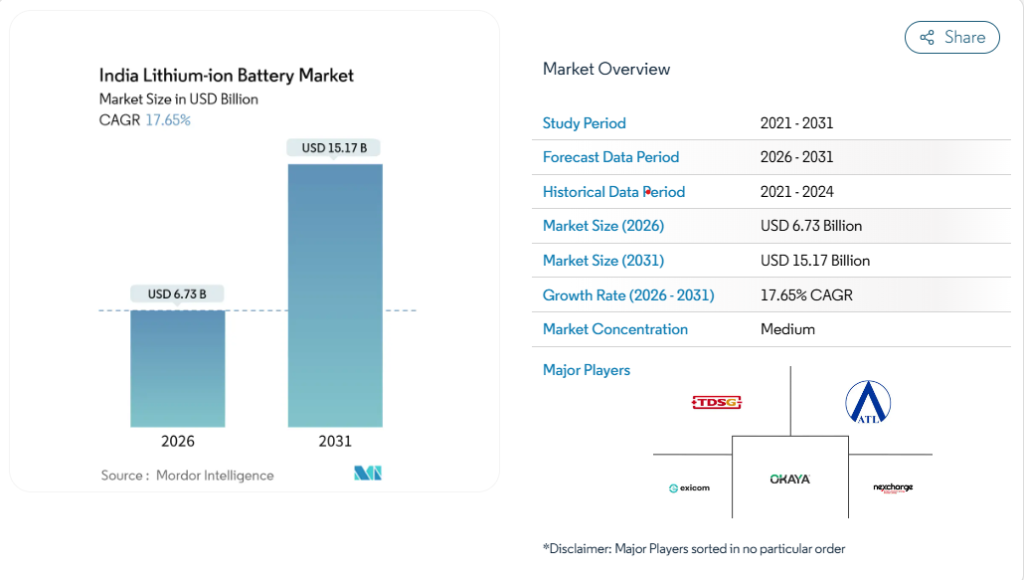
Let’s talk about the future, because the data is staggering. According to Mordor Intelligence the Indian lithium-ion battery market is currently valued at about $6.73 billion, but don’t let that number fool you into thinking the peak is here. We are looking at a projected surge to over $15.17 billion by 2031. That is a growth rate of over 17% every single year.
Where is all this power going? While we usually think of cars, there is a massive story happening in the background. As India moves toward more solar and wind energy, we need a way to “hold” that power when the sun isn’t shining. This is where Battery Energy Storage Systems (BESS) come in. We are seeing massive projects that proves that batteries are the “shock absorbers” of our national grid. Without the new lithium-ion battery plants in India, our dream of a green grid would remain just that—a dream.
The Hurdles We Still Have to Jump
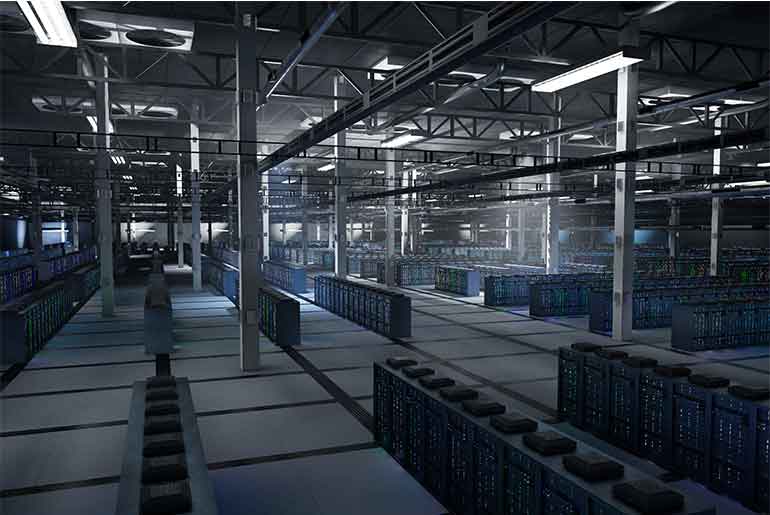
It would be unfair to say everything is perfect. Building a Gigafactory is hard. It’s not like building a typical warehouse; these are “Ultra-Dry Rooms” where even a single drop of humidity can ruin a batch of cells. We are also facing a significant skill gap. We don’t just need workers; we need electrochemical engineers and chemical experts who understand the “black magic” of battery coatings.
Then there is the question of raw materials. We don’t have massive lithium mines in our backyard—yet. To solve this, we are seeing a two-pronged strategy. First, “mineral diplomacy” through KABIL is securing stakes in mines in South America and Australia. Second, and perhaps more excitingly, we are seeing the rise of “Urban Mining.” Several Indian Companies are showing us that the “waste” batteries in our junk drawers are actually goldmines of lithium, cobalt, and nickel. By recycling these, our lithium-ion battery plants in India can become part of a circular economy that doesn’t just take from the earth but reuses what we already have.
You might be wondering, “Why should I care about the technical specs of a factory in Sanand or Krishnagiri?” This questions has the most promising answer because these plants represent the end of our dependence on foreign energy. For decades, India’s economy has been tied to the price of oil—a variable we cannot control. By shifting to a battery-led economy, we are shifting to an energy source we can manufacture, refine, and recycle right here at home.
Even for the employment sector, this is creating thousands of roles in high-tech manufacturing. For the business owner, it means stable energy costs. And for the climate-conscious citizen, it means the “green” label on your EV actually means something because the battery wasn’t shipped halfway around the world on a carbon-heavy cargo ship.
The Road Ahead
As we look toward 2030, the vision is clear. We are aiming for 50 GWh of domestic cell capacity, and based on the current momentum, we might just breeze past that. We are even seeing “multi-chemistry” approaches, where some plants focus on Lithium Iron Phosphate (LFP) for safety and longevity, while others push the boundaries of Sodium-ion for even cheaper stationary storage.
The growth of lithium-ion battery plants in India is more than just an industrial update; it is a declaration of independence. We are building the infrastructure that will power our homes, our transport, and our digital lives for the next fifty years. So, the next time you see a quiet electric bus or plug in your phone, take a second to think about the massive factories rising across our landscape. They are the silent engines of a new India, and they are just getting started.
We are no longer waiting for the future to be delivered to us in a shipping container. We are building it, cell by cell, right here at home. The “Made in India” tag is moving from the outer casing to the very chemistry inside, and that is a power surge we should all be proud of.
 Electrify your feed! Click here to join our Whatsapp group and to get the latest updates, expert insights, and innovations driving India’s energy storage revolution.