The battery industry does not lack promising science. What it lacks, more often, is a clear path from promising cell data to manufacturable products that can survive the constraints of cost, safety, qualification, and supply chain. That gap is becoming more consequential as two fast-moving markets begin to push beyond the practical limits of conventional lithium-ion: uncrewed defense systems and battery storage for AI-driven data center infrastructure.
Graphite-anode lithium-ion still dominates electric vehicles, electronics, and stationary storage for good reason. It is well understood, manufacturable at scale, and supported by an established global supply base. But its recent gains have come mostly from incremental optimization rather than architectural change. Higher-nickel cathodes, silicon-graphite blends, and improved electrolyte formulations can extend performance, yet they do not remove the underlying mass and volume penalty of the graphite host itself.
That matters more now because the next wave of battery demand is coming from applications where battery limitations show up as mission failures and infrastructure bottlenecks, not just as engineering footnotes. In uncrewed systems, energy density directly affects endurance, payload, and mission radius. In AI-linked data center storage, the pressure is different but no less real: operators need safe, dense, reliable storage that can be deployed faster than grid upgrades and managed at lower system-level risk.
Why the separator deserves a second look
Lithium-metal and anode-free architectures have long appeared to be the obvious route beyond graphite. Remove the graphite host, plate lithium directly onto a current collector, and the cell can in principle reach energy densities that conventional intercalation chemistry cannot match. The problem, as the field knows well, is that lithium metal has repeatedly failed to make the transition from attractive theory to robust commercial practice.
The reasons are familiar: unstable lithium deposition, dendritic growth, electrolyte side reactions, cycle-life loss, and the persistent difficulty of scaling laboratory performance into real production. Solid-state electrolytes have drawn much of the attention as one possible answer, but they bring their own manufacturing burdens — brittle ceramic handling, interfacial contact challenges, and process-cost penalties that have proven difficult to engineer away at volume. Silicon-rich anodes preserve compatibility with current factories but do not resolve the energy-density ceiling for weight-critical platforms and often introduce swelling and durability trade-offs. Each approach addresses part of the problem while creating new constraints. The separator is interesting because it may be the one layer where targeted innovation can improve lithium-metal viability without requiring the rest of the cell architecture to change.
Separators have traditionally been treated as passive layers: electrically insulating, ionically permeable, and thermally stable enough not to fail first. That framework made sense in graphite-based lithium-ion, where the separator was not expected to actively manage a hostile interface. In lithium-metal cells, that assumption no longer holds, because the anode-separator interface is precisely where the most consequential instability originates. Unlike ceramic-coated polyolefin films — which improve thermal stability but remain passive barriers — a separator engineered to actively manage lithium nucleation geometry at that interface is a different class of component, not simply an incremental improvement on what already exists.
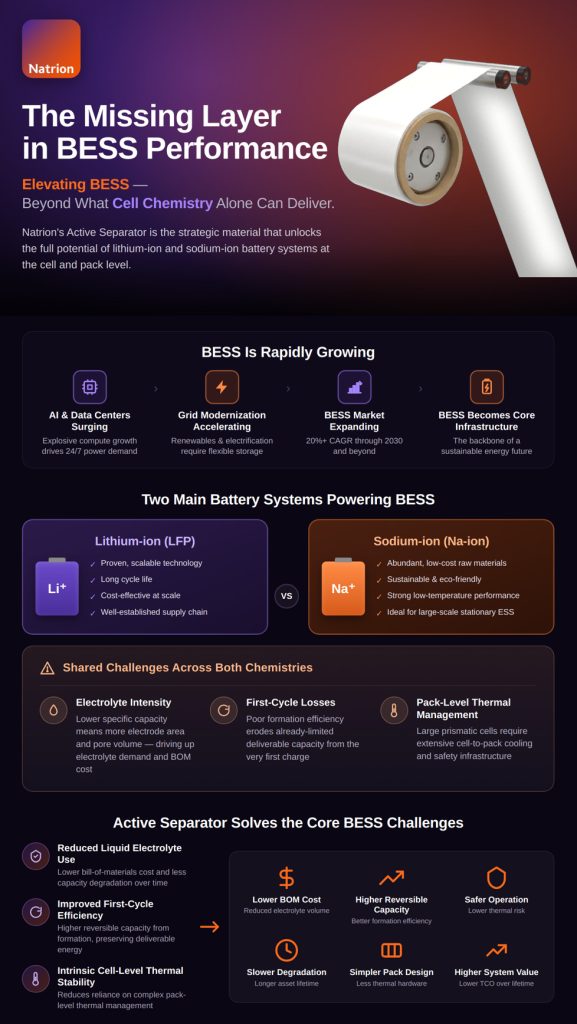
Natrion’s technical premise is that the separator should be treated as a control layer rather than a passive membrane. Its Active Separator is a ceramic-polymer composite that can replace conventional separator films while promoting more compact lithium deposition and reducing the conditions that lead to dendritic shorting and runaway side reactions. From a materials standpoint, that is a credible direction; the open question is not whether interfacial control matters, but whether it can be delivered at production yields and costs that customers will actually adopt.
The more commercially significant part of the argument is manufacturability. Natrion positions Active Separator as compatible with roll-to-roll processing and existing separator production infrastructure, which makes it a component substitution story rather than a full industrial reset. That distinction matters because the battery sector has seen no shortage of strong lab data from approaches that became far less compelling once they encountered factory economics and qualification reality.
Uncrewed defense systems
If there is one market where the case for separator-enabled lithium-metal is easiest to understand, it is uncrewed defense systems. These platforms are unusually sensitive to battery mass because battery energy competes directly against payload, endurance, and mission flexibility. In that context, battery performance is not merely a technical specification. It is a mission variable.
That framing is more useful than quoting a single cell metric. A battery that materially improves specific energy does not just improve a datasheet; it can expand surveillance radius, reduce battery swap frequency, increase payload margin, or enable a different operating concept altogether. For defense program managers and integrators, the important question is not simply whether a cell can reach a headline energy-density number, but whether the change is large enough to alter mission capability in a way worth qualifying.
This is also a segment where the procurement logic is structurally favorable to advanced batteries. First, some classes of uncrewed systems can justify higher battery cost if the operational gain is large enough. Second, many programs place a premium on domestic sourcing and NDAA-aligned supply chains, which means U.S.-manufactured advanced chemistries have a strategic advantage that goes beyond electrochemical performance.
Form-factor compatibility matters as well. Natrion’s cells are designed to remain compatible with pack formats built around 21700 cylindrical cells, which lowers evaluation friction by reducing the need for immediate system redesign. In defense adoption, that is not a trivial detail. Getting a new battery into the testing pipeline is often a bigger hurdle than proving that the chemistry is interesting.
The defense case is strongest where long cycle life is not the first requirement. Expendable and one-way systems, including defensive measures like interceptor drones, may be more realistic early markets for lithium-metal architectures because they need high energy density, acceptable safety, cost discipline, and domestic availability more than they need thousands of cycles of lifespan. That creates a plausible path for advanced batteries to prove themselves first in segments where their strengths are most valuable and their weaknesses are least punishing.
Readiness, however, should not be overstated. Defense conditions are harsher than laboratory cycling protocols and harsher than most commercial qualification environments. Wide temperature swings, shock, vibration, uncertain storage conditions, and system-level abuse tolerance still need to be demonstrated in practice. The fairest way of viewing things is not that lithium-metal batteries are ready to sweep defense markets, but that uncrewed defense is one of the few sectors where the incentive to make them work is already strong enough to justify serious adoption efforts.
AI data center storage
The second market worth watching is battery energy storage for AI-linked data center infrastructure, and the value proposition here is structurally different from defense. Data centers do not care much about gravimetric energy density on its own. They care about reliable, safe, compact, and financially predictable power support in an environment where electricity demand is rising faster than transmission buildout and interconnection timelines can accommodate.
That shift is turning battery storage from a supporting technology into a strategic infrastructure decision. As hyperscale and AI compute deployments grow, operators are evaluating on-site storage not only for backup power, but also for peak-load management, resilience, and more flexible site development while waiting for grid upgrades. In that setting, the purchasing question is less about cell chemistry prestige and more about total system economics over the life of the asset.
This is where safer cell architecture can matter more than raw energy density. Large BESS installations carry significant cost in thermal management, fire suppression, spacing requirements, insurance, and operational risk. A battery platform that improves thermal stability at the cell level and reduces the need for external risk-mitigation infrastructure can create meaningful value even before it delivers the full promise of next-generation lithium-metal energy density.
That is one reason separator technology may matter in stationary storage sooner than many observers expect. If the separator improves safety and reliability in conventional lithium-ion first, it can serve as an adoption bridge rather than requiring operators to make an abrupt leap into unfamiliar chemistry platforms. Infrastructure markets usually prefer that migration path, especially when downtime costs are high and qualification standards are conservative.
AI data center BESS has all the makings of a first large-scale market for advanced cell components like Active Separator. AI infrastructure is creating real demand for batteries that offer safer system economics, domestic supply assurance, and a practical upgrade path over time. In that sense, data center storage may become an important demand signal even before it becomes a pure chemistry-driven market.
Manufacturing remains the test
Underlying both markets is the same industrial question: can advanced battery components reach production scale in the United States at yields and costs that make them commercially useful rather than technically admirable? That question will outlast any single chemistry cycle, and it is where many battery innovations have historically struggled.
Natrion’s roll-to-roll compatibility is the answer to part of that challenge because it reduces the burden of introducing a new separator into an existing production ecosystem. But manufacturing compatibility is not the same as manufacturing proof. Volume economics, quality control, throughput, and qualification still determine whether a promising component becomes a durable business.
That is why the separator story is worth watching right now. It sits at the intersection of two persistent battery industry problems: the need for higher-performance architectures and the need to commercialize them without rebuilding the industry from scratch. If separator-based interfacial control can help close that gap, it will matter not only for one company, but for how the next generation of advanced cells is industrialized.
What’s actually different now
Lithium-metal batteries have spent decades in the category of almost here, and skepticism remains warranted. Cycle life, scale-up yield, cost, and real-world reliability are still the decisive filters, and none can be waved away by strong early data or elegant materials science alone.
What has changed is not that the chemistry suddenly became easy. What has changed is that the market now contains application areas willing to reward a battery that is not perfect, but meaningfully better on the parameters they care about most. Uncrewed defense systems value energy density as mission capability. To be a bankable technology, though, materials like Active Separator will need larger addressable markets to capture sufficient value. This is where AI data center storage, which values safer and more economically manageable power infrastructure, has a role to play. Both create real procurement pull for technologies that combine performance ambition with manufacturing pragmatism.
That makes the separator worth watching again. It may still be the thinnest layer in the cell stack, but in advanced batteries it is increasingly hard to argue that it is the least important one.
Po-Chen (Duke) Shih is CTO of Natrion Inc., a U.S.-based developer of advanced separator technologies for lithium-ion, lithium-metal, and anode-free batteries.
 Electrify your feed! Click here to join our Whatsapp group and to get the latest updates, expert insights, and innovations driving India’s energy storage revolution.