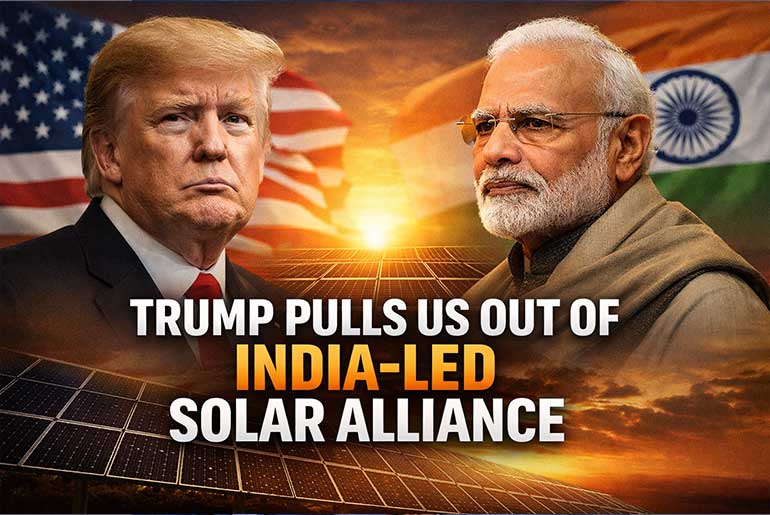
India stands at the centre of a major geopolitical and energy transition moment as the United States, under President Donald Trump, has formally withdrawn from the International Solar Alliance (ISA)—a landmark multilateral platform spearheaded by India to accelerate global solar adoption.
The decision forms part of a sweeping U.S. policy reset that exits Washington from 66 international organisations and agreements, many linked to climate action, sustainability, and multilateral cooperation. The move signals a sharp departure from collective climate diplomacy and raises critical questions about the future of global renewable energy collaboration.
A Strategic Exit With Global Consequences
The withdrawal was announced through a presidential directive stating that continued participation in several international bodies no longer aligned with U.S. national interests. While the U.S. administration has framed the move as an assertion of sovereignty and fiscal discipline, climate experts and global energy stakeholders view it as a significant setback for international renewable cooperation.
Among all exits, the decision to pull out of the International Solar Alliance stands out—given the organisation’s growing role in shaping solar deployment across emerging economies and climate-vulnerable regions.
What Is the International Solar Alliance?
The International Solar Alliance was launched in 2015 by India and France on the sidelines of the Paris Climate Conference. Headquartered in Gurugram, ISA is the first treaty-based intergovernmental organisation to be headquartered in India.
Today, the alliance brings together over 120 member and signatory countries, primarily from regions receiving high solar irradiation—Asia, Africa, Latin America, and Small Island Developing States.
ISA’s mandate goes far beyond symbolism. Its core objectives include:
- Mobilising over USD 1 trillion in solar investments by 2030
- Reducing the cost of solar technologies and finance
- Enabling energy access in developing economies
- Supporting innovation, capacity building, and solar manufacturing ecosystems
- Promoting scalable, bankable solar deployment models globally
Over the years, ISA has launched initiatives focused on solar rooftop expansion, mini-grids, e-mobility charging, solar irrigation, startup acceleration, and blended finance mechanisms for developing nations.
Why the U.S. Exit Matters
While the United States was not the largest financial contributor to ISA, its participation carried significant diplomatic, technological, and signalling value. The withdrawal sends a strong message to global markets at a time when renewable energy—and energy storage—are becoming central to energy security and economic competitiveness.
Key implications of the U.S. exit include:
- Reduced momentum in coordinated global solar finance
- Potential funding and confidence gaps for early-stage projects
- Weakening of multilateral climate leadership from advanced economies
- Strategic space opening up for other global powers to influence renewable energy governance
However, analysts also point out that ISA’s diversified membership base and India’s leadership ensure that the alliance is structurally resilient and unlikely to lose relevance overnight.
India’s Position: Continuity Over Disruption
Indian officials and ISA leadership have underlined that the alliance’s mission remains unchanged. With strong backing from countries across the Global South, Europe, and Asia, ISA will continue to focus on scaling solar deployment, reducing costs, and enabling energy transition pathways tailored to developing economies.
For India, ISA is not merely a diplomatic platform—it is a strategic extension of its ambition to emerge as a global clean-energy leader, aligned with its broader renewable and energy-storage roadmap.
A Broader Climate Signal
Trump’s decision reflects a wider retreat from multilateral climate frameworks, echoing earlier withdrawals from global climate agreements and institutions. Critics argue that such moves risk slowing collective progress on emissions reduction and climate finance at a time when global temperatures, energy demand, and climate vulnerabilities are intensifying.
At the same time, many experts believe the global clean-energy transition has reached a scale where momentum will continue—driven by economics, technology, and national self-interest—even without U.S. participation in select multilateral bodies.
What Lies Ahead for the Solar Alliance?
Despite the U.S. withdrawal, the International Solar Alliance is expected to remain a cornerstone of global solar cooperation, particularly for countries seeking affordable, scalable, and resilient clean-energy solutions.
As solar power increasingly converges with battery storage, digital grids, and hybrid systems, ISA’s role in shaping standards, finance models, and south-south cooperation may become even more critical by the end of this decade.
The global energy transition is moving forward—but this moment underscores a growing divide between multilateral climate leadership and nationalist energy politics.
 Electrify your feed! Click here to join our Whatsapp group and to get the latest updates, expert insights, and innovations driving India’s energy storage revolution.