What if charging your electric vehicle took less time than ordering a cup of coffee? Dallas-based innovation company OMI recently made a bold claim: it has developed a proprietary LnFP (Lithium nano Iron Phosphate) cathode material capable of charging at a 20C rate — meaning a battery can go from empty to full in roughly three minutes. The company says this isn’t a simulation or a theoretical projection. It has validated the material in testing and plans to begin small-scale production in the United States by 2027, with demonstration vehicles expected around the same time.
If true, this level of Ultra-Fast Charging could redefine electric mobility, reshape grid infrastructure, and even alter how AI data centers manage power. But extraordinary claims demand careful examination. Can 20C charging truly scale beyond the lab?
What 20C Really Means
To understand the magnitude of this announcement, it’s important to decode the term “20C.”
In battery language, the C-rate describes how quickly a battery charges or discharges relative to its total capacity. A 1C charge rate means a battery charges fully in one hour. A 2C rate means 30 minutes. A 5C rate drops that to around 12 minutes.
A 20C charge rate? That compresses the full charging cycle into about three minutes.
Most commercial lithium-ion batteries today operate comfortably between 0.5C and 2C. High-performance EV systems may push toward 4C or 5C under carefully controlled conditions. A sustained 20C rate represents a dramatic leap. It places enormous demands on lithium-ion diffusion, electron transport, internal resistance management, and thermal stability.
That is why the idea of Ultra-Fast Charging at 20C immediately grabs attention — and raises questions.
What OMI Claims Is Different
OMI attributes its breakthrough to a specially engineered particle architecture within its LnFP cathode material. According to the company, instead of fragile or irregular particles, it has developed high-strength, structurally robust particles that enable rapid electron exchange while maintaining chemical stability.
The chemistry is iron-based and eliminates cobalt entirely. That matters not only from a cost perspective but also from a geopolitical and ethical standpoint, given global concerns around cobalt sourcing.
OMI says the material has demonstrated stability across thousands of cycles, even under aggressive high-rate charging. The company has confirmed plans for U.S.-based small-scale production in 2027 and is currently in discussions with venture capital groups to support expansion.
However, the data available so far comes from company announcements. Independent validation, peer-reviewed testing, and third-party verification will ultimately determine whether this form of Ultra-Fast Charging can move from prototype to mass adoption.
The Thermal Reality Check
At extremely high C-rates, heat becomes the central challenge.
When charging speed increases, internal resistance causes heat generation to rise sharply. At 20C, even minor inefficiencies can create significant temperature spikes. High heat accelerates degradation, increases the risk of lithium plating, and in worst-case scenarios, can trigger thermal runaway.
Even if OMI’s cathode material can tolerate rapid lithium-ion movement, the battery pack as a whole must manage heat effectively. That requires advanced cooling systems, possibly new pack architectures, and more sophisticated battery management software.
The Ultra-Fast Charging technology entails more than just chemistry involved in the composition of the battery. It relates to how well engineered the overall system (the electrodes, cooling channels, and even safety controls) is working together, for if any of these items fail, then the three-minute charging promise becomes less reliable.
Can Infrastructure Keep Up?
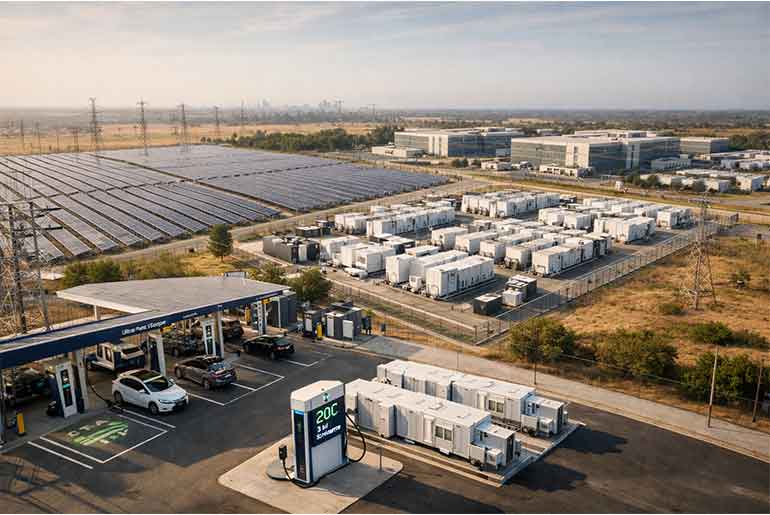
Beyond the battery itself lies an even larger question: can the grid support Ultra-Fast Charging at scale?
Consider an 80 kWh electric vehicle battery. Charging that in three minutes requires power delivery in the megawatt range — roughly equivalent to the demand of a small industrial facility. Multiply that by multiple vehicles at a charging station, and the load quickly escalates to substation-level capacity.
The urban distribution networks were originally not meant to handle such short, intense spikes in load. Upgrading equipment like transformers, cable, and substations could be necessary. This also would change the economics of charging stations significantly because of the need for higher power customers therefore requiring additional capital investments.
In other words, even if 20C cells work perfectly, Ultra-Fast Charging could strain local grids unless parallel investments are made in power infrastructure.
The AI Infrastructure Connection
This is where the conversation becomes especially interesting.
AI data centers operate continuously and require stable, high-density electricity. Training large language models, running GPU clusters, and managing AI workloads demand uninterrupted power. Even a millisecond disruption can affect operations.
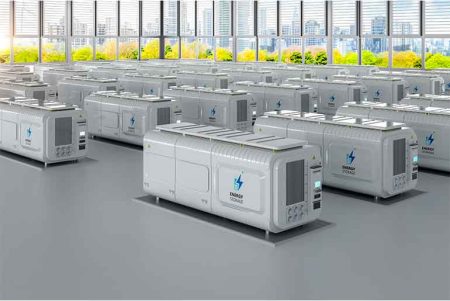
Battery Energy Storage Systems (BESS) already play a role in supporting data centers. Now imagine if those systems could recharge at ultra-high rates. Ultra-Fast Charging could shorten recharge windows for grid-scale batteries, enabling faster ramp-up during peak demand events and improving energy arbitrage strategies.
For AI infrastructure, this could mean:
• Faster recovery after discharge
• More responsive peak shaving
• Improved grid stabilization
• Reduced downtime between cycles
However, the same grid stress concerns apply. If AI clusters begin relying on storage systems that recharge aggressively at high C-rates, localized load volatility could increase. Ultra-Fast Charging might enhance flexibility — but it could also amplify stress if not carefully integrated.
How It Compares with Existing Chemistries
Today’s dominant lithium-ion chemistries include LFP, LMFP, and NMC.
LFP (Lithium Iron Phosphate) is known for stability and safety but typically supports moderate charging rates. LMFP offers slightly improved voltage and energy density. NMC provides higher energy density and somewhat faster charging potential but introduces greater thermal sensitivity.
If OMI’s LnFP chemistry can sustain 20C charging without sacrificing cycle life or safety, it would represent a major shift in the battery landscape. It could challenge the dominance of traditional LFP and reduce dependence on cobalt-heavy chemistries.
But the key word is “if.” Laboratory success does not automatically translate into gigafactory-scale manufacturing.
Scaling the Promise
Battery history is filled with breakthroughs that struggled during scale-up.
Manufacturing engineered nanoparticles consistently and economically is complex. Yield rates, quality control, and cost per kilowatt-hour determine whether a technology survives commercialization. Venture funding can accelerate development, but large-scale adoption demands reliability and affordability.
OMI’s target of beginning U.S. production by 2027 is ambitious. Demonstration vehicles will be an important milestone. Yet the transition from demonstration to mainstream deployment is where many promising technologies face their toughest tests.
Ultra-Fast Charging must prove itself not only in performance metrics but in cost competitiveness and long-term durability.
Breakthrough or Battery Hype?
The idea of charging in three minutes is powerful. It addresses one of the last psychological barriers to EV adoption: waiting time. It also introduces intriguing possibilities for AI infrastructure and grid-scale storage.
Technically, 20C charging is not impossible. With advanced material engineering and thermal innovation, it can be achieved under controlled conditions. The real question is whether it can be sustained safely, economically, and repeatedly in the real world.
If it succeeds, Ultra-Fast Charging could reshape mobility, compress infrastructure timelines, and redefine energy storage economics. If it fails to scale, it will join a long list of promising announcements that stalled between the lab bench and the factory floor.
The next few years will reveal whether three-minute charging becomes a transformative infrastructure shift — or remains an impressive but limited engineering milestone.
One thing is certain: the race toward Ultra-Fast Charging has officially begun.
 Electrify your feed! Click here to join our Whatsapp group and to get the latest updates, expert insights, and innovations driving India’s energy storage revolution.