As the global energy storage narrative expands beyond lithium, a quieter but powerful shift is underway. Zinc-based battery technologies—once confined to laboratories and niche applications—are now entering commercial scale, backed by more than $1 billion in committed investments and multiple full-scale manufacturing lines worldwide.
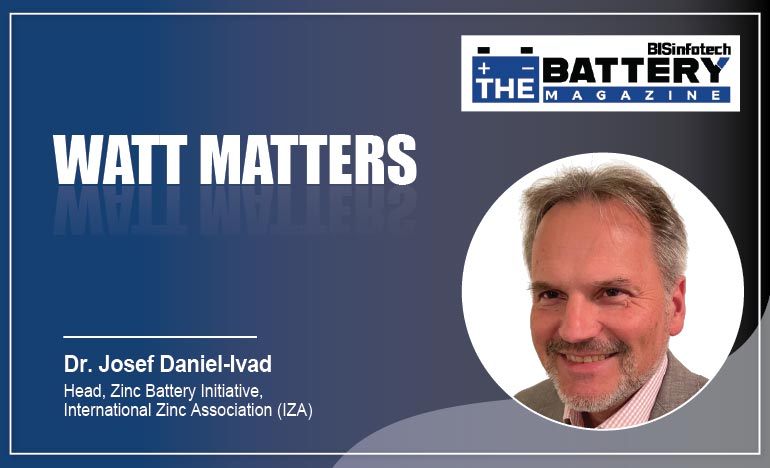
In this exclusive interaction with The Battery Magazine, Shweta Kumari, Sub-Editor, engages in a forward-looking discussion with Dr. Josef Daniel-Ivad, Head of the Zinc Battery Initiative at the International Zinc Association (IZA), where he offers a strategic lens on how zinc batteries have crossed critical technological and financial inflection points. From dendrite mitigation breakthroughs to electrolyte engineering advances and supply-chain localization, the discussion traces zinc’s evolution from promise to production.
Dr. Daniel-Ivad outlines where zinc is already gaining commercial traction—data centers, telecom backup, and long-duration storage—and where it may soon challenge conventional chemistries. He also addresses regulatory gaps, India’s emerging manufacturing role, global partnership models, and whether zinc can move from complementary chemistry to segment dominance.
As policymakers and manufacturers rethink safety, sustainability, and supply-chain resilience, zinc batteries may represent not just an alternative—but a structural diversification of the global energy storage ecosystem.
Let’s delve into the interview.
Tell us how the global zinc battery ecosystem moved from lab to scale — what specific technological or supply-chain inflection points in the last 2–3 years convinced investors and manufacturers to commit over $1 billion and build production lines?
The first key step was the advancement of rechargeable zinc battery technology, which occurred over the past ten years, when zinc battery developers overcame the limitations of legacy rechargeable zinc batteries such as dendrite growth, excessive hydrogen evolution, zinc passivation that occurred during repeated discharge/charge sessions ultimately shortening the life of the battery, and limited cycle life stability. With both increased battery and cycle life, battery developers were able to attract ample private and public investment over the last five years, as both investors and policymakers recognized the growing energy storage demand and the need to move beyond the limits of lithium and nurture other promising, safe, and sustainable technologies. Since the technology matured and the investments grew, zinc battery developers have built at least a half-dozen full-scale factories and pilot lines in the last two to three years. The $1 billion investment signifies a remarkable milestone, demonstrating confidence in the future of rechargeable zinc batteries.
Which commercial segments are most likely to adopt zinc batteries first — telecom/UPS, data-centre backup, long-duration grid storage, or EV niche applications (e.g., two-wheelers, three-wheelers)? Can you point to live deployments and their real-world performance?
Zinc batteries already have found their niche in data center backup and telecom/UPS, and because zinc batteries are non-flammable and sustainable, they provide an ideal replacement for conventional lead or lithium batteries. Our Zinc Battery Initiative members ZincFive and AEsir have supplied their high-power nickel-zinc batteries for data centers and telecom/UPS for several years.
In a slightly earlier but still commercialized stage is long duration grid storage, where zinc batteries’ long cycle life as well as lifetime, safety, and low-cost give them a competitive advantage over alternative technologies. ZBI member EOS Energy Enterprises has deployed its zinc-bromine batteries across the United States and recently signed an agreement to provide its energy storage systems in Europe. Another upcoming segment is the BESS market for AI data centers, which are essentially microgrids to support the high-power demand within the AI data center that the traditional grid cannot handle easily.
Using zinc batteries to power niche EV vehicles still is in the works, with the nickel-zinc microsponge chemistry providing the high-density energy needed for this application. ZBI member Enzinc is fine-tuning its microsponge zinc anodes and is partnering with battery companies to commercialize these to full-scale manufacturing over the next few years.
One of zinc’s biggest selling points is safety. From a regulatory and standards perspective, what steps should policymakers and utilities take now to fast-track zinc battery deployment in urban and grid-adjacent use cases while ensuring clear safety and recycling rules?
Zinc batteries are safe and sustainable, and that should be reflected in the regulatory standards. Regulators need to distinguish between lithium and aqueous zinc batteries in energy storage systems standards. Unfortunately, standards development is a slow process and zinc batteries are not yet properly incorporated in the applicable standards. This is slowly changing as the latest 2026 edition of the NFPA 855 fire code (Standard for the Installation of Stationary Energy Storage Systems) includes nickel zinc batteries, but not other zinc chemistries at this stage. Fast tracking inclusion of zinc batteries would be very welcome from a policy perspective.
India is seeing supplier commitments from firms such as Hindustan Zinc and Vedanta partnering with developers like AEsir. From IZA’s vantage point, how realistic and fast is domestic scaling of zinc-based battery supply chains in India — from raw zinc processing to cell/pack manufacturing — and what are the main policy or investment bottlenecks?
Given Hindustan Zinc’s prescient commitment to clean energy and supporting the zinc battery industry, I anticipate India can quickly ramp up zinc battery manufacturing. AEsir is partnering with Hindustan Zinc to secure the correct zinc chemistry for its nickel zinc batteries. Another Zinc Battery Initiative member, Urban Electric Power, manufactures its zinc-manganese dioxide batteries in New York, but through its partnership with Godrej Enterprises Group, also is building a manufacturing facility in India, which is already operating at the 100 MWh level. The best way for India to foster this promising technology, is to provide tax incentives and other funding for sustainable energy storage system manufacturing specific to zinc, as the current conditions are optimized for lithium. A government supportive of energy storage systems complementary to lithium also helps foster a favorable manufacturing environment.
Electrolyte engineering and dendrite mitigation are central to rechargeable zinc performance. What recent chemistry or cell-architecture breakthroughs (e.g., additives, separator design, current density control) have most materially improved cycle life and efficiency? Are these commercially proven or still lab-scale?
The biggest improvements we have seen result from combining electrolyte additives with functional separators and 3D anodes to control current density and smooth zinc plating, preventing dendrite formation. These technologies truly have moved the needle on rechargeable zinc battery performance, from hundreds of cycles and dendrites to thousands of cycles with high efficiency. Nickel-zinc and zinc-bromine battery manufacturers already are using electrolyte additives and 3D anodes with new and improved cutting-edge chemistries and technologies coming online each month. Simply put, these battery enhancers already are commercialized with many more still in lab designed to further enhance zinc battery performance. It should be noted that these solutions are proprietary to the zinc companies that developed them and not open source. As such, India would be well advised to license technology for faster commercialization to scale.
How compatible are zinc battery chemistries — NiZn, zinc-air and flow zinc variants — with existing lithium battery manufacturing lines? Can Indian cell makers repurpose any part of Li-ion lines, or does zinc manufacturing require a fundamentally different capital layout?
For the past year, the Zinc Battery Initiative has worked with the lead battery association to promote the reuse of lead battery factories for zinc battery manufacture. Because demand remains high for lithium batteries, we have not been able to achieve the same level of outreach in that space. Both lead and lithium manufacturing lines share a great deal of overlap with zinc battery manufacturing, particularly with nickel zinc technology. In fact, one ZBI member – California-based Enzinc – had been looking for a lead-acid partner to expand from pilot to full-scale manufacturing. For other types of zinc batteries, such as zinc air and flow variants, there is less overlap with lithium, as both chemistries require their own dedicated equipment; however, lines for zinc-air and flow could be co‑located with existing lithium plants to share utilities, testing, and pack‑integration capabilities.
We’re seeing strategic alliances (AEsir–Vedanta/Hindustan Zinc). From your conversations with members, which partnership models (materials supply, co-development, offtake + financing) are accelerating commercialisation most effectively? What should Indian manufacturers be prioritising in their MoUs?
The answer varies depending on the battery developer’s stage of development. AEsir manufactures on a small scale in the United States, but with Hindustan Zinc, AEsir can get the high purity zinc oxide its batteries require as well as the ability to gain a toehold for its product in India. Hindustan Zinc gains access to a proven nickel-zinc technology and the opportunity to build the zinc battery market in India with potential to sell high quantities of zinc. In general, the key ingredients for a successful partnership are a reliable supply of high purity zinc, providing both partners with opportunities in a new market or with a new technology, and aligning supplier and developer timelines for growth and commercialization. A successful MoU also requires specific milestones for testing, pilot line development, and manufacturing.
Looking five years ahead, do you see zinc batteries as complementary to Li-ion across the system (safety/backup/long-duration niches), or can zinc become dominant in certain segments? What would need to happen (tech, policy, gigafactories) for zinc to capture a meaningful share of grid and mobility markets?
Yes, zinc has the potential to dominate in some energy storage applications and already has made great inroads providing backup power to data centers and in UPS/telecom applications. Zinc batteries can play a complementary role to lithium ion batteries in grid support, playing a larger role in fire-prone climates. Over a longer time span of five to ten years, zinc batteries will play a complementary role in light mobility applications, such as e-scooters and e-bikes. Many battery technologies will have a role to play, as no one type of battery can meet the world’s growing demand for energy storage.
While investment in zinc batteries has reached a milestone, private investment in addition to public investment in the form of tax incentives for scaling up manufacturing and zinc-earmarked or technology-neutral projects are needed to continue to grow the zinc battery industry, in the same way investment boosted the lithium-ion segment 30 years ago. An increasing focus on sustainability and safety gives zinc batteries a natural advantage, and the industry’s continuing technological improvements will only serve to enhance their competitiveness in the energy storage space.
 Electrify your feed! Click here to join our Whatsapp group and to get the latest updates, expert insights, and innovations driving India’s energy storage revolution.