The global push toward electrification is accelerating at an unprecedented pace. Electric vehicles (EVs), renewable energy storage systems, and grid-scale batteries are now central to decarbonization strategies worldwide. For industry leaders and policymakers alike, batteries represent a pathway to progress (clean transportation and reduced emissions, which also lead to energy independence).
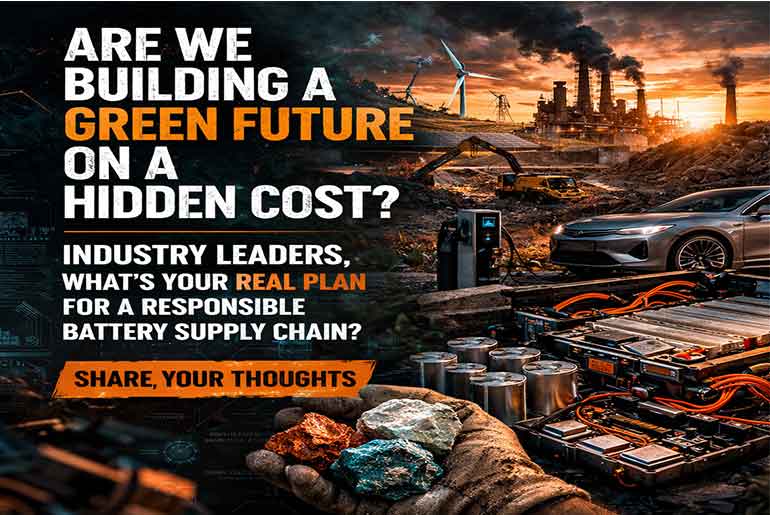
While batteries may be providing benefits regarding these issues today, they are also contributing to another layer of difficulty—the complexities associated with the purchase of raw materials needed to produce batteries, from an environmental, social, and geopolitical perspective.
The Scale of Demand: A Resource-Intensive Transition
The increase in demand for battery raw materials, especially lithium, cobalt, nickel and graphite is linked directly to the uptake of electric vehicles (EVs) and the move towards renewable energy. Data provided by the International Energy Agency (IEA) indicate that lithium will have the most significant increase in demand, estimated to be 40 x greater by 2040, under a highly aggressive clean energy future.
This increase in the level of resources consumed at a worldwide level can be described as an absolute structural change in resource consumption patterns globally.
- Lithium is a key ingredient in the production of cathodes for the creation of batteries. I.e. Lithium is required for the cathode chemistry.
- Cobalt provides enhanced stability of a battery.
- Nickel provides greater energy density and; therefore higher energy density batteries will have more capacity for holding energy.
- Graphite is the principal ingredient of anode material for batteries.
Because of the expansion of Gigafactories and therefore increasing competition between nations to produce batteries locally, mining activity at the upstream category (raw materials) has been intensified in various regions, including South America, Africa and Southeast Asia.
The question is no longer whether we need these materials—but at what cost they are being secured.
Extraction Realities: Environmental Trade-offs
Water Stress in Lithium Mining
Lithium extraction in South America’s “Lithium Triangle”—covering parts of Chile, Argentina, and Bolivia—relies heavily on brine evaporation techniques. This process consumes vast quantities of groundwater in already arid regions.
In Chile’s Salar de Atacama, lithium operations have been linked to declining water tables, affecting local ecosystems and indigenous communities that depend on these fragile water systems. Research has highlighted how brine extraction can disrupt hydrological balances, even if direct causation is still debated in some studies.
Nickel Mining Contributing to Deforestation and Pollution
The production and processing of nickel throughout Indonesia has greatly increased due to the global demand for battery supply chains for electric vehicles (EVs). This increase has had a great environmental impact as well.
Open-pit nickel mining is responsible for deforestation, soil erosion and sedimentation in the ocean, where many of the tailings waste from nickel processing are dumped into oceans.
The Carbon Footprint Paradox
While electric vehicles reduce tailpipe emissions, many still carry a considerable upstream carbon footprint due to battery production, especially from energy-intensive mining and refining processes. Without using clean energy sources to power the upstream processes, the decarbonization benefit will be partially cancelled out.
Human Cost: Ethical Challenges in the Supply Chain
Perhaps the most widely documented issue is cobalt mining in the Democratic Republic of the Congo, which accounts for over 70% of global cobalt supply.
Artisanal cobalt mining accounts for a large percentage of the total cobalt produced in the D.R. Kongos artisanal and small scale mines have been documented by several organizations such as Amnesty International as having these issues:
- child labor
- dangerous working conditions
- no safety gear used by workers
- no regulation of the mining operations
Although major OEMs and manufacturers of batteries have policies concerning responsible sourcing of cobalt, maintaining traceability in such an unfocused mine system will be a challenge.
The uncomfortable truth is this: a battery powering a premium EV may still carry material sourced under conditions that would not meet global labor standards.
Supply Chain Blind Spots: Traceability and Transparency
Battery supply chains are complex, multi-tiered, and often opaque.
The entire supply chain for materials (e.g. from mining through to refining, cathode production, cell production) involves many different intermediary operators, often in different countries. This creates a more complex challenge for end-to-end traceability of materials.
Although there is a rising number of companies reporting on their environmental, social and governance (ESG) activities, there remains a number of gap areas to address, including :
- Limited Visibility into the Tier-2 and Tier-3 Suppliers
- Inconsistent Reporting Standards
- Risk of Greenwashing in Sustainability Claims
In some areas of the world, such as Europe, there are developing ideas around battery passports (digital records of where batteries come from and how they have been used). However, these concepts are still only at an early stage of development.
Are Alternatives Truly Sustainable?
To reduce dependency on problematic materials, the industry is actively exploring alternative chemistries.
Batteries With Lithium Iron Phosphate (LFP)
In the cost-sensitive sector of electric vehicles (EVs), LFP batteries replace cobalt and nickel but still use lithium. Due to their low energy density, there are limitations on the range of applications for LFP Batteries.
Sodium-Ion Batteries
Sodium-ion battery technology has been advertised as a replacement for lithium-ion batteries; while sodium is abundant and inexpensive compared to other raw materials, sodium-ion batteries has been slow to get to market and are behind lithium-ion batteries in performance.
Solid-State Batteries
Often positioned as the next breakthrough, solid-state batteries promise higher safety and energy density. However, challenges related to scalability, cost, and material sourcing persist.
The key takeaway is not that alternatives are ineffective—but that no solution is entirely free of trade-offs.
The Recycling Gap: An Underutilized Opportunity
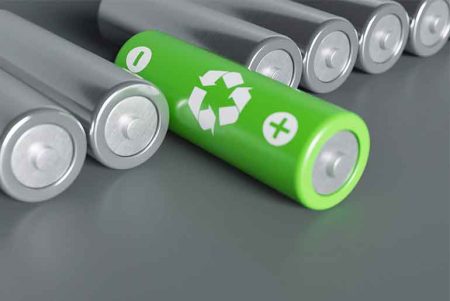
The recycling gap signifies that, while mining continues to increase, battery recycling is still largely undeveloped.
In fact, less than 10% of lithium ion batteries globally are effectively recycled (according to the World Economic Forum). As a result, this is an environmental risk and a lost economic opportunity.
Case Study: Redwood Materials
Founded by JB Straubel, a Tesla executive, Redwood Materials is an organization that recycles battery materials from spent batteries and from production byproducts.
Redwood claims to have a recovery rate greater than 95% for key metals including nickel, cobalt and lithium, returning these materials to the supply chain — a model for the circular economy; however, establishing this model across the globe is a challenge.
India’s Recycling Landscape
Battery recycling in India is still developing, and while we see new entrants into formally run facilities, a large portion of recycling (especially lead acid batteries) has historically taken place in an informal manner.
With regards to lithium-ion batteries, while there are some increasing efforts to develop regulations, there is a massive need to develop infrastructure, technology, and collection systems in order to keep pace with expected growth of electric vehicle production.
India’s Position: A Chance to Lower Import Dependency by Taking Advantage of Both the Threat and the Opportunity
India is rapidly making efforts toward increasing electricity use through initiatives like production-linked incentives (PLIs) to assist companies in producing advanced chemistry cells.
Recent finds of lithium in places such as Jammu and Kashmir encourage hope in the ability to lower their dependence on imported lithium. However, domestic mining and refining must be approached cautiously.
India has a critical opportunity: to build a battery supply chain that integrates sustainability from the outset—rather than retrofitting solutions after environmental and social costs emerge.
The question is not just whether India can secure resources, but whether it can do so responsibly.
Industry Response: Progress, But Not Enough
To its credit, the battery industry is not ignoring these challenges.
Sustainability metrics and transparency about supply chains are being standardized by organizations such as the Global Battery Alliance.
However, there is still some unevenness in the progress of these initiatives.
While voluntary commitments are necessary, they can not replace any regulatory framework or enforcement mechanism. Demand is currently growing at a faster rate than sustainable change is occurring.
However, there is still some unevenness in the progress of these initiatives.
While voluntary commitments are necessary, they can not replace any regulatory framework or enforcement mechanism. Demand is currently growing at a faster rate than sustainable change is occurring. Mr. Manikumar Uppala, Co-Founder and Chief of Industrial Engineering, Metastable Materials shed some light on the topic
Manikumar Uppala, Co-Founder and Chief of Industrial Engineering, Metastable Materials
“Battery supply chains do have environmental, ethical costs and some lack of transparency. Sourcing battery raw materials needs mining, which can be resource intensive and geographically concentrated. But looking at this ‘problem’ in the context of what alternatives are available and net environmental impact, can paint a more wholesome image. For example, ICE engines rely on continuous fossil fuel extraction, combustion, with irreversible lifetime emissions. On the other hand, batteries are material-intensive upfront but have the advantage of recoverability. With effective recycling, critical materials can be reintroduced into the supply chain, offsetting the demerits of fresh extraction. The challenge is the battery necessarily but embedding circularity in the design of the supply chain.”
A Necessary Reflection: Are We Shifting the Problem?
It is important to acknowledge that the energy transition is not optional—decarbonization is a global imperative.
But it is equally important to ask difficult questions.
- Are we reducing emissions at the point of use while externalizing environmental and social costs elsewhere?
- Are we replacing one form of resource dependency with another?
- Are we building a truly sustainable system—or a partially optimized one?
This is not an argument against electrification. It is an argument for doing it better.
The Way Forward: Building a Responsible Battery Ecosystem
To ensure that the clean energy transition does not come at hidden costs, a multi-pronged approach is essential:
1. Strengthening Ethical Sourcing
Mandatory due diligence frameworks and stricter enforcement of labor and environmental standards are critical.
2. Investing in Recycling and Circularity
Scaling recycling infrastructure can significantly reduce dependence on virgin materials.
3. Advancing Alternative Chemistries
Continued R&D into low-impact materials can diversify supply risks.
4. Improved Supply Chain Transparency
Standardized reporting and digital traceability will promote accountability in supply chain operations.
5. Aligning Strategies for Sustainable Industrial Growth
Governments must ensure that sustainable development goals coincide with their industrial policies so that they can continue to grow quickly without sacrificing long-term results.
In Summary: a Battery Revolution with Meaning Beyond Technology
The revolution of the battery will not only create new technologies; it will also change systems (ecosystems) and communities and economies around the world.
As industry stakeholders, the focus cannot remain limited to performance metrics, cost optimization, or scale alone.
Because the success of the energy transition will ultimately be measured not just by how quickly we move—but by how responsibly we do so.
The future may be electric.
But whether it is truly sustainable—that is still being decided.
 Electrify your feed! Click here to join our Whatsapp group and to get the latest updates, expert insights, and innovations driving India’s energy storage revolution.