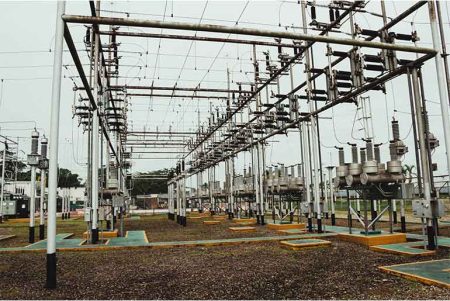

A battery energy storage system can be standing in rows of containers, connected to a substation, communicating with a control room and ready to charge. But is it ready for the grid? That is the more difficult question. BESS Grid Code requirements are now moving closer to answering it, with the Central Electricity Regulatory Commission (CERC) proposing new provisions for standalone Energy Storage Systems (ESS) under its draft Second Amendment to the Indian Electricity Grid Code Regulations, 2023, issued on September 21, 2026. The proposal includes trial-run requirements, provisions for staged commissioning of larger storage projects, rules around pre-commercial operation and primary frequency response. It is still a proposal, with stakeholders invited to submit comments and suggestions until October 21, 2026.
That timing matters.
India has spent the last few years becoming very good at announcing, tendering and contracting batteries. The next challenge is less glamorous but far more consequential: proving that those batteries can actually behave like grid assets.
A BESS is not ready simply because its containers have arrived at the site.
It has to charge. It has to discharge. It has to communicate. It has to measure. Its protection systems have to work. Its controls have to respond. And, increasingly, it has to demonstrate that it can react when the grid itself needs support.
That is where the proposed BESS Grid Code provisions become interesting.
From Installed Battery to Grid Asset
There is a temptation to look at a BESS project through two numbers: megawatts and megawatt-hours.
A 100 MW/200 MWh project sounds straightforward. It can theoretically deliver 100 MW for two hours. But the grid does not experience a BESS as a number printed on a project brochure.
The grid experiences its actual behaviour.
Can it receive power when instructed to charge? Can it deliver power when instructed to discharge? Can the system maintain the required operating parameters? Can its metering accurately capture what is happening? Can its telemetry communicate that information to the system operator? Can its protection equipment respond when something goes wrong?
These questions become particularly important as standalone BESS moves from pilot projects towards large-scale deployment.
The proposed BESS Grid Code approach therefore goes beyond asking whether a battery has been installed. It starts asking whether the storage system has demonstrated enough of its operating capability to be treated as a functioning part of the power system.
That is a subtle but important shift.
What Is CERC Actually Proposing?
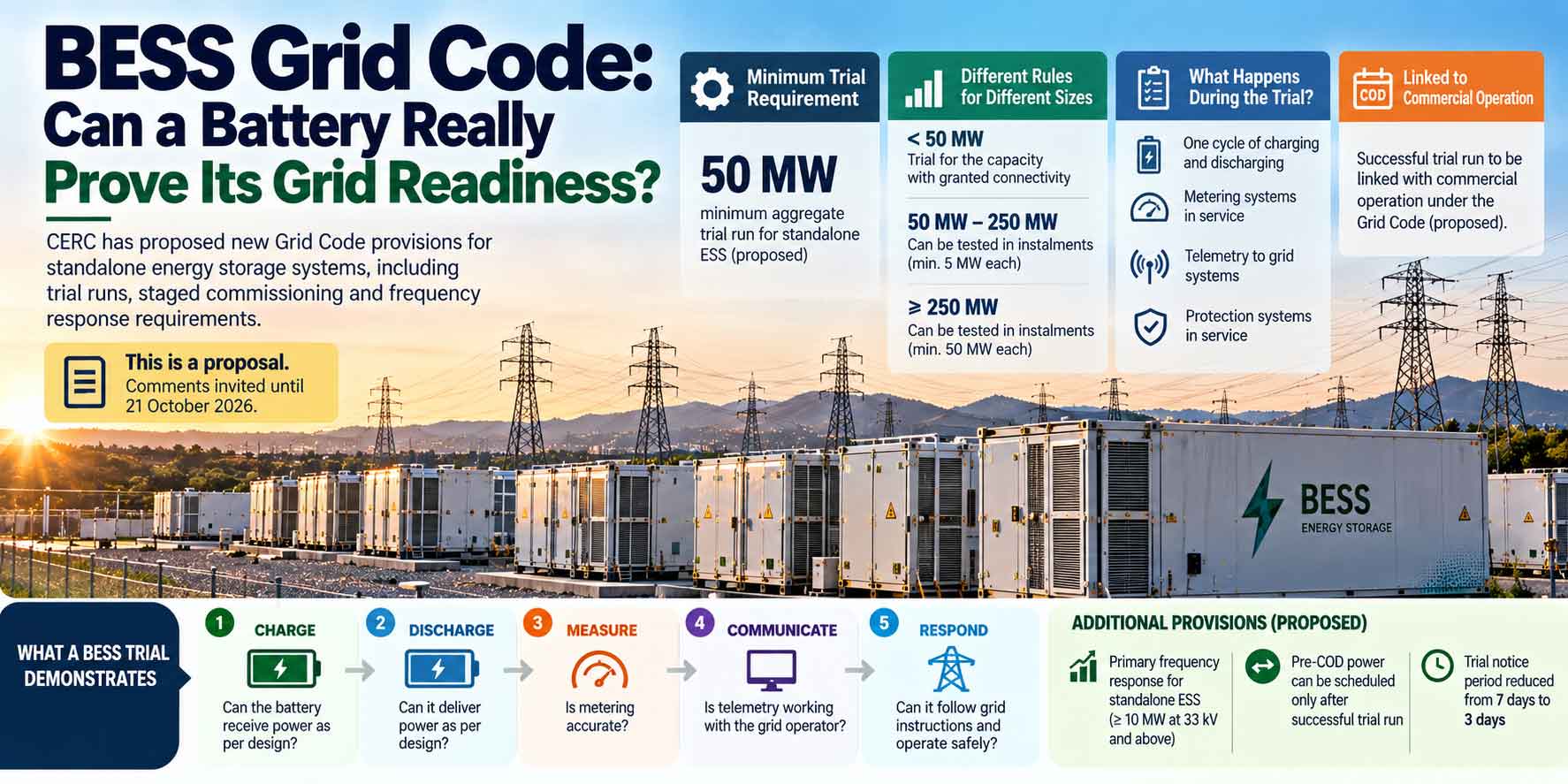
The draft Second Amendment to the Indian Electricity Grid Code proposes that standalone ESS generally undertake a trial run for a minimum aggregate capacity of 50 MW.
But CERC has not proposed a single blanket approach for every project.
For standalone ESS below 50 MW covered under the specified connectivity provisions, the trial run can be undertaken for the capacity for which connectivity has been granted. For larger projects, the draft provides a pathway for staged demonstration. ESS projects of 250 MW and above may undertake trial runs in instalments of at least 50 MW, without a specified limit on the number of instalments.
That matters because a 50 MW battery and a 500 MW battery do not present the same commissioning challenge.
Imagine a 500 MW standalone project divided across multiple blocks. Waiting until every block is completely ready before demonstrating any capability could create unnecessary delays. A staged approach allows portions of the project to demonstrate their capability progressively.
In other words, the proposed BESS Grid Code provisions appear to recognise something that developers already understand on the ground: large storage projects are built in systems and blocks, not as one enormous switch that suddenly turns on.
But What Exactly Is a “Successful” Trial?
This is where the proposal becomes more technically interesting.
A trial run is not supposed to be a ceremonial moment when somebody presses “start” on a control screen.
CERC’s earlier Grid Code framework describes a successful standalone ESS trial run as one cycle of charging and discharging according to the system’s design capability, with the required metering, telemetry and protection systems in service.
Those three supporting systems deserve more attention than they usually receive.
Metering tells the grid what actually happened.
A BESS cannot participate meaningfully in a power system if the energy flowing into and out of it cannot be accurately measured.
Telemetry allows the system operator to see what the asset is doing.
For a grid-scale battery, communication is not an optional digital layer sitting on top of the hardware. It is part of the operating architecture.
Protection is what stands between an electrical abnormality and a larger system problem.
The battery may have sophisticated internal controls, but the project still has to operate within the electrical protection framework of the grid to which it is connected.
So when we ask whether a battery can prove its grid readiness, the answer cannot come from the battery cells alone.
It comes from the battery plus PCS, BMS, EMS, metering, telemetry, protection and grid interface working together.
One Cycle Sounds Simple. It Is Not.
At first glance, requiring a charge-discharge cycle may sound modest.
But consider what that cycle represents.
The battery must accept energy. The power conversion system must manage that energy. The battery management system must monitor the battery. The energy management system must coordinate operation. The metering system must capture the flow. Communication systems must remain available. Protection systems must remain in service.
And then the system must discharge according to its demonstrated capability.
A BESS is therefore being asked to prove that its major electrical and control systems can operate together rather than merely proving that its cells can store energy.
That distinction is important.
A battery cell can be perfectly healthy while the project as a whole still has a problem with controls, communication, protection, power conversion or grid synchronisation.
The BESS Grid Code conversation is therefore increasingly becoming a conversation about system performance, not simply battery performance.
What Happens Before Commercial Operation?
This is perhaps the most commercially significant part of the proposal.
The draft links successful completion of the applicable trial run with commercial operation under the Grid Code framework. It also proposes that scheduling of infirm power from ESS before commercial operation should take place only after successful completion of the relevant trial run.
That creates a clear sequence.
Build the system.
Connect it.
Demonstrate its capability.
Complete the applicable trial.
Move towards commercial operation.
For developers, that sequence matters because a delay in one stage can have consequences beyond the commissioning team.
It can affect revenue commencement, contractual milestones, availability of the asset and the timing of scheduled power.
And this is where the proposed BESS Grid Code provisions could become relevant to project economics, even though the draft itself is primarily about grid operation.
What Happens to the Power Before COD?
A battery does not necessarily sit completely idle simply because its commercial operation date has not arrived.
There can be electricity available from the project during the pre-COD period.
The draft proposes that, where the contract does not already specify how such power should be treated, the power would first be offered to the contracted buyer with at least seven days’ advance notice. If the buyer does not avail itself of the power, the proposed framework provides for subsequent sale to another entity.
This is a relatively small provision in a large regulatory document, but it raises a practical question:
What happens to a battery’s output while the project is technically ready but not yet commercially operational?
For a thermal generator, solar plant or wind project, the treatment of infirm power has long been part of the grid-operating framework.
As storage becomes a major electricity-system asset, it needs its own practical rules. That is what makes these provisions relevant.
The Bigger Test May Be Frequency Response
There is another part of the proposed BESS Grid Code framework that could have an even bigger long-term effect.
The draft proposes primary frequency-response requirements for standalone ESS of 10 MW and above connected at 33 kV and above, bringing qualifying storage into a part of grid operation where rapid response matters. Energy-Storage.
Why does this matter?
Because one of the biggest advantages of batteries is not simply that they can supply electricity for two or four hours.
It is that they can change their power output very quickly.
A battery can move from charging towards discharging, or increase or reduce its output, much faster than many conventional generating technologies can change their operating state.
That makes BESS particularly interesting for maintaining system frequency.
And this changes the way we should think about the word “storage.”
A battery connected to the grid is not merely storing electricity for later.
It can potentially become part of the grid’s real-time balancing mechanism.
That is a much bigger role.
Why Grid Readiness Is Different From Battery Health
There is one distinction the industry should not lose in all this discussion.
Passing a trial run does not mean a battery has proven its entire lifetime performance.
A successful commissioning test cannot demonstrate fifteen years of degradation behaviour.
It cannot prove that the battery will maintain its contracted availability year after year.
It does not eliminate augmentation requirements.
It does not automatically establish compliance with every performance guarantee in a PPA, ESA or other commercial contract.
And it certainly does not replace fire-safety, thermal-management, cybersecurity or long-term maintenance requirements.
The trial answers a narrower but important question:
Can this system demonstrate the required operating capability under the prescribed test conditions?
That is different from asking:
Can this system continue doing it economically and reliably for the next 15 years?
The first is a commissioning question.
The second is a lifecycle question.
Both matter.
A 500 MW Battery Cannot Be Treated Like One Giant Battery
This is another reason the proposed staged-trial provisions deserve attention.
Large BESS projects increasingly contain multiple battery blocks, PCS units, transformers, switchgear and control systems.
The physical project may have a single connection point, but its internal architecture can be highly distributed.
A staged trial therefore has a practical advantage.
If a 500 MW project can demonstrate its capability progressively, commissioning can potentially become a managed process rather than one enormous pass-or-fail event at the very end.
The proposal for projects of 250 MW and above to conduct trials in instalments of at least 50 MW reflects that reality.
But there is also a question here that developers will have to think through:
How much of the final project’s behaviour can be inferred from a successfully tested block?
Testing one part of a system does not automatically prove that every interface across the complete plant will perform identically.
That makes integration testing and system-level commissioning increasingly important as project sizes grow.
The EPC Checklist Is Becoming a Grid Checklist
For EPC companies, the proposed BESS Grid Code provisions could make the commissioning phase more consequential.
A project cannot simply reach mechanical completion and move immediately to commercial operation.
The project team needs to know whether the systems required for the trial are ready.
- Is the PCS operating correctly?
- Is the BMS communicating properly?
- Is the EMS issuing the right commands?
- Is metering available?
- Is telemetry working?
- Are protection systems in service?
- Can the plant execute the required charge-discharge operation?
- Can the project communicate properly with the relevant grid-control infrastructure?
These are not necessarily new engineering questions.
What changes is their place in the path towards commercial operation.
As BESS projects become larger and more valuable, commissioning itself becomes a project-risk issue.
What Does This Mean for BESS Developers?
The biggest implication may be that developers will have to think about grid readiness much earlier. A common mistake in large infrastructure projects is to treat commissioning as the final chapter. For BESS, commissioning begins long before the first formal trial. The battery configuration, PCS selection, protection philosophy, communication architecture, EMS design and metering arrangement all influence whether the project can eventually demonstrate the required performance.
That means the question:
“Will the battery pass the trial?”
should not first be asked when the battery is already sitting at the substation.
It should be asked during project design. And that is perhaps one of the most useful consequences of the proposed BESS Grid Code framework. It pushes grid-readiness upstream.
And What About Contractual Performance?
There is another layer that developers and buyers will have to keep separate. A successful Grid Code trial is a regulatory/grid-operating milestone.
It does not necessarily mean that every contractual performance condition has been satisfied. A buyer may have its own requirements concerning:
– availability,
– response time,
– round-trip efficiency,
– usable energy,
– degradation,
– state-of-charge management,
– guaranteed cycles,
– auxiliary consumption,
– scheduled availability and
– other project-specific obligations.
The proposed BESS Grid Code framework should therefore not be read as replacing commercial performance testing.
Instead, it establishes another threshold:
Can the asset operate within the requirements of the electricity system?
The contract can then ask additional questions:
Can it deliver what was purchased?
Those are related questions, but they are not identical.
Three Days Instead of Seven
The draft also proposes reducing the specified notice period for trial runs from seven days to three days. LinkedIn
At first, this may appear like a procedural change.
But it fits the broader direction of the proposal.
India is trying to integrate storage into a power system that is becoming more dynamic. If trial procedures themselves become too slow, they can become another source of project delay.
A shorter notice period could give developers and system operators more flexibility around commissioning.
But speed should not be confused with lower standards.
The interesting balance will be whether projects can move through testing faster without reducing the quality of the demonstration.
That is the real commissioning challenge.
The BESS Grid Code Is Arriving at an Important Moment
This proposal is appearing at a time when India’s storage ambitions are becoming much larger.
The country is moving from a market dominated by storage tenders and early projects towards a system in which BESS is expected to participate in energy markets, provide grid services, support renewable integration and eventually operate alongside transmission infrastructure at scale.
CERC’s own recent proceedings already show BESS moving deeper into the electricity system. In August 2026, for example, the Commission was considering Power Grid Corporation of India’s proposal for BESS as integrated energy storage systems at existing substations in the Western Region.
That is a useful indicator of where the industry is heading.
The battery is no longer simply something placed next to a solar plant.
It can become an element of the grid itself.
And once that happens, the grid needs to know what the battery can actually do.
The Question Is No Longer “Is the Battery Connected?”
For years, India’s storage conversation has been dominated by capacity.
- How many MW?
- How many MWh?
- How many tenders?
- How many projects?
- How much investment?
Those numbers remain important.
But as the industry moves towards commercial operation, another number becomes important:
How much storage has actually demonstrated that it can operate reliably as part of the power system?
That is a different measurement.
A 500 MW BESS on paper is not the same thing as a 500 MW BESS that has completed its required tests, established its grid interface, demonstrated its operating capability and entered commercial service.
The difference between those two is where commissioning lives.
And increasingly, that difference is where project risk lives too.
So, Can a Battery Really Prove Its Grid Readiness?
The proposed BESS Grid Code framework does not attempt to answer every question about battery performance.
Nor should it.
Its importance lies somewhere else.
It begins to define what a standalone storage project needs to demonstrate before it can move from being a constructed facility to being a functioning participant in the power system.
A successful trial cannot tell us whether a battery will perform perfectly for 15 years.
- It cannot eliminate degradation.
- It cannot replace commercial warranties.
- It cannot guarantee that every future operating condition will be trouble-free.
But it can answer a much more immediate question:
When the grid asks the battery to charge, discharge, communicate and respond, can the system actually do it?
That question will become harder to avoid as India’s BESS fleet grows.
CERC’s proposal is still under consultation, and the final regulatory text may change after stakeholder comments. But the direction of travel is already clear: India’s batteries will increasingly have to prove that they are not just storage projects, but grid assets.
And perhaps that is the real test India now needs.
Not whether it can build a battery.
Whether the battery can earn the grid’s trust.
Oswald D’souza, Whole-Time Director and Co-Founder, CosPower Engineering Limited, said: “The recommendations made by CERC for modifications to grid norms represent a significant shift in how Battery Energy Storage Systems (BESS) are evaluated in India. The installed capacity of a battery is only one aspect of its overall efficiency. Greater emphasis must be placed on its actual performance and operational effectiveness when integrated into the grid.
This includes its ability to perform frequency regulation and maintain efficiency under varying load conditions. The proposed requirements introduce a more practical approach to assessing the performance of energy storage systems by evaluating their ability to effectively deliver their intended functions. This is particularly important as BESS integration continues to expand alongside inverter-based solutions in the power system.”
 Electrify your feed! Click here to join our Whatsapp group and to get the latest updates, expert insights, and innovations driving India’s energy storage revolution.