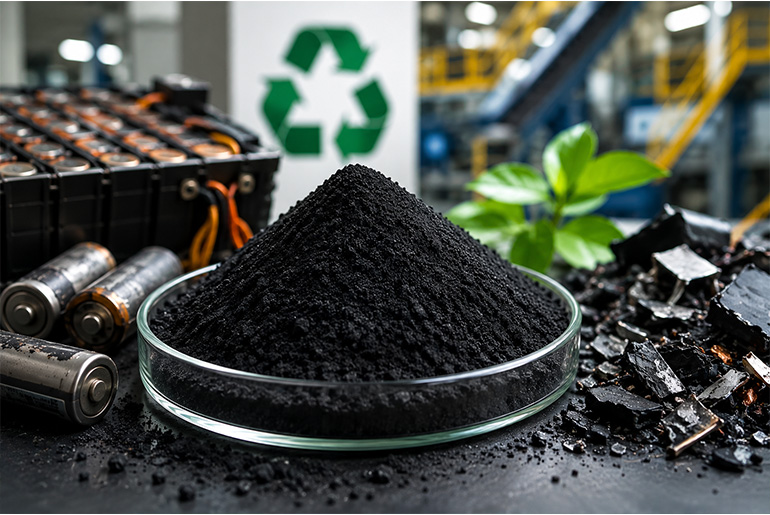
Hidden inside every discarded lithium-ion battery lies a dark powder that is quietly becoming one of the most sought-after materials in the global clean energy industry. The industry calls it black mass. Once viewed merely as an intermediate by-product of battery recycling, black mass is today emerging as a strategic resource rich in lithium, nickel, cobalt, manganese, and graphite—the very materials needed to manufacture next-generation batteries. As India ramps up electric vehicle usage, adds more Battery Energy Storage Systems (BESS) and sets up domestic gigafactories, the importance of recovering these critical minerals is becoming more and more evident. This expanding opportunity places Black Mass Recovery Companies in India at the heart of the nations circular battery economy. Instead of viewing the batteries as waste, these companies are turning them into valuable sources of raw material that can help enable the country’s long-term energy and manufacturing aspirations.
But what exactly is black mass, and why are industries, policymakers, and recyclers suddenly racing to recover it?
The Hidden Treasure Inside Every Used Battery
Imagine an electric vehicle battery that has completed years of service. It may have powered thousands of kilometres on Indian roads, supported renewable energy storage, or enabled countless charging cycles. Eventually, however, every battery reaches the end of its first life.
For decades, such batteries were largely viewed as waste. Today, that perception is changing. Modern lithium-ion batteries are often described as urban mines because they contain valuable critical minerals that can be recovered and reused. The real treasure inside these batteries does not lie in the aluminium casing or external components. It lies in a fine, dark powder generated during recycling—black mass.
This material may not look like much, but it is packed with large quantities of lithium, nickel, cobalt, manganese and graphite. Indeed, while the black mass constitutes only a small fraction of the weight of a battery, it represents a large part of its economic value.
Black mass is being increasingly seen not as waste, but as a strategic resource in the scramble for critical minerals by nations across the globe. This pivot could be transformative for India, which is rapidly building a domestic battery ecosystem, yet still reliant on imported critical minerals.
Suddenly, yesterday’s battery is no longer the end of a story. It is the beginning of a new one.
What Exactly Is Black Mass?
Black mass is, quite simply, the powdery material left behind when lithium-ion batteries reach the end of their life and are broken down, shredded and mechanically separated in the recycling process. It is the link between waste battery and recovery of critical minerals.
The process begins with the collection of spent batteries from electric vehicles, consumer electronics, telecom infrastructure, manufacturing scrap or energy storage systems and delivery to authorised recycling facilities. The recyclers first discharge the batteries to make them safe. This helps to prevent fire. Then they break the battery packs into smaller bits called modules and cells.
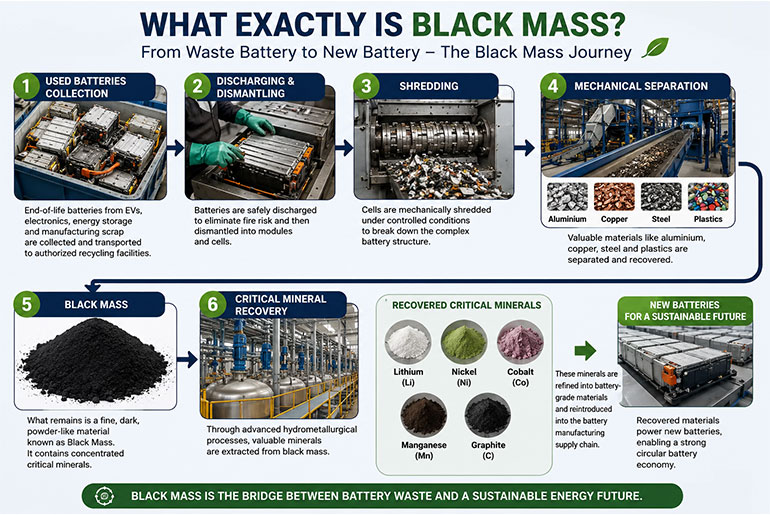
Then the cells are mechanically broken down under carefully controlled conditions. At this stage of the process materials such as aluminium, copper, steel and plastics are separated and recovered. This creates a dark powdery substance known as black mass.
The composition of black mass depends on the battery chemistry. But it is often rich in valuable materials such as lithium, nickel, cobalt, manganese and graphite – the building blocks for new batteries.
This is precisely why black mass has become one of the most valuable outputs of the recycling chain. Recovering these materials reduces dependence on virgin mining while strengthening domestic supply chains for battery manufacturing.
To understand the broader journey through which spent batteries are transformed into reusable materials, readers can explore our detailed article on the Lithium Battery Recycling Process.
Increasingly, experts believe that the future of critical mineral security may not lie only beneath the earth, but also inside the batteries already in circulation.
Why Black Mass Matters in India’s Battery Economy
To understand why black mass is attracting so much attention, we must first understand the scale of India’s battery ambitions.
India is no longer building a niche market for batteries. It is building an entire battery economy.
Electric vehicles are being rapidly adopted in two-wheelers, passenger vehicles, commercial fleet and public transport systems. At the same time, Battery Energy Storage Systems (BESS) are emerging as an important pillar to support India’s renewable energy transition. Couple that with the nation’s burgeoning aspirations for domestic cell manufacturing and the centrality of batteries to India’s energy future becomes clear.
According to an assessment by NITI Aayog’s Advanced Chemistry Cell (ACC), India’s demand for batteries could be close to 260 GWh by 2030 in an accelerated growth scenario. The Institute for Energy Economics and Financial Analysis (IEEFA) said industry estimates based on projections by the India Energy Storage Alliance (IESA) show India’s demand for ACC batteries could rise to nearly 272 GWh by FY30 from around 28 GWh in 2025. And the slope gets even steeper after 2030, with IESA estimating a cumulative lithium-ion battery demand of over 500 GWh (across multiple applications). The battery revolution, however, extends far beyond electric mobility.
India’s National Electricity Plan estimates that the country could require nearly 74 GW/411 GWh of energy storage capacity by 2032, with Battery Energy Storage Systems expected to contribute approximately 236 GWh. This means that batteries are increasingly becoming as important for energy infrastructure as they are for transportation.
Yet every battery requires materials.
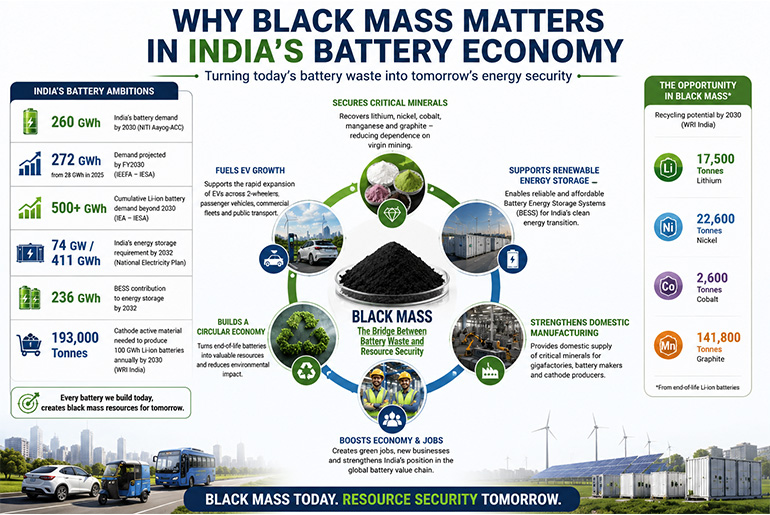
Research by WRI India estimates that producing 100 GWh of lithium-ion batteries could require approximately 193,000 tonnes of cathode active material annually by 2030. These materials include lithium, nickel, cobalt, manganese, and graphite—the same critical minerals concentrated inside black mass.
This is where the story becomes particularly interesting.
Every electric vehicle sold today, every gigafactory announced, and every BESS project commissioned is not only creating future battery demand, but also creating future black mass resources.
In other words, India is simultaneously building tomorrow’s urban mines.
Rather than allowing these valuable materials to be lost as waste, Black Mass Recovery Companies are increasingly working to recover and reintroduce them into domestic supply chains. In fact, many Battery Recycling Companies in India are rapidly scaling up their capacity for black mass processing, hydrometallurgical recovery and critical mineral refining.
As resource security becomes more important, black mass is being viewed not only as an industrial waste, but as a strategic resource that can help India bolster its critical mineral ecosystem.
Suddenly, black mass is no longer waste. Looks like opportunity.
Why Recovering Black Mass Is Becoming Big Business
Traditionally, battery recycling was seen primarily as a waste management exercise. But today the industry is increasingly recognising that the real value lies in the critical minerals that are concentrated in the black mass.
The opportunity for India in this space is enormous.
India has the potential to recycle nearly 128 GWh of lithium-ion batteries by 2030, said WRI India. Such end-of-life batteries could yield some 17,500 tonnes of lithium, 22,600 tonnes of nickel, 2,600 tonnes of cobalt and almost 141,800 tonnes of graphite. These figures show the great potential of used batteries as a resource.
For a country that remains heavily dependent on imports for several critical minerals, these numbers are difficult to ignore.
As EV adoption grows and Battery Energy Storage System (BESS) deployments increase, the sourcing of reliable supplies of lithium, nickel, cobalt and graphite will become increasingly important. Recovering these materials from black mass offers India an opportunity to reduce import dependence and strengthen domestic supply chains.
This is one of the reasons why Black Mass Recovery Companies are attracting growing investments. Every battery reaching the end of its useful life represents not merely a waste management challenge, but also a future source of critical minerals.
Another important debate is also emerging within the industry: should India export black mass or refine it domestically?
Many experts see black mass exports as exports of valuable critical minerals before they have undergone much value addition. The real economic opportunity is in refining black mass into battery grade materials to feed back into domestic cell manufacturing.
The expansion of the EV Battery Recycling Market India could see black mass refining as a way to support gigafactories, battery manufacturers and cathode producers in the country, while helping India to meet its circular economy ambitions.
In many ways, the black mass is much more than a recycling opportunity. This gives India a chance to transform from a producer of battery waste to a hub for the recovery of critical minerals.
Leading Black Mass Recovery Companies in India
As the battery ecosystem in India expands, companies are looking beyond traditional recycling and investing in capabilities like black mass generation, recovery and refining. These companies don’t just recycle battery waste; they’re helping to build a domestic supply chain for critical minerals.
- Attero is one of the leading Black Mass Recovery Companies and one of the pioneers in lithium-ion battery recycling and critical mineral recovery in India. The company has developed proprietary hydrometallurgical technologies that can recover lithium, cobalt, nickel, manganese and graphite from end-of-life batteries. With a strong patent portfolio and focus on urban mining, Attero is increasingly positioning itself as a critical minerals recovery company and not just a recycler.
- Lohum has grown to be one of the largest integrated battery circular economy players in the country. The company is engaged in battery recycling, black mass processing and material refining and reuse. Its vertically integrated model facilitates the creation of a closed-loop ecosystem for the recovery of valuable materials and their reintroduction into the supply chains for battery manufacturing.
- BatX Energies is a deep-tech startup, a next-gen trailblazer in the sector. The company is dedicated to producing high-purity black mass and reclaiming battery-grade materials with advanced recycling technologies. Industry has taken a great deal of interest in BatX’s low impurity black mass targets and sustainable processing.
- Another important player is Rubamin, which has leveraged its extensive metallurgical expertise to establish black mass refining capabilities. The company has consistently advocated for domestic refining, arguing that India should retain and process black mass locally rather than export it for value addition elsewhere.
- Companies like RecycleKaro too are scaling their lithium-ion battery recycling infrastructure at a rapid pace and investing in critical mineral recovery. Likewise, specialised firms like ReBAT are working on producing high-purity black mass from multiple battery chemistries, such as NMC, LFP, and LCO batteries.
Together, these companies are laying the groundwork for a domestic black mass ecosystem. With their investments in recycling, refining and material recovery, they are slowly turning India from a battery waste generator into a potential hub for critical mineral circularity.
For a detailed analysis of the ecosystem of this transition, check out our analysis of Battery Recycling Companies in India.
Challenges Facing India’s Black Mass Industry
However, while optimism is growing around black mass recovery, there are still several challenges that are holding back the sector.
One of the major challenges is feedstock availability. Although India is rapidly increasing recycling and refining capacities, the country’s electric vehicle market is still relatively young. This means that there are still not enough end-of-life batteries to take full advantage of existing recycling infrastructure.
Another big concern is the existence of informal recycling chains. A large share of battery waste is still going through informal channels, often resulting in unsafe practices, reduced recovery efficiencies and loss of valuable critical minerals. So, bringing informal collectors into the formal recycling ecosystem will be key.
The industry is also witnessing an ongoing debate around black mass exports. Many stakeholders argue that exporting black mass means losing the opportunity to recover high-value materials domestically. Developing local refining infrastructure will be essential if India wishes to maximize value addition and strengthen its critical mineral security.
Another challenge is technology cost. To extract battery-grade materials from black mass requires advanced hydrometallurgical processes, specialised equipment and large capital investments.
Finally, robust collection systems, traceability and a steady supply of feedstock for recyclers will hinge on the effective implementation of the Battery Waste Management Rules India and the Extended Producer Responsibility (EPR) framework.
The Road Ahead: From Waste to Strategic Resource
For decades, countries searched beneath the earth for critical minerals. Increasingly, however, the future of these resources may lie above the ground—in discarded batteries.
As India’s battery economy continues to expand, black mass is expected to become an increasingly important secondary source of lithium, nickel, cobalt, manganese, and graphite. The growth of Black Mass Recovery Companies exemplifies an industry trend: batteries are increasingly seen not just as a product, but as a source of valuable materials.
The road from waste battery to battery-grade materials is still under construction. But one thing is clear already. For a country looking for energy security, resource resilience and a circular economy, black mass could be far more than a recycling by-product.
It may well become one of the building blocks of India’s clean energy future.
 Electrify your feed! Click here to join our Whatsapp group and to get the latest updates, expert insights, and innovations driving India’s energy storage revolution.