Every electric vehicle gliding silently on Indian roads today carries within it a story that extends far beyond mobility. Long after the vehicle has completed thousands of kilometres and its battery reaches the end of its useful life, another journey begins—one that could shape India’s resource security, critical mineral supply chains, and circular economy ambitions. India’s electric mobility revolution is picking up pace at an unprecedented rate. Electric two-wheelers are becoming more common on city streets, electric buses are transforming public transport, and passenger electric vehicles are slowly gaining popularity among consumers. But behind this visible transformation is another equally important development that gets much less attention – the rise of EV Battery Recycling Market India.
For decades, end-of-life batteries were largely considered waste to be safely disposed of. That perception is changing fast today. There is growing recognition of the value of retired EV batteries as sources of lithium, nickel, cobalt, manganese, graphite and other critical minerals needed for next-generation batteries.
This change is especially significant for India.
The country is speeding up its uptake of EVs, scaling up its domestic battery production and chasing big clean energy goals, so sourcing enough critical minerals in a sustainable way is turning into a strategic must-have. The recovery of valuable materials from used batteries can help reduce dependence on imports and also fit into India’s broader vision of developing a circular battery economy.
In many ways, every electric vehicle sold today is quietly creating tomorrow’s recycling opportunity.
And this is precisely where the EV Battery Recycling Market India enters the picture.
India’s EV Revolution Is Creating a New Industry
India is no longer experimenting with electric mobility—it is scaling it.
As per industry analysis based on Vahan dashboard, India saw more than 2.5 million electric vehicles in FY 2025-26 with continued growth across vehicle segments. Electric two-wheelers are still leading the charge in adoption, while electric three-wheelers, buses and passenger vehicles are steadily building their positions in the market.
The scale of future adoption could be even more spectacular. Industry estimates say that India’s private car sales could be 30% electric by 2030, with commercial car sales at 70%, bus sales at 40% and two- and three-wheeler sales at almost 80%.
Such growth is not merely creating a mobility transition. It is creating an entirely new industrial ecosystem encompassing battery manufacturing, second-life applications, material recovery, and recycling.
Millions of batteries entering service today will eventually reach the end of their first life. When that happens, they will not simply become waste. They will become feedstock for a rapidly emerging recycling industry capable of recovering valuable materials and feeding them back into the manufacturing cycle.
In other words, India’s EV revolution is simultaneously laying the foundation for a multi-billion-dollar recycling opportunity.
Why EV Battery Recycling Matters for India
To understand why the EV Battery Recycling Market India is attracting growing attention, one must first appreciate the scale of the country’s battery ambitions.
India is no longer building a niche market for electric vehicles. It is building an entire battery economy. According to the Vahan dashboard analysis by industry, India witnessed over 2.5 million electric vehicle registrations in FY2025-26, with the EV penetration as high as close to 8.5% of the total vehicle sales. Electric two-wheelers continue to lead the transition, followed by electric three-wheelers, buses and passenger vehicles.
But the growth story is only beginning.
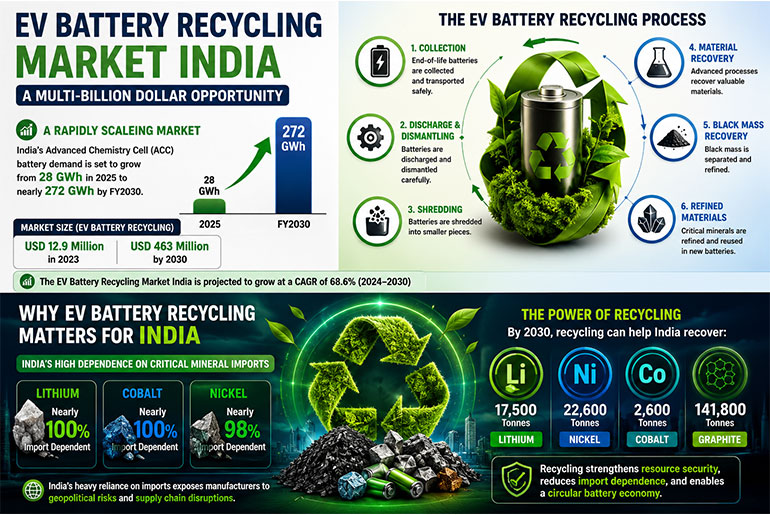
NITI Aayog and the Rocky Mountain Institute (RMI) estimate India’s cumulative battery demand to be between 106 GWh and 260 GWh by 2030, depending on the pace of EV adoption and energy transition. More recent industry estimates cited by the Institute for Energy Economics and Financial Analysis (IEEFA) based on projections from the India Energy Storage Alliance (IESA) suggest that India’s Advanced Chemistry Cell (ACC) battery demand could leap sharply from approximately 28 GWh in 2025 to nearly 272 GWh by FY2030.
The trajectory becomes even steeper beyond 2030. IESA estimates that cumulative lithium-ion battery demand across multiple applications could exceed 500 GWh, underlining the sheer scale of India’s emerging battery ecosystem.
The battery revolution, however, extends far beyond electric mobility.
India’s National Electricity Plan projects the country’s requirement for almost 74 GW/411 GWh of energy storage capacity by 2032, of which Battery Energy Storage Systems (BESS) alone are expected to provide some 236 GWh. That means batteries are becoming as important to India’s energy infrastructure as they are to transportation.
But all batteries need materials.
WRI India research estimates that to manufacture 100 GWh of lithium-ion batteries by 2030, around 193,000 tonnes of cathode active material may be needed every year. These materials include lithium, nickel, cobalt, manganese and graphite – the same critical minerals that India is importing in large quantities today.
Seen from the point of view of resources security, the strategic importance of recycling is even more evident. According to the Ministry of Mines and several industry studies, India is almost entirely dependent on imports for critical battery minerals such as lithium, cobalt and nickel. According to analyses by IEEFA and others, India today is almost 100% import-dependent for these minerals, making domestic manufacturers vulnerable to geopolitical risks and supply chain disruptions. Recycling provides a pathway to resource security and supply chain resilience for a country aspiring to become a global hub for battery manufacturing.
That’s why recycling is so important.
Every EV sold today, every gigafactory announced, every battery deployed in the field is also creating tomorrow’s opportunity for recycling. Today’s batteries powering India’s mobility transition could be tomorrow’s urban mines, returning critical materials to domestic manufacturing supply chains.
Many EV batteries still retain 70-80% of their original capacity after their automotive life cycle. These batteries are frequently refurbed, repurposed or used in second life applications such as stationary energy storage before entering the recycling stream.
Suddenly, end-of-life batteries no longer look like waste. They look like opportunity.
How the EV Battery Recycling Market India Is Evolving
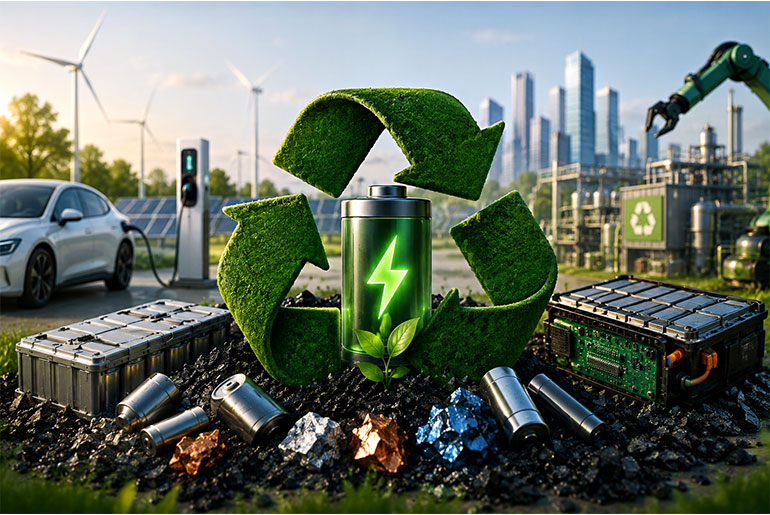
The EV Battery Recycling Market India is still in its early stages, but all indicators suggest that it is poised for exponential growth during the coming decade.
As India’s electric mobility ecosystem expands, millions of batteries currently powering electric vehicles will eventually reach the end of their useful life. Contrary to popular perception, however, these batteries do not immediately become waste.
Eventually, though, every battery reaches the end of its life.
WRI India estimates that nearly 128 GWh of end-of-life lithium-ion batteries could be generated in India by 2030, of which around 46% of the volume is likely to be from electric vehicles alone. This represents a huge future feedstock opportunity for recyclers.
The upside in the market is equally attractive. Industry estimates indicate that the Indian EV battery recycling market, valued at USD 12.9 million in 2023, is expected to reach close to USD 463 million by 2030, driven by the rapid rise in battery retirements and material recovery opportunities. Meanwhile, JMK Research estimates that India’s cumulative lithium-ion battery market could grow from about 2.9 GWh in 2018 to nearly 800 GWh in 2030. This means a huge feedstock base for recyclers to tap in the future.
Collected end-of-life batteries are dismantled, safely discharged and material separated. If you want to go deeper into the whole technical procedure, read our complete feature on the Lithium Battery Recycling Process.
A main product of this recycling chain is black mass – a dark powder packed with lithium, nickel, cobalt, manganese and graphite. As we discussed in our article on Black Mass Recovery Companies, this material is increasingly being viewed as a strategic resource that can contribute to the domestic critical mineral ecosystem in India.
The scale of this opportunity is gigantic.
“Recycling of end-of-life lithium-ion batteries in India by 2030 could recover approximately 17,500 tonnes of lithium, 22,600 tonnes of nickel, 2,600 tonnes of cobalt and almost 141,800 tonnes of graphite,” says WRI India. Recovery of these materials can significantly reduce India’s dependence on imported critical minerals and strengthen domestic battery production.
In many ways, the EV Battery Recycling Market India is no longer merely about managing waste. It is about transforming retired batteries into a secondary source of strategic materials capable of powering India’s next phase of industrial growth.
The batteries driving India’s EV revolution today could very well become tomorrow’s urban mines.
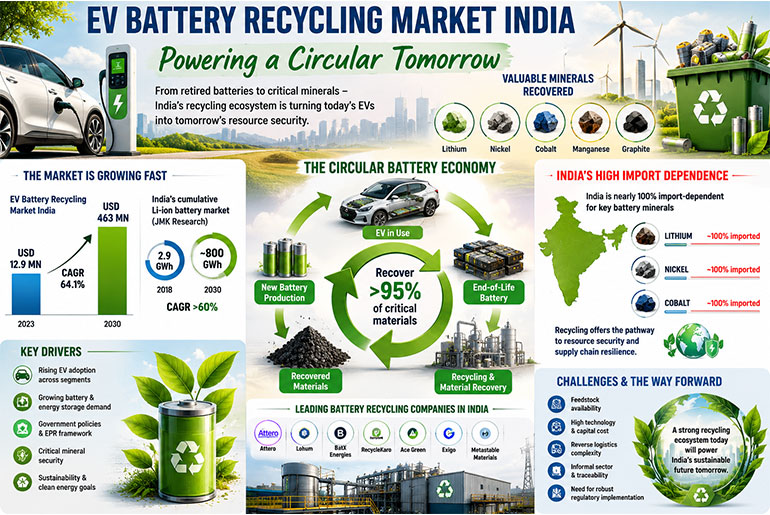
Key Players Driving the EV Battery Recycling Market India
EV Battery Recycling Market India is growing at a fast pace and is being fuelled by a variety of companies from traditional recyclers, deep-tech startups to circular economy experts. These companies are not just recycling waste batteries, they’re building domestic capabilities for critical mineral recovery, battery reuse, and resource circularity.
Attero is one of the pioneers and has emerged as one of the leading recyclers of lithium ion batteries in India. The company has developed proprietary hydrometallurgical technologies to recover lithium, cobalt, nickel, manganese and graphite from end-of-life batteries. With its large patent portfolio and focus on urban mining, Attero is moving more and more towards a critical mineral recovery company rather than a recycler.
Lohum has become one of India’s largest integrated battery circular economy companies. It works in several areas of the battery life cycle, including collection, reuse, repurposing, recycling, black mass refining and battery-grade material production. Lohum functions with a vertical integration model where the valuable materials recovered from the used batteries enter the manufacturing supply chains enabling a closed-loop ecosystem.
BatX Energies is the next generation of innovation to develop indigenous technologies for battery recycling and critical minerals recovery. The startup is focused on high-purity black mass production and sustainable material recovery with a focus on a net-zero waste approach. Technology Development Board of Government of India has also supported its efforts.
Another important player is RecycleKaro, which has quickly ramped up its lithium-ion battery recycling infrastructure in the last few years. The company wants to recover strategic materials from end-of-life batteries, while constantly scaling-up its processing capacities to cope with increasing volumes of battery waste.
Companies like Ace Green Recycling are bringing environmentally focused recycling technologies to market. It is aiming at sustainable, low-emission recycling processes for emerging battery chemistries, which are expected to be widely adopted in the next few years.
At the same time, Exigo Recycling is expanding the formal recycling ecosystem in India through collection, dismantling and material recovery activities, while assisting with compliance under Extended Producer Responsibility (EPR) regulations.
There are also startups like Metastable Materials that are innovating with new technologies for critical mineral recovery and battery material circularity. These companies are expected to play a key role in shaping the future of the EV Battery Recycling Market India.
Together, these companies represent the evolution of India’s recycling ecosystem beyond waste management. Critical minerals’ security, import reduction and enabling a circular battery economy is increasingly becoming a strategic industry.Readers can also refer to our elaborate analysis of Battery Recycling Companies in India for a better understanding of the broader recycling ecosystem.
LICO Materials recycles end-of-life lithium-ion batteries to recover valuable battery materials such as lithium, cobalt, nickel, and manganese, and reintegrates them into the battery supply chain to support a circular economy. It also repurposes these batteries into energy storage solutions through LiGRID, its sustainable Battery Energy Storage System (BESS).
“As battery demand grows, securing critical minerals through circularity will be essential for reducing import dependence and strengthening the country’s clean energy ambitions.
At LICO Materials, we believe every end-of-life lithium-ion battery represents a valuable resource rather than waste. Through advanced recycling technologies, we recover critical materials such as lithium, nickel, cobalt, and manganese, enabling them to re-enter the battery value chain and support the production of next-generation energy storage solutions. This circular approach not only conserves natural resources but also significantly lowers the carbon footprint associated with mining and processing virgin materials.
As India accelerates towards its clean mobility and energy transition goals, the country needs a robust and formalized recycling ecosystem supported by technology, policy, and industry collaboration. LICO is committed to building this ecosystem by delivering high recovery efficiencies, ensuring responsible processing, and creating reliable domestic supply chains for critical battery materials,” said Gaurav Dolwani, CEO, LICO Materials.
Challenges Facing India’s EV Battery Recycling Market
The EV Battery Recycling Market India is full of huge opportunities but there are certain challenges that might impact the growth rate. The biggest challenge is feedstock availability. India’s electric vehicle adoption is picking up speed but the market is still in its infancy. This means there are still huge quantities of end-of-life EV batteries to enter the recycling stream. Many recyclers now use manufacturing scrap, consumer electronics batteries and imported feedstock to keep their operations moving.
Another major hurdle is the development of robust reverse logistics systems. Unlike conventional waste streams, EV batteries are hazardous, bulky, and geographically dispersed. Establishing efficient collection, transportation, storage, and tracking infrastructure remains a critical requirement for the industry.The dominance of the informal sector presents another challenge.
A large proportion of battery waste in India continues to flow through unorganised channels, often leading to unsafe handling practices, lack of traceability, environmental risks and loss of valuable material.Technology and capital costs are still a major obstacle.
Recovering battery-grade lithium, nickel, cobalt and graphite requires sophisticated recycling technologies, advanced hydrometallurgical processes and massive investments in infrastructure and environmental safeguards.
Industry stakeholders are also debating black mass exports. A lot of experts say that exporting black mass before it’s refined could mean precious critical minerals and economic value are lost. This will require strengthening domestic refining capabilities.
Finally, effective implementation of Battery Waste Management Rules India and robust Extended Producer Responsibility (EPR) mechanisms will be vital in creating a transparent, traceable and efficient recycling ecosystem.
The Road Ahead: Powering Circular Mobility
In the case of India’s electric mobility story, it doesn’t end when an EV battery completes its journey on the road. That is where a new journey begins in a lot of ways.
In the next decade, while millions of electric vehicles will hit Indian roads, the country will also produce one of the world’s largest future streams of end-of-life batteries. The challenge will not be just disposal of this waste, but the conversion of waste into opportunity.
The emergence of the EV Battery Recycling Market India is a clear indication of the paradigm shift in the perception of batteries. Batteries are no longer just considered as products with an expiration date, but as stores of important minerals that could support future manufacturing and resource security. The path from spent battery to battery-grade material is still being built. But one thing is already evident: India’s transition to clean mobility will be incomplete without a robust, innovative and circular battery recycling ecosystem.
The vehicles powering India’s future today may very well provide the materials needed to power its future tomorrow.
 Electrify your feed! Click here to join our Whatsapp group and to get the latest updates, expert insights, and innovations driving India’s energy storage revolution.