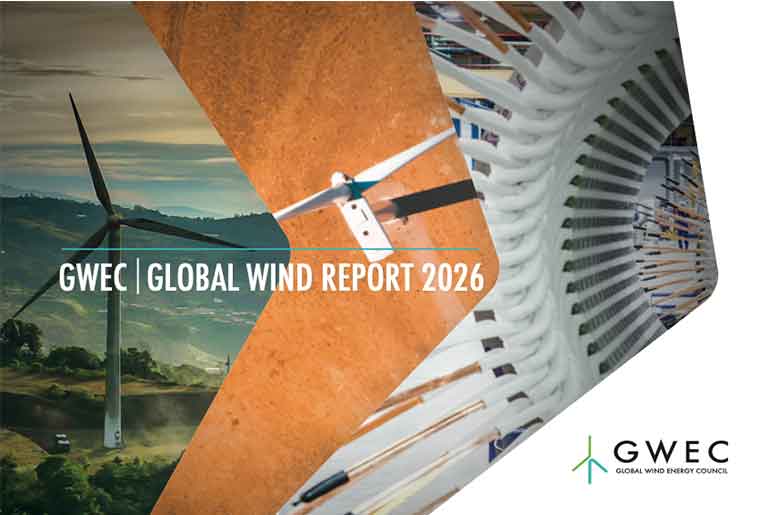
The global wind energy sector delivered a historic performance in 2025, with 165 GW of new installations, marking a 40% increase over the previous year and pushing total installed capacity to 1,299 GW, according to the Global Wind Report 2026 released by the Global Wind Energy Council (GWEC).
This record expansion highlights wind energy’s growing role as a reliable, scalable, and cost-competitive pillar of the global energy transition, particularly amid volatile fossil fuel markets and rising energy security concerns.
“The steep increase we have seen in global wind installations sets a new benchmark for an industry which is rapidly accelerating and responding to heightened demand for homegrown, affordable and resilient renewable energy,”
“At a time when skyrocketing oil and gas prices and supply shocks are once again causing disruption to economies around the world, the wind sector has demonstrated its ability to scale at speed. Accelerated growth led by Asia is enabling the rapid transition of fast-growing energy markets to electro-state economies, and showing that, where wind is built at scale, it can successfully compete with all alternatives, from coal to nuclear,”
said Ben Backwell, CEO of GWEC.
Wind Energy Expands Across 138 Countries with Record Installations
Wind energy deployment continued to broaden globally, with 138 countries now utilising wind power and 57 countries installing new wind turbines in 2025.
A total of 28,395 wind turbines were installed during the year, reinforcing the scale and industrial maturity of the sector.
The growth trajectory comes at a time when global energy systems are under pressure from supply disruptions and price volatility, further strengthening wind energy’s position as a domestic and resilient power source.
Asia Pacific Leads Wind Energy Growth, China and India Drive Installations
The Asia-Pacific region dominated global wind additions, contributing approximately 80% of total installations in 2025.
- China installed over 120.5 GW, accounting for the majority of global additions
- India added 6.3 GW, marking an 86% year-on-year increase, up from 3.4 GW in 2024
India’s strong growth places it among the top three global wind windmarkets, alongside China and the United States, and aligns with its broader renewable energy target of 500 GW non-fossil capacity by 2030.
The top five markets—China, the United States, India, Germany, and Brazil—accounted for 86% of total wind energy additions and nearly 75% of global installed capacity, reflecting concentrated growth driven by policy alignment and investment scale.
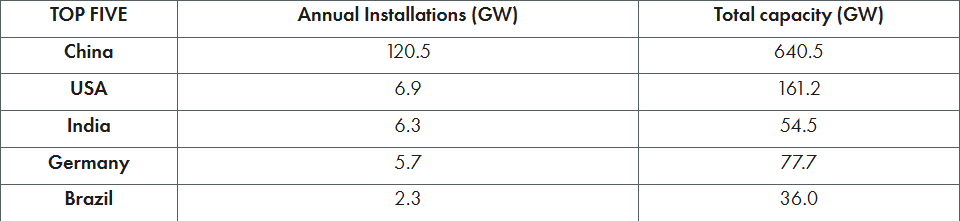
“A 40% phenomenal growth across 138 countries demonstrates the accelerating role of wind in the global energy transition. The top five markets – China, the United States, India, Germany and Brazil – accounted for 86% of new capacity additions in 2025 reflecting a powerful convergence of policy alignment, scale and investment.”
“These markets also represent nearly 75% of the world’s total installed wind capacity, reinforcing their leadership in shaping the future of the sector. With this sustained momentum, we are firmly on track to potentially surpass wind’s global potential of 2 TW by 2030.”
said Girish Tanti, Vice Chairman of Suzlon Group and Vice Chair of GWEC.
Onshore Wind Energy Dominates, Offshore Approaches 100 GW Milestone
Onshore wind remained the backbone of global expansion:
- 155.3 GW of onshore wind capacity added (up 42%)
- 9.3 GW of offshore wind capacity added (up 16%)
Global offshore wind capacity reached 92.3 GW, moving closer to the 100 GW milestone, with China leading installations and Europe continuing steady deployment.
China alone contributed over 110 GW of onshore wind, accounting for 73% of global onshore additions, underscoring its dominance across both segments.
Europe Crosses 300 GW, US Shows Recovery in Wind Energy Installations
Europe’s wind sector crossed a major milestone, with total installed capacity exceeding 300 GW, supported by 19.1 GW of new installations in 2025.
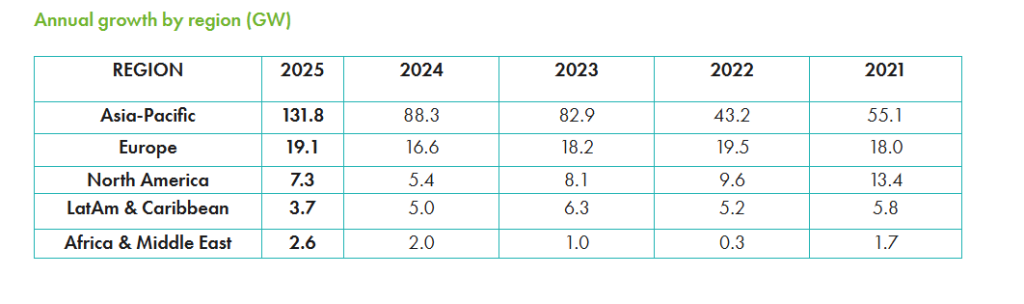
However, installation rates remain below the levels required to meet the European Union’s 2030 climate targets.
In the United States, onshore wind installations increased by nearly 7 GW, signaling a rebound after several years of slower growth.
Emerging markets also played a growing role:
- Africa and the Middle East recorded strong expansion, driven by South Africa and Saudi Arabia
- Saudi Arabia achieved a record-low wind tariff of $1.338/kWh, setting a new benchmark for cost competitiveness
Auction Slowdown and Grid Constraints Challenge Wind Energy Expansion
Despite record growth, structural challenges continue to impact wind deployment globally.
- Global onshore auction volumes declined to 32.8 GW in 2025, down 39% from 2024
- Permitting delays and grid infrastructure bottlenecks remain key constraints
These challenges are limiting the pace at which new wind projects can be commissioned, particularly in emerging markets.
“Even as the wind industry growth is accelerating, there is no escaping that global growth remains uneven, and the world is still not on track to triple renewables by 2030.”
“Bureaucratic red tape and slow roll-out of grids is stopping badly needed projects from being built in many areas of the world. However, by acting decisively to address the blockages, policymakers can quickly access a huge pipeline of ready to invest projects.” said Ben Backwell, CEO of GWEC
Wind Energy Outlook: 969 GW Additions Expected by 2030
Looking ahead, the wind sector is expected to maintain strong momentum.
- 969 GW of new wind capacity projected between 2026–2030
- Average annual installations expected at 194 GW
- Global capacity forecast to exceed 2 TW by 2029
While China is expected to contribute 63% of installations in the near term, growth is likely to diversify across Southeast Asia, Central Asia, and Africa & the Middle East by the end of the decade.
Wind Energy Strengthens Energy Security and Price Stability
Industry leaders emphasized that wind is not only a climate solution but also a strategic economic asset.
“Wind power set a new record in 2025… confirming that renewables-based electrification is already delivering clear results,” said Jorge Pedrón, Head of Global Power Business, Iberdrola.
“Wind is strengthening energy security, reducing price volatility, and providing a domestic, competitive, and sustainable source of energy,” he added.
The record-breaking expansion of wind in 2025 signals a decisive shift toward renewable-led power systems. However, the next phase of growth will depend on grid modernisation, faster permitting, and integration with storage technologies.
As global capacity moves toward the 2 TW milestone, wind energy is no longer just an alternative—it is becoming the foundation of future energy systems worldwide.
 Electrify your feed! Click here to join our Whatsapp group and to get the latest updates, expert insights, and innovations driving India’s energy storage revolution.