
NTPC’s termination of a 400 MWh BESS contract at Mouda is the latest reminder that India’s storage story is moving from tender announcements to the harder questions of pricing, contracts, execution and commissioning.
A battery storage tender can look very different on paper from what happens after the award.
The numbers are attractive. A utility announces hundreds of megawatts. Developers submit bids. A tariff is discovered. An award is issued. The project enters the pipeline.
And then comes the difficult part.
Someone has to procure the cells. The PCS has to arrive. The BMS and EMS have to work together. Containers have to be delivered. Civil and electrical works have to move. The grid connection has to be ready. Testing has to happen. Financing has to hold. And finally, the battery has to charge, discharge and actually serve the grid.
India’s BESS market is now entering this uncomfortable but necessary phase.
On September 19, 2026, NTPC terminated the ₹413.37-crore contract awarded to G R Infraprojects for a 400 MWh BESS at Mouda Super Thermal Power Station in Maharashtra. NTPC said the contractor had failed to meet contractual obligations and required project progress after significant delays in critical activities. The company said it had encashed securities worth approximately ₹91 crore and had initiated steps to re-tender the project.
That is not the same thing as cancelling a tender.
And that distinction is exactly where the larger story begins.
Because BESS tender cancellations are only one part of a much bigger problem: the distance between storage capacity that is announced, capacity that is awarded, capacity that is under construction, and capacity that is actually available to the grid.
India is learning that those are four very different numbers. The BESS pipeline is growing. So is the list of projects that changed course. The scale of India’s storage procurement is no longer in doubt.
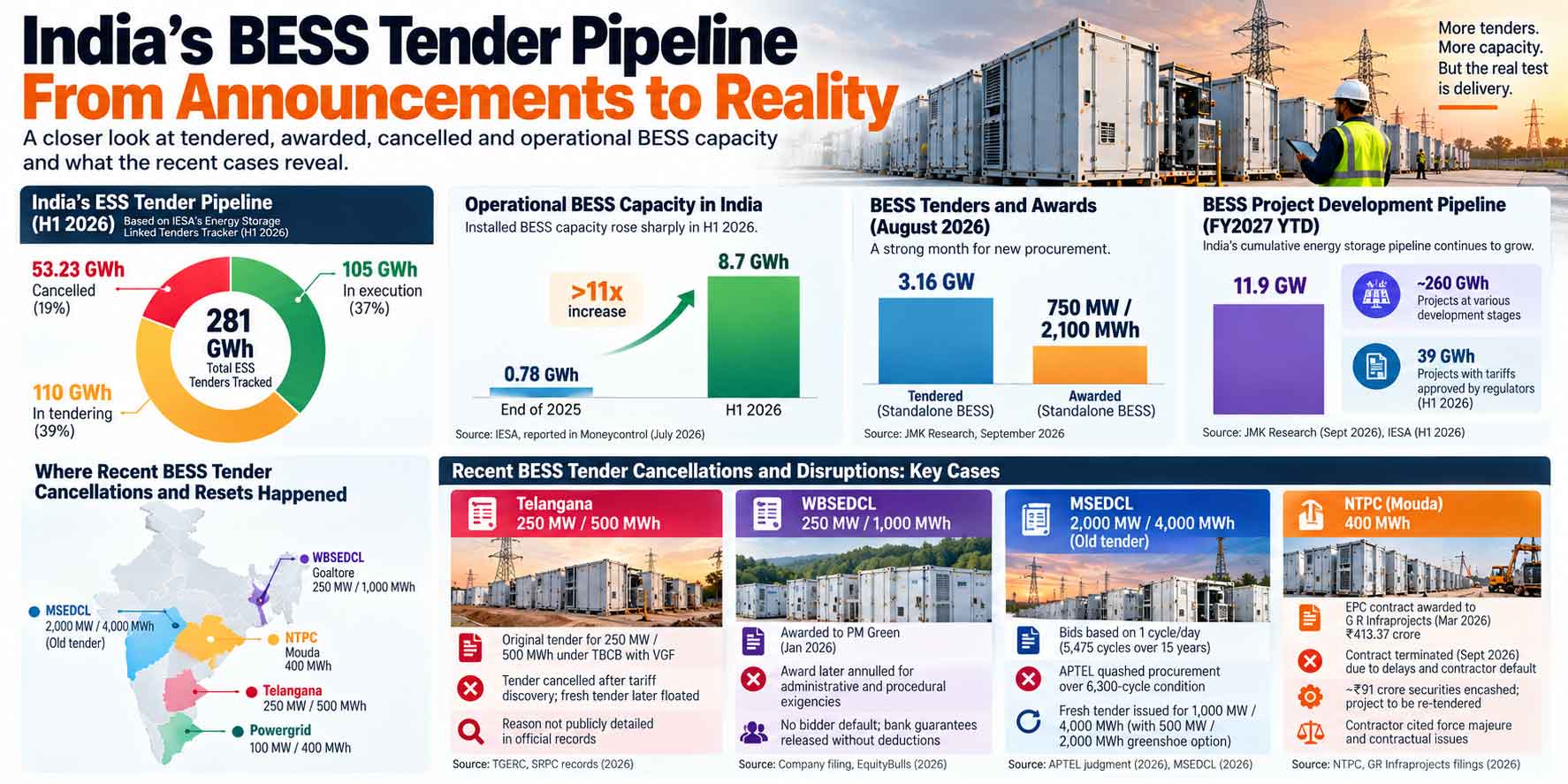
The India Energy Storage Alliance’s H1 2026 Energy Storage Linked Tenders Tracker recorded 281 GWh of ESS capacity across the tenders it had tracked. Of this, 105 GWh was in various stages of execution, 110 GWh remained in the tendering process and 53.23 GWh had been cancelled across 37 tenders. The tracker showed 8.52 GWh of BESS operational at H1 2026.
The numbers need to be read carefully.
The 53.23 GWh figure is ESS tender capacity tracked by IESA, not a claim that India cancelled 53.23 GWh of BESS projects during 2026 alone. It includes different storage technologies and procurement stages in IESA’s linked-tender database.
Still, the number tells us something important.
A sizeable part of the procurement pipeline does not move in a straight line from tender to commissioning. And 2026 has produced several examples. Some tenders were cancelled or annulled after tariff discovery. Some were affected by regulatory proceedings. Some were cancelled for administrative reasons. And in the latest NTPC case, the tender had already crossed the procurement stage and reached an EPC contract before the contract itself was terminated.
That is a very different problem.
First, let us separate a cancelled tender from a failed project. This distinction matters more than it may appear.
When people hear that a BESS tender has been cancelled, it is easy to put every case into one bucket.
But there are several points at which a storage project can fall out of the pipeline.
A tender can be cancelled before award. An award can subsequently be annulled. A regulatory order can overturn a procurement process. A contract can be terminated after award. Or a project can technically remain awarded but move slowly because of financing, contracting, supply-chain or implementation problems.
These situations have different causes and different consequences.
The March 2026 Power Grid Corporation of India notice provides a straightforward example. Powergrid annulled the bidding process for its 100 MW/400 MWh BESS package in Tamil Nadu, part of a larger 375 MW/1,500 MWh standalone BESS programme. The notice, dated March 13, 2026, says the bidding process was annulled under Clause 8.0 of the invitation for bids; it does not state a specific commercial reason in the notice.
That last point is important.
Not every cancellation has a publicly stated explanation.
An analyst should resist the temptation to fill that gap with assumptions about tariffs, battery prices or bidder behaviour.
The public record should lead the story.
Three different cancellations, three different lessons
The first half of 2026 also produced a useful cluster of cases that show why BESS tender cancellations cannot be explained with one reason. IESA’s H1 2026 tracker recorded 37 cancelled ESS tenders. The Battery Magazine’s H1 market review, drawing on industry tender data, identified three prominent tender reversals in the first six months: a Telangana 250 MW/500 MWh tender, a WBSEDCL 250 MW/1,000 MWh tender and the MSEDCL 2,000 MW/4,000 MWh procurement that was subsequently overturned by APTEL.
Telangana: the tender that was later re-floated
TGGENCO’s original procurement was for 250 MW/500 MWh of standalone BESS, under tariff-based competitive bidding with VGF support and a BOO model. Telangana regulatory documents confirm the project structure and the original 2025 RfS.
The Southern Regional Power Committee’s 2026 records subsequently noted that the 500 MWh BESS tender had been cancelled and a fresh tender floated. The same record describes a separate 1,500 MWh plan at Maheswaram and Choutuppal.
This is an important pattern. Cancellation does not always mean that the requirement has disappeared. Sometimes the requirement comes back in another form. The storage need remains. The procurement mechanism changes. That is very different from a project being permanently abandoned.
West Bengal: when the bidder was not blamed
The WBSEDCL case is even more revealing.
WBSEDCL had awarded a 250 MW/1,000 MWh standalone BESS project at Goaltore to PM Green Private Limited, a wholly owned subsidiary of the Power Mech group. The Letter of Award was issued on January 8, 2026.
The procurement was later annulled. But the explanation matters. The cancellation was attributed to administrative and procedural exigencies arising from circumstances beyond the control of either party. The company disclosure also stated that the decision was not due to bidder default or non-compliance. The bid security and performance bank guarantee were released without deductions.
This case tells us something that is easy to miss when discussing BESS tender cancellations. A cancelled project does not automatically mean that the developer failed. Sometimes the procurement process itself changes.
And when that happens, the commercial impact travels beyond the utility. The developer has spent time bidding, planning and preparing for execution. The utility has to return to procurement. The grid does not receive the expected storage on the original schedule.
Everyone moves backwards, even when no bidder has technically defaulted.
MSEDCL shows how one changed requirement can unsettle an entire procurement
Then comes perhaps the most important case for understanding India’s evolving BESS procurement architecture.
MSEDCL’s original RfS sought 2,000 MW/4,000 MWh of BESS.
The original procurement documents provided for two-hour discharge and initially specified two cycles per day. An addendum subsequently changed the requirement to one cycle per day, or 5,475 cycles over the 15-year contract period.
Financial bids were opened in November 2025. The lowest tariff under the final allocation was ₹1,65,998/MW/month, with 2,000 MW/4,000 MWh ultimately allocated at that rate.
Then another condition entered the picture.
The Ministry of Power’s December 31, 2025 approval of the revised cycling requirement required MSEDCL to retain the contractual right to use the BESS for at least 6,300 cycles during the contract period without additional cost.
That created a dispute over whether a condition introduced after bidding materially changed the basis on which bidders had submitted their offers.
On June 5, 2026, the Appellate Tribunal for Electricity dealt with the matter. Its judgment records the bidding history, the 5,475-cycle basis and the later 6,300-cycle condition.
The result was consequential: the procurement process was set aside.
This is not simply a story about a cheap tariff. It is a story about procurement certainty. A BESS developer does not price only the battery. It prices how often the battery will be used, how much energy it will have to move, what degradation it must manage, what availability it must guarantee and how long it must perform.
Change those assumptions and the economics can change too.
That is why procurement documents have to be extremely clear before the financial bid is opened. Then came
NTPC Mouda — and the problem moved beyond tendering
The NTPC case is different. There was no unresolved bidding process sitting on the table. The contract had already been awarded. On March 28, 2026, G R Infraprojects disclosed that it had received NTPC’s Notification of Award for the EPC package for BESS implementation at Mouda. The project covered a 400 MWh BESS, including design, supply, installation and comprehensive annual maintenance for the design life. The contract value was ₹413.37 crore excluding GST, with an execution period of 15 months from the appointed date.
Six months later, NTPC terminated the contract.
NTPC’s September 19 statement says critical activities had experienced significant delays and that GRIL failed to take the required corrective measures after contractual notice. NTPC said approximately ₹91 crore in available securities had been encashed and that it would re-tender the project at the contractor’s risk and cost.
But there is another side that should not be ignored.
G R Infraprojects had disclosed its own position in relation to the contract, including issues it associated with force majeure and war-risk circumstances. So the responsible way to report the episode is not to declare a broader conclusion about the contractor. The fact that can be established is simpler:
NTPC says contractual obligations and required progress were not achieved, and it terminated the contract.
And now a 400 MWh project that had already passed through the tender and award stages is going back into procurement.
That is the difference between a tender problem and an execution problem.
The price problem is becoming harder to ignore
There is another thread running through several of these cases. Battery storage prices have changed quickly.
In its H1 2026 review, IESA reported that tariffs for two-hour, two-cycle BESS without VGF were averaging around ₹3.35 lakh/MW/month during the first half of 2026, higher than the levels seen in 2025.
Industry commentary has become more cautious since then.
A July 2026 report citing IESA said India’s battery-storage tariffs were expected to rise as higher input costs put pressure on low-priced projects. It reported that installed BESS capacity had risen more than elevenfold to around 8.7 GWh in H1 2026 from 0.78 GWh at the end of 2025. The same report said about 260 GWh of storage projects were at various stages of development.
IESA President Debmalya Sen was quoted saying that standalone BESS tariffs had fallen sharply on expectations that battery-cell costs would continue declining, while rising costs had raised questions about how many projects would remain viable.
That is where aggressive tariff discovery becomes important. A low tariff looks attractive when a project is being awarded. But a BESS contract can run for many years. The developer still has to buy cells, maintain the system, manage degradation, replace or augment equipment where required, maintain availability and meet the contractual performance requirements. A tariff that looked competitive when the bid was submitted can become difficult if the underlying cost assumptions move sharply. This does not mean every low tariff will fail.It means the market has to distinguish between price discovery and sustainable price discovery.
India is still building — and building fast
This is where the story needs balance. It would be wrong to look at BESS tender cancellations and conclude that India’s storage market is slowing down or failing. The evidence does not support that.
In fact, the market is expanding.
IESA’s H1 2026 review recorded 47 GWh of ESS tenders floated between January and June, including 22 GWh of BESS tenders from the NTPC group. It also reported 18 GWh of ESS awards during the first half and 39 GWh of projects with tariffs approved by regulators.
The same review estimated that India’s commissioned BESS capacity increased from 0.78 GWh at the end of 2025 to 8.7 GWh by H1 2026, with around 7.1 GWh added to the grid during the first half, much of it through merchant BESS projects.
The Central Electricity Authority is also tracking BESS development and deployment on a continuing basis, with project-status updates published through July 2026.
So this is not a story of a market disappearing. It is a story of a market maturing under pressure. And maturity often means discovering where the weak points are. The most revealing number is not tendered capacity
This may be the biggest lesson from the 2026 data.
For years, the easiest way to describe India’s emerging BESS market was through announced capacity.
A utility tendered 500 MWh.
Another tendered 2 GWh.
Another announced 4 GWh.
The numbers added up quickly.
But there is a difference between a battery that appears in a tender tracker and one that is available to the grid.
IESA’s H1 2026 tracker puts that difference into perspective.
Of the 281 GWh of ESS capacity tracked, 105 GWh was in various stages of execution, 110 GWh was still in tendering and 53.23 GWh was cancelled. Only 8.52 GWh of BESS was listed as operational at H1 2026.
Again, these categories should not be read as a single pipeline where every gigawatt-hour must eventually become operational.
But they demonstrate why BESS tender cancellations deserve attention. The procurement number is only the beginning. The more meaningful chain is:
Tendered → Awarded → Contracted → Under construction → Commissioned → Available to the grid.
Every arrow matters.
And Maharashtra has already shown what happens next
The MSEDCL story is not ending with the tribunal order. On September 24, 2026, MSEDCL issued a fresh tender for procurement of energy for five years through 1,000 MW/4,000 MWh of BESS, with a 500 MW/2,000 MWh green-shoe option, under tariff-based competitive bidding to meet its Energy Storage Obligation. MSEDCL
That is significant.
The storage requirement did not disappear because the previous procurement process was overturned.
The utility has gone back to the market.
The new procurement therefore becomes a real-world test of whether lessons from the earlier process have been incorporated into the new structure.
And that may be the more useful way to look at BESS tender cancellations.
Not every cancellation is an endpoint. Sometimes it is a reset.
The question is whether the reset produces a better procurement structure — one that can survive regulatory scrutiny, remain commercially workable for developers and ultimately deliver the storage the grid needs.
What is really behind India’s BESS tender cancellations?
There is no single answer. And the 2026 examples show why.
Procurement design
MSEDCL demonstrates how technical and contractual requirements such as cycling assumptions can have major consequences for bid economics.
Administrative decisions
The WBSEDCL case shows that an award can be annulled for administrative or procedural reasons even when the bidder is not accused of default.
Tender-process decisions
Powergrid’s Tamil Nadu BESS package shows that a bidding process can be annulled before it reaches the award stage, while the public annulment notice itself may not disclose the specific reason.
Commercial pressure
Rising battery and input costs can challenge assumptions behind aggressive bids. Industry data cited by IESA points to this pressure becoming more visible in 2026.
Execution
NTPC Mouda shows the next risk: even after procurement is completed and a contract is awarded, the project still has to be built.
That last point may become increasingly important as BESS projects get larger.
The industry now needs to track delivery, not just tenders
India has done the first difficult thing. It has created a market for utility-scale storage. Government support through VGF, procurement by central and state agencies, storage obligations and increasing renewable penetration are creating demand.
The next challenge is different.
- Can the market execute?
- Can developers build at the tariffs they bid?
- Can utilities design contracts that accurately reflect how BESS will be used?
- Can procurement conditions remain stable?
- Can financing survive changes in battery prices?
- Can EPC contractors manage increasingly large projects?
And can projects move from award letters to actual commissioning without repeatedly returning to the tender table?
These questions are not arguments against BESS.
They are questions that become unavoidable when BESS becomes infrastructure rather than an emerging technology.
The next BESS race is not for the lowest tariff
There was a time when the biggest headline from a BESS tender was the tariff. The lowest number naturally attracted attention. But the events of 2026 suggest that another metric deserves equal attention:
delivery.
A tariff of ₹1.65 lakh/MW/month looks impressive in a tender document. A 400 MWh contract worth ₹413.37 crore looks impressive when the award is announced. A 2,000 MW/4,000 MWh procurement looks enormous when the bids are opened. But the grid ultimately needs something much simpler. A working battery. That is why India’s storage story should now be read beyond tender announcements. The country needs to know how much capacity is tendered, yes.
But also how much is awarded.
How much reaches construction.
How much reaches commissioning.
And how much is actually available when the grid needs it.
The NTPC Mouda episode is therefore bigger than one terminated contract.
The Powergrid annulment, the WBSEDCL reset, the MSEDCL regulatory dispute and the wider numbers tracked by IESA all point to the same transition: India’s BESS market is moving from a procurement story to a delivery story.
And that may be the most important change yet.
Because India has already shown that it can tender batteries at scale.
The next test is whether those batteries can survive the journey from a tender document to the grid.
 Electrify your feed! Click here to join our Whatsapp group and to get the latest updates, expert insights, and innovations driving India’s energy storage revolution.