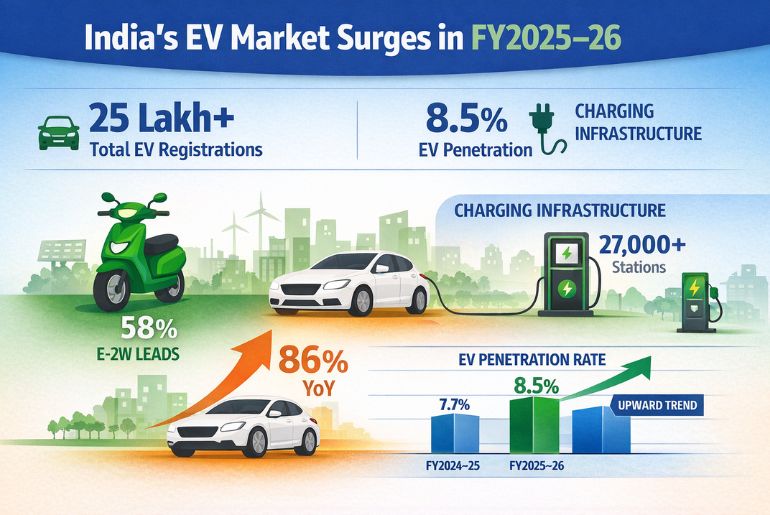
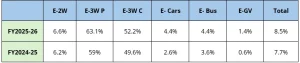
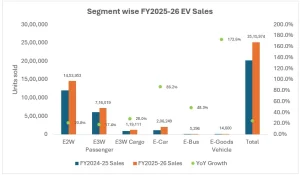
The number of electric vehicles (EVs) registered in India continued to rise in FY2025–26, reaching more than 25 lakh units, a 24% increase from the previous year. EVs made up about 8.5% of all vehicle registrations, up from 7.7% in the previous fiscal year. Even though things are getting better, the market still isn’t close to the government’s long-term goal of having 30% of cars be electric by 2030.
Segment-Wise Growth Trends
Growth across EV segments varied, with each category driven by different factors:
- Electric two-wheelers (E-2W): Continued to dominate the market, accounting for nearly 58% of total EV sales.
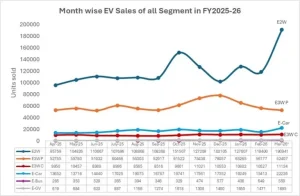
- Electric three-wheelers – Passenger (E-3W P): Reached a peak of 78,057 units in December 2025, supported by mandatory e-rickshaw registrations in West Bengal. Sales declined afterward as PM E-Drive incentives for the L5 category were exhausted.
- Electric three-wheelers – Cargo (E-3W C): Recorded steady growth, driven by total cost of ownership (TCO) advantages for last-mile delivery operations.
- Passenger EVs (E-cars): Emerged as the fastest-growing segment with an 86% year-on-year increase, despite being excluded from PM E-DRIVE purchase incentives, indicating strong organic demand.
- Electric goods vehicles (E-GV): Witnessed a sharp 172% year-on-year growth, with penetration rising to 1.4% from 0.6% in FY2024–25. This was driven by the inclusion of e-trucks under PM E-DRIVE incentives and increasing fleet electrification by logistics and e-commerce companies.
Table 1: % EV Penetration YoY Growth
Key Market Trends
- Legacy OEMs such as TVS Motor, Bajaj Auto, and Hero MotoCorp collectively held 61% of the electric two-wheeler market, supported by strong dealer networks, after-sales service, and brand trust.
- In the passenger EV segment, Tata Motors remained the market leader, though its share declined from around 57% to 39% due to rising competition from JSW MG Motor, Mahindra, and Hyundai.
- New entrants such as VinFast and Maruti Suzuki intensified competition, especially in the ₹12–25 lakh segment, a key category for urban SUV demand.
- Charging infrastructure expanded significantly, with public charging stations exceeding 27,000 by March 2026, improving EV usability for both city and highway travel.
Record-Breaking March 2026
March 2026 recorded the highest-ever monthly EV registrations at 2.8 lakh units. This surge was driven by year-end discounts, anticipation of price increases, and increased fleet procurement. Many buyers also rushed to avail benefits under the PM E-Drive scheme before incentive deadlines.
Outlook for FY2026–27
The strong performance in FY2025–26 gives us a solid base for more growth. By FY2026–27, the number of electric vehicles on the road is expected to be between 9.5% and 10%. Extended PM E-DRIVE deadlines for electric two-wheelers and three-wheelers (L3 category), as well as ongoing improvements in charging infrastructure, domestic manufacturing, financing options, and new product launches, back up this outlook.
 Electrify your feed! Click here to join our Whatsapp group and to get the latest updates, expert insights, and innovations driving India’s energy storage revolution.