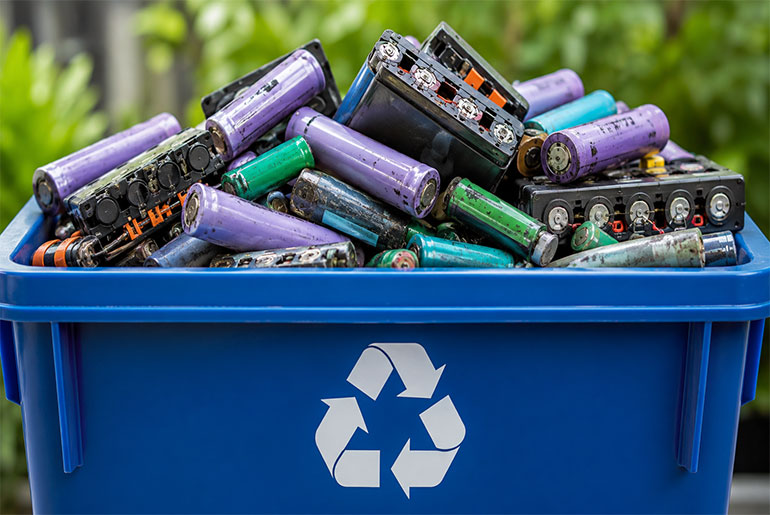
The lithium battery recycling process may sound like a technical subject reserved for scientists and engineers, but in reality, it is becoming one of the most important conversations shaping India’s clean energy future. Before we understand how old batteries are dismantled, processed, and transformed into valuable materials again, it is worth asking a far more fundamental question: why has lithium become so important?
Take a moment and look around. The electric scooter weaving through city traffic, the smartphone charging beside the bed, the electric car silently cruising down a highway, and even the battery energy storage systems supporting solar and wind projects all share a common thread. Hidden within each of them is lithium—a metal that has quietly become the backbone of the modern energy transition.
For the last 10 years, lithium’s evolution has been incredible. From being a small-scale business material to now being a central player in the global competition among countries, car manufacturers, battery makers, and energy companies; billions of dollars are being spent by governments to ensure that they have enough critical minerals available; multiple gigafactories have been announced on every continent and energy storage projects are being pursued like never before. With all the movement surrounding lithium, it is important to understand at the core of the reason for all this excitement about lithium – batteries require lithium.
India is no exception. The country is rapidly embracing electric mobility, expanding renewable energy capacity, and building the foundations of a domestic battery manufacturing ecosystem. Yet beneath this growth lies a question that will define the next chapter of India’s battery story: where will all the lithium come from?
The answer may not lie only in mines, new discoveries, or overseas supply agreements. Increasingly, it may also lie in the batteries that have already completed their first life. To understand why, we must first understand the scale of the battery revolution unfolding across India.
India Is Not Building a Battery Market. It Is Building a Battery Economy
To understand why the lithium battery recycling process is gaining importance, we need to first understand the scale of India’s ambition on batteries.
Batteries still have strong associations with electric vehicles for many. EVs are still a big growth driver, but the reality is much bigger. Batteries are quickly emerging as the backbone for a wide range of industries, driving everything from mobility and consumer electronics to renewable energy integration and grid-scale storage.
These numbers show how fast this transformation is happening.
NITI Aayog, in its assessment on Advanced Chemistry Cell (ACC), has projected that India’s battery demand may reach nearly 260 GWh by 2030 in an accelerated growth case. To put this in context, to meet such demand would require the equivalent of around 26 gigafactories, each producing 10 GWh per year. This is not the growth of one industry, it is the birth of a new industrial ecosystem.
Industry estimates cited by the Institute for Energy Economics and Financial Analysis (IEEFA) based on projections from India Energy Storage Alliance (IESA) indicate that India’s ACC battery demand could increase from around 28 GWh in 2025 to around 272 GWh by FY2030. The curve is even steeper beyond 2030. Total lithium-ion battery demand across multiple applications is estimated by IESA to be more than 500 GWh.
What makes these numbers particularly significant is that electric vehicles are only one part of the story.
India’s renewable energy transition is creating another powerful source of battery demand. As solar and wind installations continue to grow, the need for energy storage is increasing just as rapidly. According to the National Electricity Plan, India could require around 74 GW / 411 GWh of energy storage capacity by 2032, of which nearly 236 GWh is expected to come from Battery Energy Storage Systems (BESS).
Pause for a moment and consider what that means.
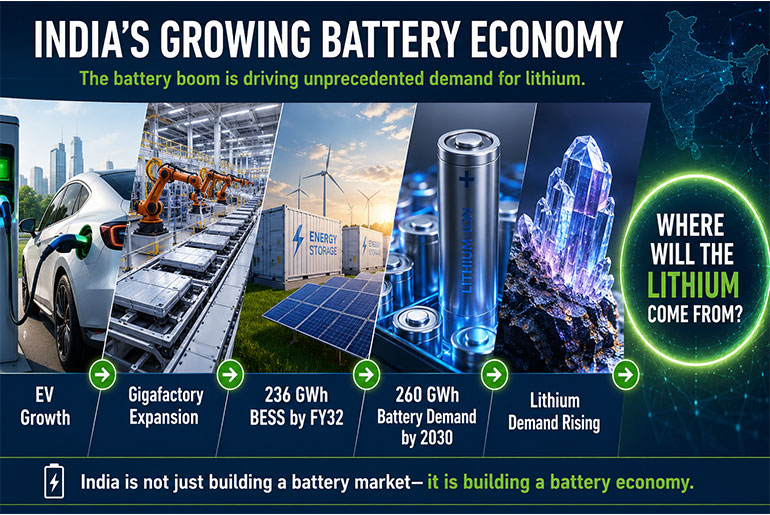
Batteries were for years mostly seen as a mobility solution. Today they are becoming an integral part of India’s energy infrastructure. They’re no longer just helping vehicles move – they’re helping renewable energy flow reliably through the grid.
This changes the conversation about lithium fundamentally.
It’s not just about EV batteries when it comes to lithium. Two of the most important transitions in India are electric mobility and energy storage. They are becoming imperative to happen together.
And every battery requires materials.
Research by WRI India highlights the scale of this challenge. The organization estimates that producing 100 GWh of lithium-ion batteries could require approximately 193,000 tonnes of cathode active material (CAM) annually by 2030. These materials include lithium alongside other critical minerals such as nickel, cobalt, manganese, and graphite.
In simple terms, every gigafactory announced in India increases demand not only for batteries but also for the materials inside them.
The pressure is already beginning to show.
According to an analysis by the Observer Research Foundation (ORF), India’s demand for critical minerals—including lithium, cobalt, nickel, and manganese—could exceed 250 kilotonnes by 2030. As battery manufacturing scales, securing these resources will become just as important as building factories or deploying charging infrastructure.
This is why experts increasingly argue that India is not merely building a battery market—it is building a battery economy.
An economy where EV manufacturers need batteries.
Battery manufacturers need lithium.
Energy storage developers need battery cells.
Gigafactories need critical minerals.
And the entire ecosystem depends on a stable supply of resources.
Every electric vehicle sold.
Every gigafactory announced.
Every BESS project commissioned.
Every gigawatt-hour of storage deployed.
Ultimately leads back to the same question:
Where will the lithium come from?
India’s Lithium Challenge: Building Batteries Without Enough Lithium
India’s EV and gigafactory boom faces a huge roadblock: no domestic lithium. The country has been heavily dependent on battery material imports for years, leaving its ambitious clean energy transition highly susceptible to global price fluctuations, shipping disruptions, and geopolitical tensions.
The vulnerability is only worsened by the global playing field. A handful of countries dominate the market – Australia, Chile and Argentina own the raw reserves, with China enjoying near-monopoly on refining and processing. India’s huge gigafactories are useless without a secure, steady supply of critical minerals like lithium, cobalt and nickel to feed them.
That’s why the discovery of lithium deposits in Jammu and Kashmir was such a big deal. It is a rare ray of hope for resource independence that could provide India with the domestic foundation to secure its energy future and compete on the global stage.
However, discovering lithium and producing battery-grade lithium are two very different milestones.
A mineral discovery must still move through detailed exploration, resource validation, environmental clearances, mining development, processing infrastructure, refining capabilities, and commercial production before it can support large-scale industrial demand. Even under favourable conditions, developing a complete lithium value chain is a long-term process rather than an immediate solution.
There is another reality that is often overlooked in discussions about critical minerals.
Mining alone cannot solve India’s lithium challenge.
Even if domestic mining does develop in future, the growth in battery demand will require multiple sources of supply. India’s battery future will continue to depend on a mix of international partnerships, domestic resource development, material processing capabilities and circular economy solutions.
This is where the conversation begins to shift.
Because while India may not control all global lithium reserves, it is steadily creating another source of lithium within its own borders.
Every electric vehicle battery sold today will eventually reach the end of its useful life. Every battery deployed in an energy storage system will one day require replacement. Every battery-powered device entering the market is also becoming a future source of recoverable materials.
In other words, India is not only building battery demand—it is also building a future reservoir of lithium.
The question is whether those materials will be lost as waste or recovered and returned to the supply chain.
That is precisely why the lithium battery recycling process is attracting growing attention across the industry. Experts are increasingly seeing recycling not as a waste-management activity but as a strategic route to recovering valuable materials, strengthening resource security and supporting a more resilient battery ecosystem.
And as millions of batteries end their first life in the coming years, recycling could become one of the most practical tools for India to secure the lithium needed for the next phase of its growth.
The Lithium Battery Recycling Process: Following the Journey of a Battery
Now we know why lithium is so important for India’s battery future. We see, too, why recycling is becoming a strategic imperative, not a waste management activity. The next question is easy:
What really happens when a battery gets to the end of its life?
To answer that, let’s follow the journey of a lithium-ion battery from an electric vehicle, energy storage system or electronic device to a recycling facility.
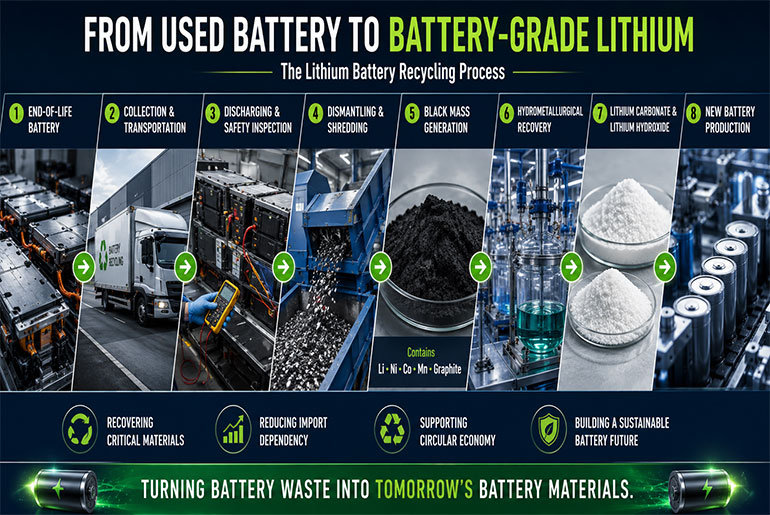
The lithium battery recycling process starts long before any metal is recovered. In fact, the process begins when an end-of-life battery enters a collection network.
Collection & Transport: Safe Beginnings
The recycling journey starts with collecting old batteries from EVs, phones, and grid storage. Thanks to India’s Battery Waste Management Rules, companies are finally moving this process into safer, formal channels.
It sounds simple, but transport is actually high-risk. Dead batteries often still hold a residual charge. They can short-circuit and catch fire if punctured or crushed in transit. That’s why they must be carefully packed, labelled and shipped under strict safety rules before ever reaching a recycling facility.
Inspection & Discharging: Eliminating the Risks
Just because a battery can no longer power a car doesn’t mean it’s completely dead.
The very first step at the facility is fully discharging any leftover energy so the battery is completely safe to handle. Next, workers inspect the packs. If a battery still has decent health, it might get a second life as stationary backup storage for solar power or homes. If it’s truly spent, it moves forward to the teardown phase to recover its valuable metals.
Modern lithium-ion batteries are complex, highly engineered systems with many parts. For example, an electric vehicle battery consists of battery packs, modules, cells, electronic control systems, cooling components, copper wiring, aluminium casings and different structural materials. These batteries are carefully taken apart at recycling facilities. Valuable components such as aluminium, copper, steel and plastics are recovered for reuse.
Next, the battery cells are mechanically processed by crushing or shredding systems to break them down to smaller fractions. This may sound like a destructive process, but this is actually where recyclers start to unlock the materials hidden inside the battery.
And that makes one of the most valuable products in the whole recycling chain.
Black Mass The Material Everyone Craves
After shredding and mechanical separation, recyclers are left with a dark powdery material called black mass . To the uninitiated, black mass can appear as normal dust. Indeed, it is one of the most valuable products that come out of the lithium battery recycling process.
Black mass contains many of the critical materials battery makers use, such as lithium, nickel, cobalt, manganese and graphite. These are the same materials that enable today’s lithium-ion batteries. This is why black mass has become such an important commodity within the recycling industry. Around the world, specialized processors and Black Mass Recovery Companies are investing heavily in technologies designed to extract maximum value from this material.
In many ways, black mass acts as the bridge between battery waste and battery manufacturing.
The challenge now is separating these valuable materials and recovering them in a form that can be used again.
Recovering Lithium: Where Science Meets Sustainability
This is the stage where chemistry takes centre stage.
Most leading Battery Recycling Companies in India are increasingly investing in hydrometallurgical recycling technologies to recover valuable materials from black mass. Compared with traditional high-temperature recycling methods, hydrometallurgy generally offers higher recovery rates and better lithium recovery potential.
The process begins with what recyclers call leaching.
The black mass is leached with carefully controlled chemical solutions which convert the valuable metals into liquid form. Once these materials are dissolved, they go through a number of purification and separation steps to isolate individual elements such as lithium, nickel, cobalt and manganese.
Recyclers use advanced techniques, such as filtration, solvent extraction and precipitation, to achieve the high levels of purity required by battery producers.
This step is widely considered as the technological core of lithium battery recycling as it establishes how efficiently valuable materials can be recovered and re-integrated into the supply chain.
From Waste to Battery-Grade Materials
The aim of recycling is not just to recover metals, but to create materials that can be used to make new batteries.
The lithium recovered is often converted to battery grade compounds such as lithium carbonate and lithium hydroxide, both of which are major ingredients in modern battery manufacture .
Then the circular economy is more than just an idea.
Lithium used to power an electric vehicle can now help create another battery. Materials now thought of as waste are converted into resources that are ready to re-enter the manufacturing ecosystem.
This ability to recover and reuse important materials is exactly why the lithium battery recycling process is becoming a matter of strategic importance around the world.
The implications for India are far greater than waste management. By recovering each kilogram of lithium through recycling, we can help decrease reliance on imported materials, fortify domestic supply chains and bolster the nation’s growing battery economy.
As more batteries reach the end of their first life in the coming years, the importance of the process will only continue to grow.
The Future of Lithium Recycling in India
For many decades, recycling of batteries was largely considered as a waste-management activity. But it could become one of the most important pillars supporting India’s battery economy in the coming years.
The reason is the sheer size of what is coming.
India’s electric vehicle market is growing in two-wheelers, three-wheelers, passenger vehicles and commercial fleets. Simultaneously, Battery Energy Storage Systems (BESS) are increasingly becoming a critical component of the country’s renewable energy infrastructure. Together, these sectors will be churning out millions of batteries that will one day be at the end of their useful life.
What appears to be a challenge is also a big opportunity.
Industry estimates suggest India could have a recycling potential of close to 128 GWh of lithium-ion batteries by 2030. Meanwhile, projections show more than 1.2 million EV batteries could need to be recycled annually by the end of the decade. These batteries are increasingly being seen not as waste but as a valuable reservoir of lithium, nickel, cobalt, manganese, graphite, copper and aluminium by the industry.
This opportunity is fuelling investment throughout the recycling value chain.
Several Battery Recycling Companies in India are already building advanced capabilities in lithium-ion battery recycling, black mass processing, hydrometallurgical recovery, and battery-grade material production. Companies such as Attero, Lohum, RecycleKaro, BatX Energies, Gravita, and other emerging players are helping create the infrastructure needed to support a circular battery economy.
They are not just looking to process waste batteries.
The idea is to recover the valuable materials, process them in India and bring them back to the manufacturing ecosystem where they can be reused in new batteries. This is, in many ways, the evolution of recycling from an environmental responsibility to a strategic industrial activity.
The growth of EV Battery Recycling Market India is expected to further accelerate the shift. As collection networks improve, recycling technologies mature and Battery Waste Management Rules continue to strengthen the formal ecosystem, higher volumes of end-of-life batteries are expected to enter organised recycling channels.
The future will also see more focus on black mass recovery which is emerging as one of the most valuable sectors of the recycling industry. As more batteries are recycled, specialised processors and Black Mass Recovery Companies are expected to play a growing role in extracting critical minerals and feeding them back into battery manufacturing supply chains.
Perhaps most remarkable about this transformation is the way it changes the way we think about resources.
For years lithium was regarded primarily as a material that had to be dug up from the earth. Today, the industry is starting to see another source – used batteries. This idea of urban mining could change how countries secure critical minerals in the future.
India’s battery dreams are rising fast. Demand for batteries is increasing, gigafactories are being planned, needs for renewable energy storage are increasing and the need for critical minerals is growing. A combination of mining, global partnerships, domestic processing and recycling will be needed to meet these demands.
Of these solutions, recycling provides something special.
It recovers and reuses valuable materials already within the economy reducing waste, whilst strengthening resource security.
Conclusion
For years lithium was regarded primarily as a material that had to be dug up from the earth. Today, the industry is starting to see another source – used batteries. This idea of urban mining could change how countries secure critical minerals in the future.
India’s battery dreams are rising fast. Demand for batteries is increasing, gigafactories are being planned, needs for renewable energy storage are increasing and the need for critical minerals is growing. A combination of mining, global partnerships, domestic processing and recycling will be needed to meet these demands.
Of these solutions, recycling provides something special.
It recovers and reuses valuable materials already within the economy reducing waste, whilst strengthening resource security.
 Electrify your feed! Click here to join our Whatsapp group and to get the latest updates, expert insights, and innovations driving India’s energy storage revolution.