In a major push to fast-track India’s decentralised renewable energy transition, officials from the Ministry of New and Renewable Energy (MNRE) conducted a high-level review meeting in Bengaluru, Karnataka, to assess and accelerate the implementation of flagship schemes including PM-KUSUM and PM Surya Ghar.
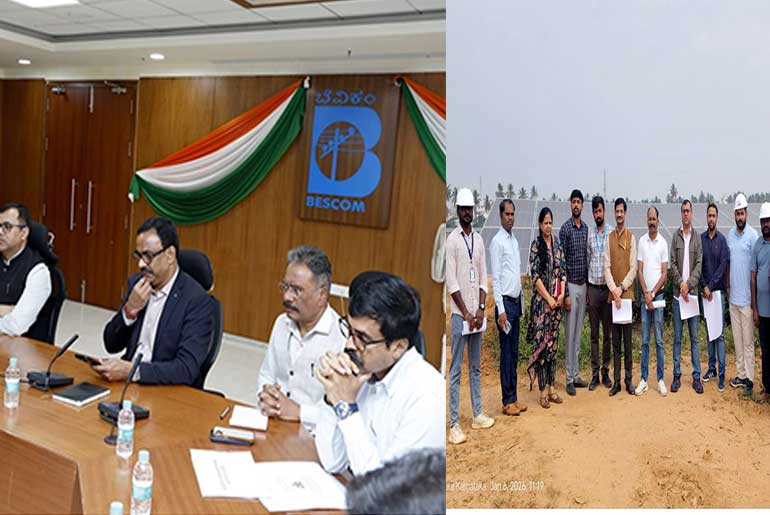
The review was led by senior MNRE officials, including Aditya P. Singh, Director, MNRE, and was attended by key state government representatives and officials from BESCOM. Discussions focused on addressing execution challenges, improving inter-agency coordination, and scaling deployment timelines to maximise on-ground impact across Karnataka.
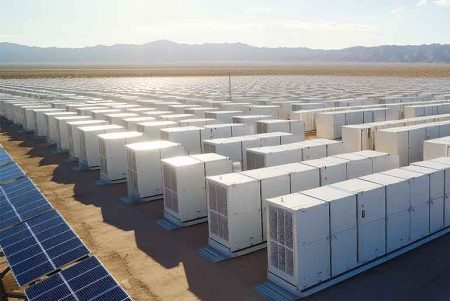
As part of the visit, the MNRE delegation toured BESCOM’s rooftop solar-powered electric vehicle (EV) charging station in Bengaluru, which is supported by second-life battery energy storage. The project demonstrates an integrated clean-energy model—combining rooftop solar, energy storage reuse, and EV charging—to reduce grid dependency while extending the usable life of batteries. Such pilots align with India’s broader goals of circular energy systems and grid flexibility.
The team also visited the 8.4 MW solar power plant at the Sulibele substation, developed under PM-KUSUM Component-C (Feeder Level Solarisation). The project enables solar-powered agricultural feeders, ensuring reliable daytime power supply to farmers while reducing distribution losses and discom subsidy burdens. According to details shared by BESCOM, feeder solarisation under PM-KUSUM is already delivering tangible benefits, including improved voltage quality, reduced outages, and lower carbon emissions.
PM-KUSUM plays a critical role in India’s rural energy strategy by integrating solar generation with agricultural infrastructure, while PM Surya Ghar aims to democratise rooftop solar adoption in urban and residential segments. Together, these schemes are central to India’s target of expanding non-fossil power capacity and empowering consumers to become energy producers.
The Karnataka review underscores MNRE’s hands-on approach in ensuring timely implementation, state-level alignment, and real-world scalability of renewable energy initiatives—reinforcing clean power, sustainable mobility, and energy security as pillars of India’s ongoing energy transition.
 Electrify your feed! Click here to join our Whatsapp group and to get the latest updates, expert insights, and innovations driving India’s energy storage revolution.