
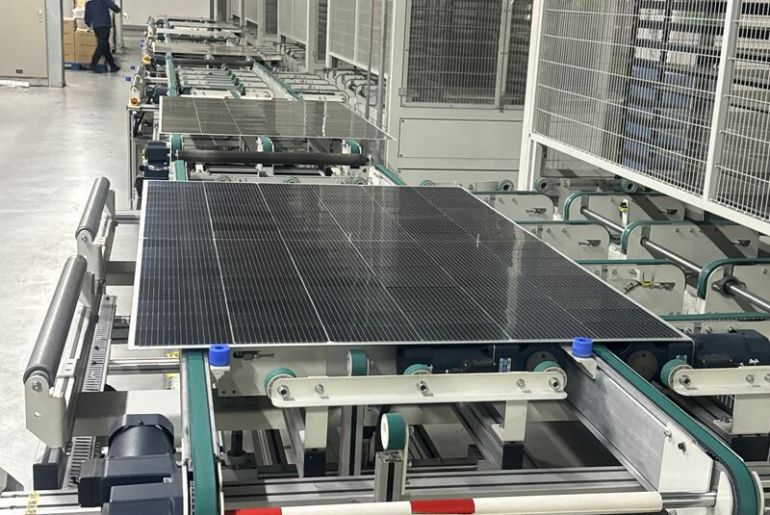
Solar module manufacturer Navitas Solar is planning to invest around ₹1,500 crore in Gujarat to establish a 3.6 GW solar cell manufacturing facility, along with a pilot production line for wafers and ingots.
The expansion marks Navitas Solar’s entry into solar cell manufacturing and reflects the company’s strategy to strengthen its presence across the solar value chain through backward integration. The project will be developed in multiple phases, with the first phase expected to be commissioned in 2027, depending on market conditions and project progress.
The investment aligns with India’s growing focus on domestic solar manufacturing and reducing dependence on imported components. The implementation of the Approved List of Models and Manufacturers (ALMM) List-II framework is expected to increase demand for locally produced solar cells in eligible renewable energy projects.
Solar Cell Facility Under Development
Navitas Solar has started civil work for the upcoming facility, which will cover more than 10 lakh square feet. The company has completed technology partnerships for the manufacturing line and appointed a leadership team to manage the new solar cell business vertical.
The planned facility will feature highly automated production systems and will be designed to support future upgrades, including advanced solar cell technologies.
Along with the solar cell manufacturing unit, Navitas Solar plans to establish a pilot wafer-and-ingot production line in 2027. The initiative is part of the company’s long-term roadmap to develop deeper manufacturing capabilities and reduce reliance on imported solar supply chain components.
India’s clean energy transition requires strong domestic manufacturing capabilities across the solar value chain. This expansion is aimed at creating a future-ready platform covering modules, cells and deeper backward integration,” said Vineet Mittal, Director – Finance & Strategy, Navitas Solar.
Strengthening India’s Solar Manufacturing Ecosystem
The planned investment reflects a wider industry shift in India, where solar manufacturers are expanding beyond module production into upstream segments such as cells, wafers and ingots.
Navitas Solar currently operates 3 GW of annual solar module manufacturing capacity and produces Mono PERC and TOPCon modules ranging from 40 W to 720 W. Through its subsidiary Navitas Alpha Renewables, the company also manufactures solar encapsulants, adding further integration to its manufacturing portfolio.
The company expects the new expansion to create nearly 1,000 direct employment opportunities across manufacturing, engineering, operations and research functions. Additional jobs are also expected to be generated through logistics and supporting industries.
The new solar cell facility is expected to strengthen Navitas Solar’s position in India’s renewable energy manufacturing sector as the country moves towards greater localisation of solar production and increased domestic capacity for utility-scale and commercial projects.
 Electrify your feed! Click here to join our Whatsapp group and to get the latest updates, expert insights, and innovations driving India’s energy storage revolution.