
India and the world are entering the next phase of the energy transition. The first phase was about adding renewable capacity fast. For much of the past decade, the energy storage conversation has been dominated by power, speed and short-duration balancing. That made sense in the first phase of renewable integration, when grids mainly needed to smooth solar ramps, handle evening peaks, and provide frequency support. The next phase is about making that renewable electricity usable when it is actually needed. That is a much harder problem. A net-zero grid is not only a generation challenge; it is a time-shifting of energy challenge. As wind and solar rise, the mismatch between when electricity is produced and when it is needed expands from minutes and hours to days, weeks, and seasons. The International Energy Agency has explicitly warned that once variable renewables move to very high shares of annual generation, power systems need flexibility across all timescales, including seasonal and interannual variability. In its analysis of systems with renewables beyond 60% of annual generation, the IEA concludes that no single flexibility tool is enough; grids need a portfolio that can manage both short-term balancing and long-duration, seasonal mismatch.
If a grid can generate abundant renewable power in some months but cannot carry that energy across time, it will still rely on fossil backup, curtail clean generation or overbuild infrastructure. In all three cases, the cost of decarbonization rises. Seasonal storage, therefore, is not a niche concept for the distant future. It is becoming a core requirement for any grid that wants to move from moderate renewable penetration to deep decarbonization.
India is approaching that inflection point quickly. As of 31 March 2026, the country had installed 283.46 GW of non-fossil power capacity, including 150.26 GW of solar, 56.09 GW of wind, 51.41 GW of large hydro and 8.78 GW of nuclear. India is now the world’s third-largest renewable energy market by installed capacity. That is a remarkable achievement. But it also means the country is moving from a capacity-addition story into a system-integration story. The question is no longer whether India can build renewables at scale. It is whether India can preserve the value of renewable generation across time and geography. A separate government note stated that by 31 January 2026, non-fossil capacity had already crossed 271.97 GW, or more than 50% of total installed electricity capacity, five years ahead of the 2030 target. This is a major achievement, but it also means India is moving from a capacity-addition story into a system-integration story.
The system consequences are already visible. The Government of India stated in December 2025 that the Central Electricity Authority estimates a need for about 336 GWh of energy storage by 2029-30 and about 411 GWh by 2031-32 to support reliable renewable integration. That is not a niche requirement. It signals that storage is becoming core grid infrastructure. At the same time, India is already seeing the cost of inadequate flexibility. Ember reported that the national grid curtailed 2.3 TWh of solar generation between May and December 2025 for grid-security reasons, with nearly 40% of that curtailment occurring in October alone. In other words, this is no longer a theoretical future problem. India is already spilling clean electricity because the system cannot absorb and shift it efficiently enough.
Transmission bottlenecks are reinforcing the same message. Reuters reported on 13 April 2026 that Rajasthan, India’s largest solar state, had about 60 GW of renewable projects awaiting transmission links. Applications for grid connectivity there totaled around 130 GW, while transmission systems had only been planned or were under development for 73 GW. That gap highlights a broader issue: renewable growth alone does not guarantee usable renewable power. If transmission, storage, and flexibility do not scale with generation, curtailment and stranded capacity will rise. The next stage of India’s transition will be defined not only by generation capacity, but by the quality of storage, flexibility and network planning that sits behind it.
This is also why not every storage technology is equally suited to the net-zero endgame.
This is where the storage discussion becomes more strategic. Lithium-ion batteries are excellent for fast response and short-duration applications. NREL’s utility-scale battery benchmark models lithium-ion 4-hour system as the central reference case for utility-scale. That does not mean lithium cannot be built for longer durations, but it does show where the technology is most mature and most economically established today. As duration stretches, the system becomes more energy-heavy and more expensive, because the same electrochemical architecture is being used to provide both power and energy.
Pumped hydro sits at the other end of the spectrum. It is proven, large-scale, and valuable, and India is rightly pushing it. The CEA’s January 2026 roadmap explicitly targets pumped storage projects over time. But pumped hydro is also site-specific, infrastructure-heavy, approval-intensive, and long-gestation by nature. It is essential, but it will not fit every geography or every use case.
Hydrogen offers a route to very long-duration and even seasonal storage, but today it still faces practical hurdles in round-trip efficiency, infrastructure complexity, and system cost.
The gap, then, is clear: grids need something between short-duration lithium systems and very large, infrastructure-heavy seasonal options. That is where mechanically rechargeable zinc-air batteries become interesting.
A mechanically rechargeable zinc-air battery stores energy as metallic zinc plates and uses those plates later to generate electricity in a zinc-air stack. The simplest way to understand it is this: zinc is the fuel, and the battery is the engine. As long as zinc plates continue to be fed into the system, power can continue to be delivered. During discharge, the zinc is converted into zinc oxide (ZnO). That ZnO is then taken to a regeneration unit, where renewable electricity converts it back into zinc plates. These plates are then moved back to the battery site for reuse.
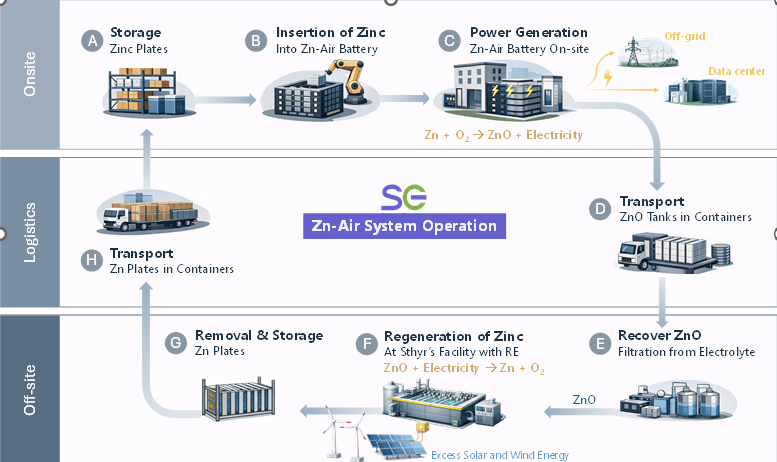
This architecture matters economically because it decouples energy and power. In lithium-ion systems, increasing duration usually means adding more battery material inside the same active electrochemical architecture. In a mechanically rechargeable zinc-air system, the power block is the zinc-air stack, while the energy is stored separately in solid zinc inventory. That makes long-duration storage fundamentally more scalable. It also matters technically. Because the energy is stored as solid zinc outside the active battery environment, the system is far better suited to holding energy for long periods with minimal self-discharge. This is exactly the kind of characteristic that becomes valuable when the grid problem shifts from four hours to four months.
India’s future power challenge will not be annual energy shortage, but seasonal mismatch, local reliability, and grid stress. NHPC’s hydro plants are a good example. Hydro generation is high in strong water months and lower in lean months, creating a recurring gap across the year. Seasonal storage can help by shifting surplus energy from high-generation periods to lower-generation periods. This reduces dependence only on reservoir management, market purchases, or transmission expansion. In this system, lithium-ion is useful for short-duration balancing, while long-duration and seasonal storage is needed to move energy across months.
This is also why mechanically rechargeable zinc-air batteries can be a strong replacement for diesel gensets in some applications. Diesel generators are widely used for long backup, but they come with fuel cost, fuel transport, maintenance, emissions, and noise. A zinc-based system solves the same reliability problem differently. Zinc plates are supplied to the site and used to generate power. The discharge product, ZnO, is then taken back and regenerated into zinc plates using renewable energy. This creates a circular energy loop instead of a one-way diesel fuel chain. That makes it especially useful for data centres, defence, disaster management, islands, industrial clusters, and remote infrastructure.
This matters now because India’s data centres are growing fast and need reliable 24/7 backup power. Islands such as Lakshadweep and Andaman & Nicobar still depend heavily on diesel, where fuel logistics are costly and outages are difficult to manage. These are exactly the kinds of places where long-duration zinc-based storage can add value.
India therefore needs to start building storage technologies for future grid needs now. No single chemistry will solve every problem. Lithium-ion will serve some use cases, pumped hydro others, and hydrogen may play a role later. But India also needs safe, modular, long-duration storage systems for the gap between short-duration batteries and large infrastructure-heavy options.
The opportunity is bigger than energy independence. If India develops and manufactures these energy technologies early, it can become not just a user of clean-energy systems, but also a provider of energy technologies to the net-zero world.
 Electrify your feed! Click here to join our Whatsapp group and to get the latest updates, expert insights, and innovations driving India’s energy storage revolution.