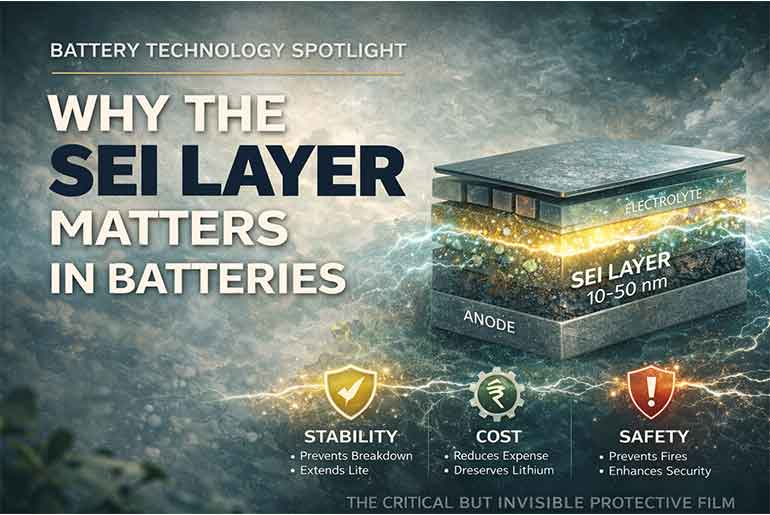
In lithium-ion battery manufacturing, the most critical structure is also the least visible. It is not the cathode chemistry, not the anode material, and not even the cell design that ultimately defines long-term performance. The SEI layer, or Solid Electrolyte Interphase, is a nanoscale film that forms when a battery cell is first charged.
The SEI layer is like the battery’s “security gatekeeper” between the anode and the electrolyte. When this layer is formed perfectly, lithium ions flow smoothly, allowing the battery to maintain high performance for thousands of charges. However, if this gatekeeper is weak or unevenly built, the battery begins to break down from its very first day—resulting in power loss, physical swelling, increased internal resistance, and, in the worst cases, dangerous safety failures.
Top-tier scientific research confirms that a major part of a battery’s permanent energy loss happens right at the start due to an unstable SEI layer. This shifts the “formation stage” from being just another manufacturing step to being the most critical moment in a battery’s entire life. It is the invisible foundation that determines whether a cell will be a long-lasting success or an early failure.
The Birth of the SEI Layer: What Happens During Formation
A lithium-ion cell is not truly ready for use the moment it leaves the assembly line. Its real “activation” happens during the formation process, which is the very first time the cell is charged under extremely precise conditions.
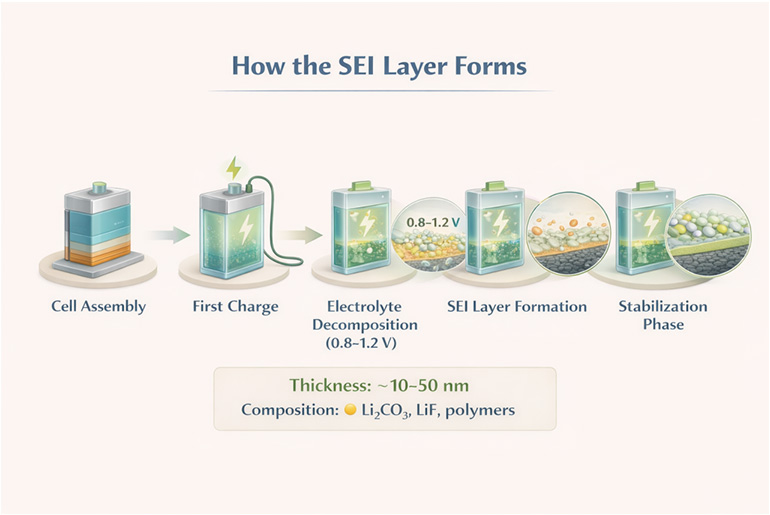
Think of this first charge as a chemical “setting” phase. During this process, several critical things happen:
- Chemical Reactions: As the voltage hits approximately 0.8–1.2 V, the liquid electrolyte begins to react with the anode.
- The Protective Shield: These reactions create a microscopic, solid film on the surface of the anode—this is the SEI layer.
- Composition: This thin “skin” is made up of a lot of different compounds, such as lithium carbonate (Li₂CO₃), lithium fluoride (LiF), and different kinds of organic polymers.
This layer is what makes the battery work safely and well for years. It is the basis for the cell’s entire operational life.
There is a basic challenge that occurs at the cell level which the SEI layer will provide a solution for and this can be thought of very clearly. The SEI layer is described as acting as a selective filter as it needs to be porous enough to pass Lithium Ions through when charging and discharging, but solid enough that the electrolytic cannot reach back and come into contact with the anode (i.e., without this “shield”, the electrolytic would continue to decompose and thus, ultimately destroying the battery).
Because this layer is so delicate, the formation process is managed with the precision of a laboratory experiment, using three main levers:
- Ultra-Low Charging Rates (0.05–0.1C): The battery isn’t just “charged”; it is slowly “grown.” Using a low current ensures the SEI layer settles evenly and densely across the anode surface, preventing cracks or gaps.
- Controlled Temperature (Temp: 25C-45C): Heat is a catalyst. Heating the cell within this range causes very fast chemical reactions that keep it stable and organized so it works well and reliably.
- MULTI-STEP OPERATING PROTOCOL (No continuous run): Manufacturers do not follow the “Single Continuous Charge,” but have more intricate, multi-step (recipes) charge/discharge processes to progressively strengthen the layer for continued durability, even after years of rigorous use.
However, forming the SEI layer is not instantaneous. After initial formation, cells undergo an ageing phase lasting between 7 to 21 days, during which:
- The SEI stabilizes
- Voltage drops are monitored
- Defective cells are identified
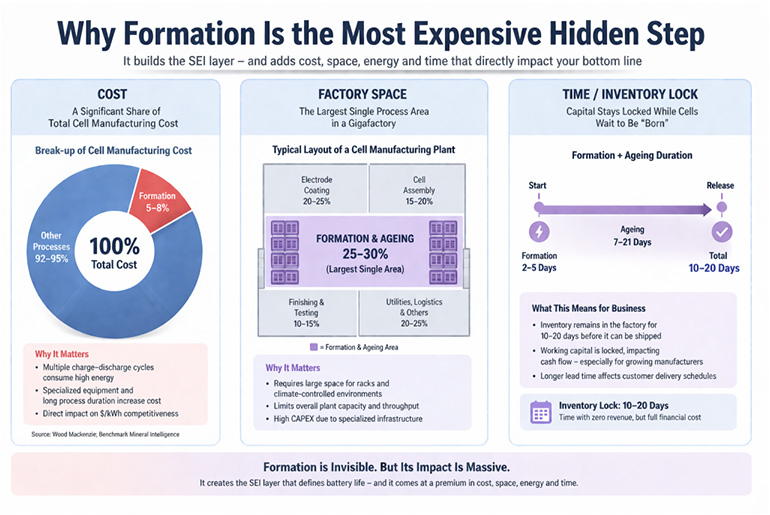
This is why formation and ageing together can occupy up to 25–30% of a gigafactory’s floor space, making it one of the largest and slowest stages in battery manufacturing.
SEI Failure: The Root Cause Behind Battery Degradation
The stability of the SEI layer directly determines battery life. When this layer is unstable or improperly formed, several degradation mechanisms are triggered.
1. Lithium Plating
- Lithium plating occurs when lithium ions do not penetrate the anode and accumulate as solid metal on the surface of the anode.
- Lithium plating generally occurs because of fast charging or using lithium-ion batteries in very low temperatures.
- Lithium plating presents a danger because it forms dendrites (small sharp needles). These dendrites can penetrate the internal structure of the battery and short-circuit the cell.
Studies show that lithium plating is one of the five major causes of death for lithium-ion batteries and results in a 30% to 50% reduction of useful life per cell.
2. Continuous SEI Growth
An unstable SEI continues to react with the electrolyte, growing thicker over time.
Consumes active lithium inventory and Leads to capacity fade
Typical capacity loss:
- ~2–5% per year (normal conditions)
- Up to 20% early loss in poorly formed cells
3. Creation of Gas and Volume Increase in Battery
Gassing of the electrolyte when the electrolyte decomposes; CO2 generally, but also hydrocarbons, will be evolved.
- There is a Visible Effect: In pouch cells, the gas that is produced has no place to go resulting in the actual physical puffs or swelling of the battery.
- There is Damage: The gassing produces high levels of pressure (mechanical stress) on the internal components of the battery eventually resulting in a total failure.
4. Impedance Rise
A thicker SEI layer increases internal resistance.
- Reduces power output
- Increases heat generation
Over time, this contributes to thermal instability and accelerates ageing.
The Impact of the SEI Layer on Battery Production Costs
Aside from battery performance, the SEI layer has a major effect on the economics of production.
Energy Use
- The process of forming SEI requires numerous charge-discharge cycles which uses up a lot of energy.
- 5-8% of the total cost of manufacturing cells is attributed to these processes.
Capital Lock-Up
Cells remain in formation and ageing for 10–20 days, during which:
- Inventory is immobilized
- Revenue realization is delayed
For Indian manufacturers, where cost of capital is relatively high, this becomes a major financial constraint.
Cells remain in formation and ageing for 10–20 days, during which:
- Inventory is immobilized
- Revenue realization is delayed
For Indian manufacturers, where cost of capital is relatively high, this becomes a major financial constraint.
Factory Footprint
Formation and ageing require:
- Large rack systems
- Controlled environments
- Continuous monitoring systems
This results in 25–30% of plant space being dedicated to this single stage—reducing overall throughput efficiency.
India’s Unique Challenge: Heat, Humidity, and Process Control
India’s environmental conditions introduce additional complexity in SEI stability.
High Temperatures
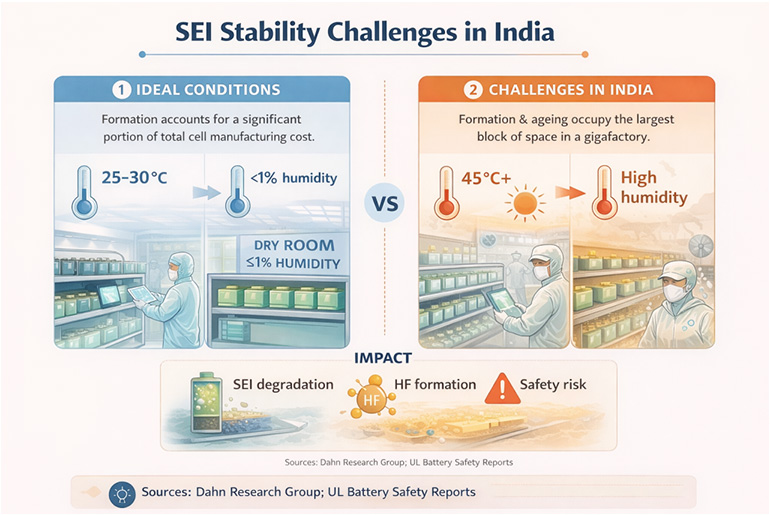
Ambient temperatures exceeding 45°C can:
- Accelerate side reactions
- Destabilize the SEI layer
- Humidity Sensitivity
Moisture reacts with electrolyte salts (like LiPF₆), forming hydrofluoric acid (HF).
- HF attacks the SEI layer
- Leads to rapid degradation
Maintaining dry-room conditions below 1% relative humidity is critical—but still evolving across many facilities.
Safety Link
SEI breakdown is one of the earliest triggers of
Thermal Runaway
When the SEI layer collapses:
- Exothermic reactions begin
- Heat generation accelerates
- Chain reactions lead to fire or explosion
The Innovation Race: Can SEI Formation Be Accelerated?
Reducing formation time without compromising SEI quality is one of the biggest technological challenges in battery manufacturing.
Electrolyte Additives
Additives are being used to engineer stronger and more stable SEI layers.
- Vinylene Carbonate improves film stability
- Fluoroethylene Carbonate enhances elasticity and thermal resistance
Fast Formation Technologies
Advanced techniques include:
- Pulse charging
- AI-driven formation protocols
- Optimized current profiles
The goal is to reduce formation time from 15–21 days to under 5 days, without increasing defect rates.
Global Industry Direction
Leading players such as:
- Tesla
- CATL
- LG Energy Solution
are investing heavily in formation optimization, as it directly impacts both cost and scalability.
India is still in early stages of this transition, with most players focusing on process stabilization rather than acceleration.
Conclusion: The SEI Layer Will Define the Future of Indian Batteries
The global battery race is often framed in terms of gigafactory capacity and advanced chemistries. However, the real differentiator lies at the nanoscale.
The SEI layer decides:
- How long a battery lasts
- How safely it works
- How cheaply it can be made
For India’s growing battery ecosystem, learning how to make SEI layers is not optional; it’s essential. The quality of future Indian cells won’t just be based on their specifications, but also on how stable their SEI layers stay after hundreds and thousands of cycles.
 Electrify your feed! Click here to join our Whatsapp group and to get the latest updates, expert insights, and innovations driving India’s energy storage revolution.