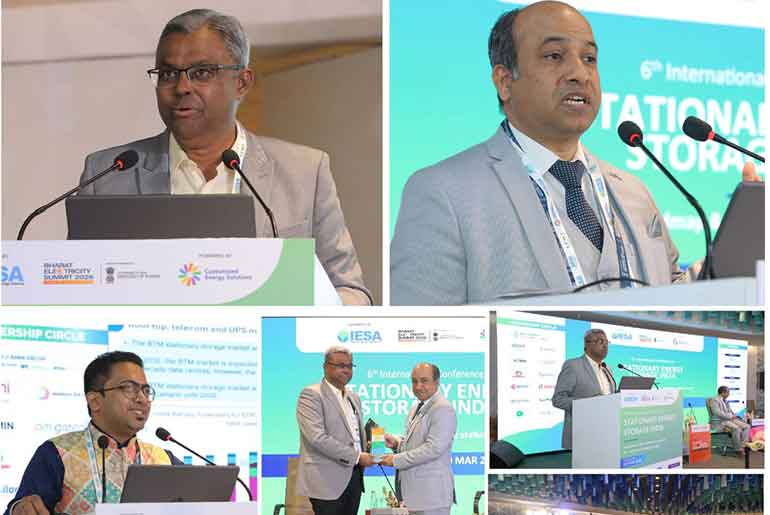
The 6th International Conference on Stationary Energy Storage India (SESI 2026), organized by the India Energy Storage Alliance (IESA) at Yashobhoomi, brought together over 350 industry stakeholders, marking a decisive shift in India’s energy transition narrative—from capacity addition to system intelligence, integration, and execution.
The conference opened with a high-impact inaugural session, where Shri S.C. Saxena, Chairman & Managing Director, Grid Controller of India Limited, set the tone by underlining the changing dynamics of India’s power sector. With solar generation already touching ~83 GW during peak periods and the country targeting ~500 GW of renewable capacity, the focus is shifting toward managing variability and ensuring grid stability. He highlighted that while solar hours are well supported, non-solar hours present significant challenges, with ramp rates reaching up to ~30 GW/hour. In this context, Energy Storage Systems (ESS) are emerging as a critical enabler, supported by the Central Electricity Authority’s target of 208 GWh storage capacity and VGF-backed deployments. Key priorities identified included the adoption of grid-forming inverters, transition toward multi-revenue BESS models, and the need for continuous-operation systems with minimal cooling downtime.
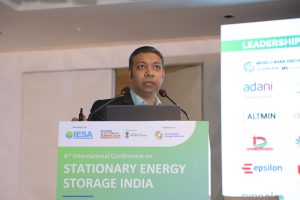
Addressing the critical aspect of safety and standardization, Richie Stephen, Senior Standards Project Manager, UL Standards & Engagement, emphasized the need for robust certification frameworks and globally aligned standards to support the rapid deployment of Battery Energy Storage Systems (BESS) across diverse applications.
A fireside chat on policy and regulation featuring Naveen Munjal, Director (BD&C), Apraava Energy, and Shri Sivakumar Vepakomma, PS Director, SECI, highlighted the operational realities of integrating renewable energy with storage. Deployment examples included hybrid systems such as diesel-solar-BESS microgrids in Andaman and hydro-solar-battery integration in Himachal Pradesh, demonstrating the role of storage in addressing intermittency and enabling peak demand management.
The discussion underscored the need for coordinated policy mechanisms, including viability gap funding (VGF), and emphasized the importance of integrating multiple storage technologies to ensure system-level efficiency and resilience.
In a leadership address, Venugopal Rao, Chairman & MD, Pace Digitek, outlined structural challenges within India’s BESS ecosystem. The sector continues to face over 95% dependence on imported lithium cells, limited domestic manufacturing at the cell level, and high supply chain volatility driven by fluctuations in global raw material prices. He also flagged concerns around aggressive bidding practices impacting long-term project sustainability, while calling for accelerated implementation of Production Linked Incentive (PLI) schemes for advanced chemistry cells.
A panel discussion on utility-scale projects, featuring Avinash Rao, MD & CEO, Mahindra Susten; Deepak Gupta, EVP & Head – Commercial (Utility Projects), ReNew; Naresh Baluja, MD, Engie; Samir Patel, Chief – Technology & Operations (BESS Energy Division), SPML; Suman Nag, Global BD, Envision; and Brajesh Kumar, SVP, Navayuga Group, reflected a clear transition in project evaluation metrics.
The discussion indicated a shift from tariff-led decision-making toward value optimization through system design, lifecycle planning, and operational efficiency. Participants highlighted that BESS is increasingly being deployed as a multi-functional asset capable of delivering arbitrage, ancillary services, and peak load management.
Technological advancements and system-level optimization were further explored through multiple product and project showcases. Kumar M, Founder & CEO, SmartGrid Analytics, presented the role of Energy Management Systems (EMS) as a centralized intelligence layer enabling real-time monitoring, forecasting, and coordinated control across solar, wind, grid, and storage assets. The integration of EMS with Battery Management Systems (BMS) and grid infrastructure was identified as critical for optimizing dispatch and improving system efficiency.
A dedicated panel discussion on Behind-the-Meter (BTM) and C&I applications, moderated by Kartikeya Narain Sharma, Co-Founder & CBO, Sunsure Energy, brought together Abhishek Ranjan (BSES Delhi), Darshan Joshi (Radiance Renewables), Alekhya Datta (TERI), Sindhu Sharma (Nxtra by Airtel), and Sushmita Ajwani (Aditya Birla Renewables). The discussion highlighted a strong shift toward profitability-driven BESS adoption, supported by falling battery costs, energy arbitrage opportunities, and participation in ancillary markets. Panelists emphasized the increasing deployment of storage across commercial, industrial, and residential segments, alongside challenges such as grid instability due to high rooftop solar penetration. The conversation also pointed to the rise of virtual power plants (VPPs), AI-driven EMS platforms, and aggregated storage systems, indicating a transition toward digitally optimized, distributed energy ecosystems with multiple value streams beyond traditional capacity-based models.
In a session on merchant BESS, Chandan Rastogi, VP – BESS, Juniper Green Energy, highlighted evolving market dynamics, including declining capital costs and increasing price spreads in electricity markets. He emphasized the importance of advanced optimization tools and digital twins in managing price volatility and maintaining battery health, noting that operational strategies must balance revenue generation with lifecycle management.
Manufacturing and system integration emerged as key focus areas. Himanshu Jadhav, CEO, Jendamark India Pvt. Ltd, showcased automated, modular production systems enabling scalable BESS manufacturing, supported by Industry 4.0 technologies and real-time analytics. Complementing this, Akash Kaushik, Co-Founder, GoodEnough Energy, highlighted that the majority of system failures originate at the integration level rather than the cell level, emphasizing the importance of engineering, testing, and thermal management.
The role of Battery Management Systems (BMS) was detailed by Satish Reddy, Founder & CEO, Xbattery, who described BMS as the central control system governing battery safety, performance, and longevity. The session also pointed to continued import dependence for BMS electronics and the need for indigenous platform development.
Alternative storage technologies were also discussed, with Dr. Dinachandra Singh, NTPC NETRA, presenting the deployment of Vanadium Redox Flow Batteries (VRFB) in hybrid microgrid systems. With a 25-year lifecycle, high safety profile, and full recyclability, VRFB was positioned as a viable solution for long-duration energy storage applications.
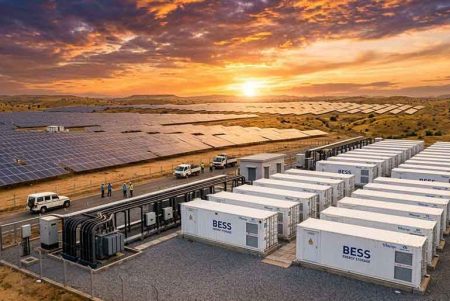
Project execution insights were presented by Mahadevan Srinivasan, Larsen & Toubro, who detailed a large-scale hybrid project integrating 185 MW solar capacity with a 254 MWh BESS system. The project demonstrated improved capacity utilization and effective management of peak demand through integrated system design.
Further discussions highlighted the growing role of pumped hydro storage in delivering round-the-clock renewable energy. Parveen Nanda, Greenko Group, outlined large-scale storage deployment plans and emphasized the integration of solar, wind, and pumped storage systems to deliver dispatchable and cost-effective clean power.
System integration challenges were reinforced by Udyut Goyal, Amperehour, who noted that BESS performance depends on the seamless coordination of multiple subsystems, including BMS, EMS, power conversion systems, and thermal management. Standardization of the digital layer and improved system architecture were identified as key priorities.
The conference also covered the complete value chain of energy storage systems. Yash Chaliawala, Replus, detailed the progression from cell to container, highlighting the importance of safety systems, modular design, and manufacturing scale in delivering grid-ready solutions.
Across sessions, a consistent theme emerged—India’s energy storage sector is transitioning from early-stage deployment to large-scale execution, with increasing emphasis on system design, digital intelligence, and operational performance.
SESI 2026 reflected a maturing energy storage ecosystem, where the focus is rapidly shifting from expansion to execution. Discussions across policy, technology, manufacturing, and project deployment converged on a single direction—energy storage is becoming central to grid operations, renewable integration, and power system stability.
As deployments scale and market mechanisms evolve, the sector is entering a phase defined by engineering precision, integrated system design, and data-driven optimization, positioning storage as a core component of India’s power infrastructure.
 Electrify your feed! Click here to join our Whatsapp group and to get the latest updates, expert insights, and innovations driving India’s energy storage revolution.