Battery Energy Storage Systems (BESS) have moved to the center of the power sector, stabilizing grids and enabling new business models. As governments and industries across the world invest in BESS, a quieter constraint is emerging – the availability of people with right skills, at the right stage and in the right geography. This article walks through the BESS value chain, maps the critical skilling needs, and uses real-world examples to highlight workforce readiness.
The value-chain approach helps with effective skilling and workforce planning.

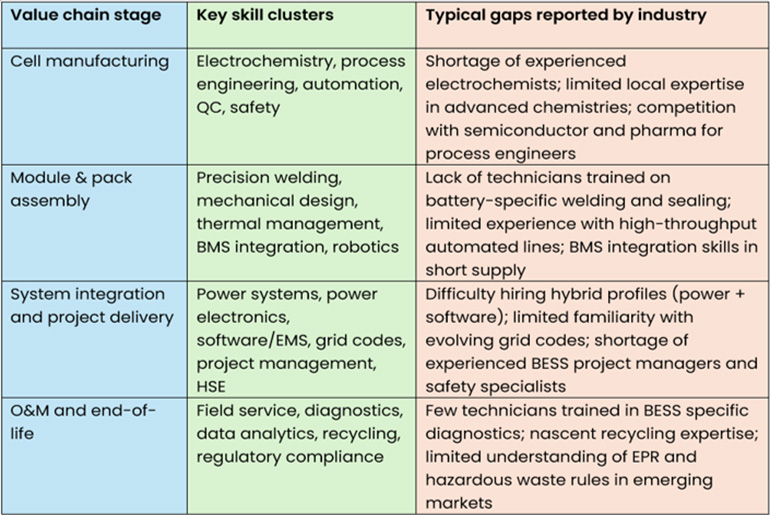
Cell manufacturing is the most capital-intensive and technically demanding segment of the battery value chain. Domestic cell manufacturing plays a critical role in strengthening energy storage ecosystems and reducing import dependence.
It includes:
- Materials and chemistry R&D (cathode, anode, electrolyte, separator)
- Electrode production (mixing, coating, calendaring)
- Cell assembly (stacking/winding, electrolyte filling, formation, ageing)
Skills required here include electrochemistry, process engineering, advanced automation, quality control, safety engineering, and clean-room operations. Leading cell manufacturers have built large in-house training ecosystems to continuously upgrade workforce capabilities as battery chemistries evolve.
Module and pack assembly: Cells are combined into modules and packs with mechanical structures, thermal management and electrical interconnections. This stage is often closer to end markets and can be co-located with EV plants or BESS integrators.
Key skills include:
- Precision welding (laser, ultrasonic)
- Busbar design and electrical interconnection design
- Thermal design and validation
- Battery Management System (BMS) integration
- Robotics and automation programming
- Line maintenance and troubleshooting
Compared with cell manufacturing, module and pack assembly can create more technician roles, however, automation is rapidly changing the nature of these jobs towards robotics and mechatronics (India Manufacturing Workforce, 2025).
System integration and project delivery is one of the fastest growing and most important stages of the BESS ecosystem. System integrators turn packs into complete BESS solutions by adding:
- Power Conversion Systems (PCS)
- Energy Management Systems (EMS) and SCADA
- Protection, safety & fire detection and suppression systems
- Civil, electrical and grid-connection infrastructure
This stage demands inter-disciplinary skill sets: power systems engineering, software and controls, cybersecurity, grid codes, project management and HSE (health, safety and environment). Finding engineers who bridge power electronics and software is one of the biggest hiring challenges (Cleantech, 2026).
Operation, maintenance and end-of-life: Once commissioned, BESS assets require:
- Monitoring and predictive maintenance
- Performance analytics and warranty management
- Safety inspections and incident response
- Second-life assessment and recycling logistics
Here, skills blend field service, data analytics, remote asset monitoring, safety management and regulatory compliance (for example, extended producer responsibility and hazardous waste rules). As more systems reach mid-life, demand is rising for specialists in diagnostics, repowering and recycling. (NITI Aayog, Deloitte, GIZ)
To summarize, three patterns stand out for BESS workforce landscape:
- Geographic concentration: Cell manufacturing jobs are concentrated in China, Europe and North America with other regions racing to catch up through policy and gigafactory initiatives. (European Commission, JRC, 2026)
- Skill polarization: Demand is growing fastest for high-skill roles (electrochemists, automation engineers, power electronics specialists, data scientists, grid integration experts), while low-skill assembly roles are increasingly automated. (India Manufacturing Workforce, 2025 and ACC PLI impact report, 2026)
- Timing mismatch: Gigafactories and BESS projects are being announced and built faster than local training systems can produce qualified workers.
- Talent competition: EV manufacturing, semiconductor production, renewable-energy integration, and advanced manufacturing industries are often competing for the same engineering and automation talent pools.
While policies are expected to create tens of thousands of jobs over the coming decade, industry surveys
Consistently highlight a shortage of:
- Experienced cell and pack manufacturing engineers
- BMS and power electronics specialists
- Safety and certification experts
- Skilled technicians for automated lines and field O&M
A significant challenge is gap between academic training and industry requirements. Many engineering programs still lack – battery specific curriculum, hands on laboratory exposure, industry-linked certification pathways and interdisciplinary learning modules.
This is where the value chain lens becomes particularly useful: different stages require different skilling strategies.
Skilling needs across BESS value chain:
The rise of hybrid roles
One of the most striking trends is the rise of the hybrid roles that cut across traditional disciplinary boundaries, e.g. electrochemistry + data science for cell performance analytics, electrical engineering + cybersecurity for grid-connected storage systems etc.
Industry interviews and surveys repeatedly note that these hybrid profiles are the hardest to hire and retain, especially outside established clusters. (Worldmetrics, 2026, and Cleantech 2025)
What industry and policy makers need to do
Reports by IEA, European Commission, World Metrics, India’s ACC PLI impact study and industry experiences summarize key aspects:
1. Integrate skills planning into project planning: Workforce planning, training partnerships and curriculum development should be a part of the early project design for gigafactories and large BESS programs, not an afterthought.
2. Invest in hybrid profiles: Programs that deliberately blend power systems, software, data and safety will pay the highest dividends, because these are the roles that unlock system-level performance and reliability.
3. Use automation as a skilling lever (not a substitute): Automation and AI should be paired with structured upskilling for operators and technicians, turning them into higher-value problem solvers rather than displacing them without a pathway.
4. Build regional centers of excellence: Shared training centers, test beds, certification labs can reduce duplication and raise standards, especially in markets where individual firms may not have the scale to do everything alone.
5. Embed diversity and inclusion from the start: Where companies have proactively recruited and supported women and under-represented groups into technical roles, they have expanded their talent pool and improved retention. Making this a design principle, not a side project, will be critical as competition for skills intensifies.
6. Strengthen Industry-Academia collaboration: Battery-focused curriculum, apprenticeships, certification programs, hands-on labs should be developed jointly by educational institutions and industry stakeholders.
Conclusion: The real storage constraint is human. The BESS industry is often described in terms of gigawatt, gigawatt-hours and gigafactories. But behind every line of capacity is a line of people: technicians, engineers, project managers, safety officers, data analysts and many others.
If industry and policymakers treat skilling with the same urgency as they treat financing and permitting, then nothing can stop the BESS sector from growing into a resilient, high-quality backbone of the clean energy system. We just need to realize that skills are as strategic as materials and capital.
 Electrify your feed! Click here to join our Whatsapp group and to get the latest updates, expert insights, and innovations driving India’s energy storage revolution.