The future of energy may be powered by batteries, but it will ultimately be defined by the trust they inspire. As renewable energy scales at an unprecedented pace, the industry is no longer looking for storage alone—it is demanding systems that are safer, smarter and built to perform for decades. For more than a century, Saft, a wholly owned subsidiary of TotalEnergies, has been quietly building that foundation, combining deep battery expertise with advanced engineering to deliver energy storage solutions for some of the world’s most critical applications
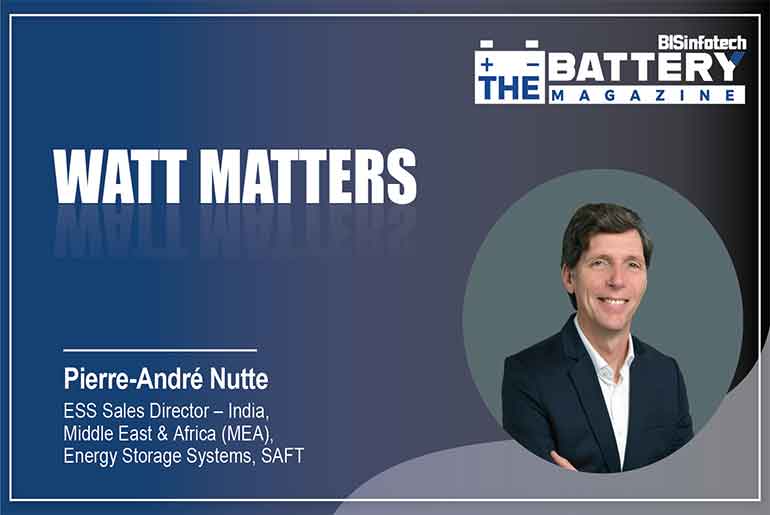
At India Energy Storage Week (IESW) 2026, Shweta Kumari, Sub-Editor, The Battery Magazine, sat down with Pierre-André Nutte, ESS Sales Director – India, Middle East & Africa (MEA), Energy Storage Systems,SAFT, TotalEnergies, to discuss Saft’s growing role in India’s rapidly evolving Battery Energy Storage System (BESS) landscape. From the company’s debut at IESW with its integrated 5.1 MWh iFLEX AC solution to its century-long engineering legacy, AI-powered asset monitoring, cybersecurity and uncompromising focus on safety, Pierre-André Nutte shares how Saft is prepared for an energy future where reliability will be just as valuable as capacity.
This is Saft’s first participation at India Energy Storage Week. How has your experience been, and what products are you showcasing this year?
We are delighted to participate in India Energy Storage Week for the first time. It is an important platform for engaging with the rapidly growing Indian energy storage ecosystem, and we are proud to introduce Saft’s latest innovations to this market.
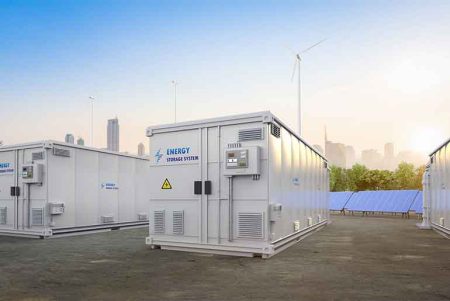
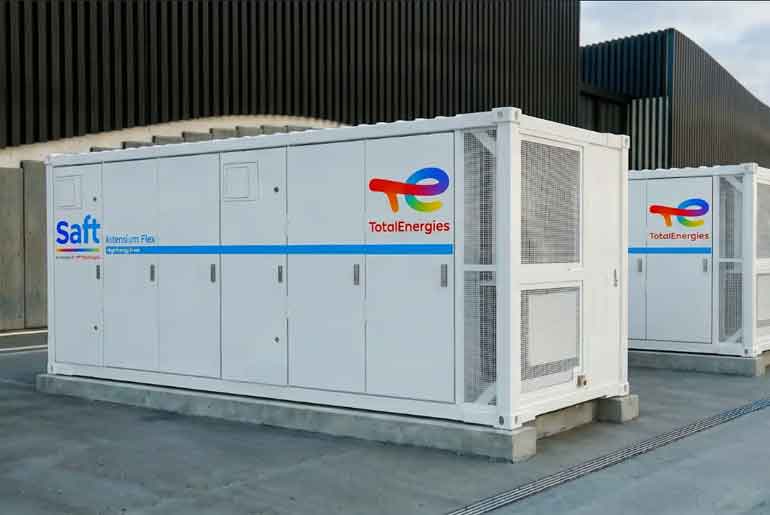
This year, we are showcasing our iFLEX AC, an integrated 5.1 MWh Battery Energy Storage System (BESS). One of its key differentiators is that the Power Conversion System (PCS) is integrated within the container, creating a highly compact, factory-integrated solution that simplifies deployment while optimizing space and performance.
India is entering a significant phase of energy storage adoption, and we believe solutions like iFLEX AC can effectively support the country’s accelerating renewable energy transition.
Saft has over a century of battery expertise. What would you say is the company’s biggest USP in today’s competitive BESS market?
Saft’s greatest strength lies in its more than 100 years of battery expertise. Since our inception, we have designed and manufactured batteries for a wide range of critical applications across the world, giving us unmatched experience in multiple battery chemistries and technologies.
This deep technical knowledge enables us to bring proven expertise into today’s Battery Energy Storage System market.
Since becoming a wholly owned subsidiary of TotalEnergies in 2016, we have combined Saft’s battery heritage with the global strength, financial stability and long-term vision of TotalEnergies. Together, this makes us a reliable and trusted partner for customers worldwide.
Another important differentiator is our in-house technology development. Our Battery Management System (BMS), hardware and software are developed and manufactured in France, providing a high level of cybersecurity and system integrity—an increasingly important consideration for modern grid-scale energy storage projects.
Safety is another cornerstone of our philosophy. Our engineering teams continuously focus on minimizing operational risks through advanced system design, and we are proud to have recently successfully completed a Large-Scale Fire Propagation Test, demonstrating the robustness of our safety architecture.
What key trends are you observing in India’s Battery Energy Storage System market?
India is among the world’s fastest-growing renewable energy markets, and its progress has been truly impressive.
As renewable energy capacity continues to expand, Battery Energy Storage Systems become essential for ensuring grid stability, improving renewable energy utilization and supporting the country’s energy transition.
Beyond large utility-scale projects, we are also witnessing strong momentum in the Commercial and Industrial (C&I) segment. Industries are increasingly adopting battery storage for backup power, energy optimization and integrating renewable energy into their operations.
These developments indicate that energy storage is becoming an integral part of India’s evolving power infrastructure.
Many industry experts describe this as the ‘Decade of Energy Storage.’ How is Saft contributing to this transformation?
Saft is contributing to the global energy storage transition through both its technology and extensive project experience.
Today, we have more than 170 contracted Battery Energy Storage System projects worldwide, representing over 10 GWh of installed and contracted capacity.
The experience gained across diverse markets, applications and operating environments enables us to deliver highly reliable and efficient energy storage solutions. We believe this accumulated expertise, combined with proven technology, allows us to support customers with confidence as the global energy transition accelerates.
Safety, reliability and performance remain the three most important pillars of BESS. How is Saft addressing these priorities?
For both Saft and TotalEnergies, safety is always the highest priority.
We have developed sophisticated safety systems and engineering practices designed to minimize operational risks and prevent fire propagation. Every aspect of our solution is engineered with safety at its core.
Reliability is another area where our long history provides a significant advantage. Saft has decades of operational experience in battery technologies, and we installed one of the world’s earliest Battery Energy Storage Systems in Alaska more than 20 years ago. That installation continues to operate successfully today, reflecting the durability and long-term reliability of our solutions.
This operational experience gives customers confidence that they are investing in proven technology capable of delivering dependable performance over its lifecycle.
What can customers expect from Saft in the coming years?
Innovation will remain a key focus for Saft.
We will continue enhancing our iFLEX AC platform by increasing the energy capacity that can be integrated within a standard 20-foot container, helping customers achieve greater energy density without increasing their installation footprint.
As the energy transition accelerates, we believe Saft’s BESS solutions will deliver significant operational and sustainability benefits to industrial and commercial customers.
Another major area of development is digital intelligence. Our advanced monitoring and supervision platform, iSight, enables real-time monitoring of Battery Energy Storage Systems down to the individual cell level.
By combining this detailed operational data with Artificial Intelligence (AI), iSight supports predictive maintenance, improves operational efficiency and helps customers maximize the performance and lifetime of their energy storage assets.
These innovations reflect how we envision the future of Battery Energy Storage Systems—solutions that are not only safer and more compact but also increasingly intelligent and data-driven.
As India’s BESS market scales rapidly, what policy or regulatory developments would further accelerate the deployment of energy storage across the country?
From Saft’s perspective, the next phase of India’s BESS growth will be accelerated by policy frameworks that recognize energy storage as a critical grid asset, not only as an add-on to renewable generation. Clear long-term procurement visibility, transparent market mechanisms for ancillary services, and stable regulations for hybrid renewable-plus-storage projects will help developers and utilities invest with greater confidence.
Equally important is the alignment of safety, grid compliance and quality standards with internationally recognized frameworks. As BESS becomes part of essential power infrastructure, customers and authorities will increasingly expect proven system-level safety, robust testing, responsible sourcing, lifecycle serviceability and clear accountability across the value chain. These principles are consistent with Saft’s engineering approach and TotalEnergies’ broader commitment to responsible energy development.
Cybersecurity is becoming increasingly important for grid-connected energy storage systems. How do you see this evolving over the next few years, and how is Saft preparing for it?
Cybersecurity will become a defining requirement for all ESS assett, because these assets are increasingly digital, remotely monitored and integrated into critical power networks. Over the next few years, we expect cybersecurity expectations to move from being a technical preference to a formal requirement in tenders, grid codes, insurance reviews and customer risk assessments.
Saft is preparing for this through a security-by-design approach. Our BMS, controls and supervision architecture are developed with strong attention to access control, secure communications, hardening, monitoring and vulnerability management. Furthermore, to guarantee full control, cybersecurity, and product integrity, all BMS software and hardware are entirely designed, developed, and manufactured in France. Our approach is aligned with recognized industrial cybersecurity frameworks such as IEC 62443, and benefits from TotalEnergies’ cybersecurity governance, operational security capabilities and experience in protecting critical energy infrastructure.
TotalEnergies has a strong global presence across the energy value chain. How does being part of the TotalEnergies Group strengthen Saft’s ability to deliver advanced Battery Energy Storage solutions in markets like India?
Being part of TotalEnergies significantly strengthens Saft’s ability to deliver advanced BESS solutions in markets such as India. TotalEnergies brings global scale, financial strength, project discipline and deep experience in operating energy assets across complex regulatory and market environments. This gives customers confidence that Saft is not only a technology provider, but also a long-term partner backed by a major global energy company.
This support is especially important for utility-scale BESS, where bankability, safety culture, sustainability, cybersecurity, responsible procurement and lifecycle service are as important as the battery technology itself. By combining Saft’s century-long battery expertise with TotalEnergies’ global energy transition strategy, we can offer customers reliable, secure and future-ready storage solutions that support India’s renewable energy ambitions over the long term.
 Electrify your feed! Click here to join our Whatsapp group and to get the latest updates, expert insights, and innovations driving India’s energy storage revolution.