
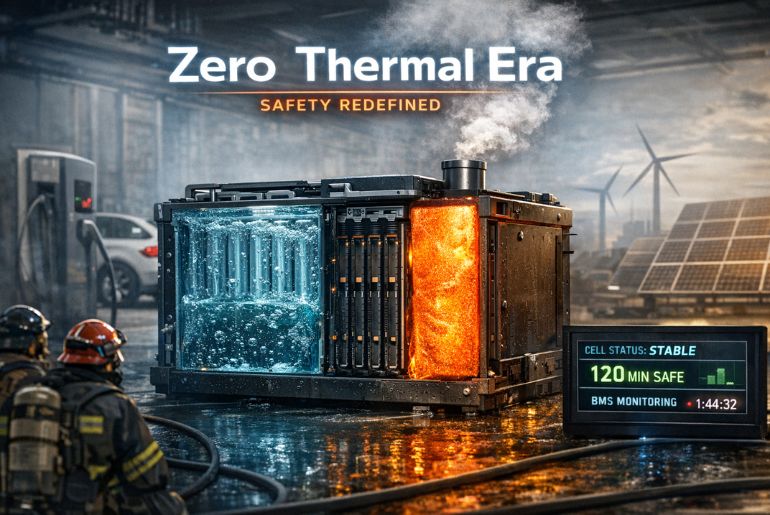
For years, the energy storage industry has operated under a quiet, unsettling compromise. We accepted that if a lithium-ion battery cell failed, a “five-minute warning” was a success. It was just enough time for a user to move away or pull a device to a safe area before a catastrophic event. But as we approach the mandatory enforcement deadline in July 2026, that era of “managed danger” is officially over.
China’s new GB 38031-2025 standard has dropped a regulatory hammer on the global stage. The mandate is simple but brutal: zero fire and zero explosion for at least two hours after a cell enters thermal runaway. In the engineering world, this is being hailed as the zero thermal era – a shift that fundamentally moves the goalpost from “evacuation time” to “total containment.” To meet this zero thermal benchmark, battery manufacturers can no longer rely on simple plastic dividers; they are being forced to redesign the very DNA of the battery pack.
The Death of the “Flammable” Battery
The transition to zero thermal propagation is not just a paperwork update; it is a technological purge. Previous regulations, like the 2020 version of the standard or even India’s current AIS 156 Phase 2, focused on delaying the inevitable. They required a 5-minute window of safety. GB 38031-2025, however, demands zero thermal spread for 120 minutes.
Think of it this way: the old standard was like a fire door that held for five minutes while you ran out of a burning building. The zero thermal standard requires the door to be so robust that the fire never leaves the room where it started. This effectively mandates the phase-out of high-nickel chemistries (like NCM 811) in their current unprotected forms, as they are notoriously difficult to keep in a zero thermal state once a short circuit occurs. To achieve zero thermal success, the energy must stay trapped within the failed cell itself.
The New Toolkit: Immersion Cooling and Structural Polymers
How do you achieve zero thermal propagation in a pack packed with energy? The industry is moving toward two radical solutions:
-
Immersion Cooling: Instead of running coolant through small pipes (cold plates), engineers are “dunking” the entire battery module in specialized dielectric fluid. This fluid acts as a massive heat sink. If one cell fails, the liquid absorbs the energy so quickly that the adjacent cells never reach the trigger temperature, ensuring a zero thermal spread across the pack. This is the gold standard for zero thermal engineering.
-
Fire-Resistant Structural Polymers: We are seeing a rise in “aerogel” blankets and advanced flame-retardant polymers that can withstand temperatures over 1,000°C. These materials act as physical shields, maintaining the zero thermal integrity of the pack even if the internal temperature of a single failing cell skyrockets. Without these, reaching zero thermal targets would be impossible.
Humanizing the Tech: Why 120 Minutes Matters
To an engineer, zero thermal is a data point. To a person living in a high-rise apartment with a battery backup system, or a delivery rider in a crowded city, zero thermal is the difference between a mechanical failure and a life-altering tragedy.
In the Indian context, where ambient temperatures often hover near 45°C, the challenge of maintaining zero thermal propagation is even steeper. India has seen its share of battery fires in scooters and storage units, leading to the implementation of AIS 156. While AIS 156 was a massive leap forward, the global shift toward the zero thermal two-hour window will likely influence Indian regulators to tighten local norms even further. For the Indian consumer, this means that the “fear of the floorboard” or the “fear of the home inverter” will finally vanish. A zero thermal rated battery means you aren’t sitting near a potential firework; you’re near a sophisticated energy storage device that is designed to fail gracefully.
The Regulatory Domino Effect
China’s move toward zero thermal mandates is already rippling outward. Since China is the world’s largest battery producer, any global company – from smartphone makers to renewable energy firms must adopt zero thermal designs to remain competitive. This “Brussels Effect” ensures that the zero thermal standard will likely become the blueprint for future UN regulations and European safety updates.
If a factory wants to export its cells, it must prove it can hit the zero thermal mark. The economic pressure to reach zero thermal status is now higher than the cost of the technology itself. Every major R&D department is currently obsessed with this zero thermal requirement, as failure to comply means being locked out of the world’s largest market.
The Mechanics of Safety
Achieving a zero thermal rating isn’t just about cooling; it’s about venting. In a zero thermal pack, when a cell vents, the hot gases are routed through dedicated “fire-breathing” chimneys that keep the heat away from other cells. This keeps the rest of the battery in a zero thermal state. Furthermore, software now plays a role in the zero thermal journey. Battery Management Systems (BMS) are being trained to predict a failure before it happens, preemptively cooling the pack to maintain zero thermal conditions.
| Feature | GB 38031-2020 | GB 38031-2025 (Zero Thermal Era) |
| Safety Window | 5 Minutes | 120 Minutes (2 Hours) |
| Smoke Entry | Allowed after 5 mins | Prohibited from human-occupied spaces |
| Bottom Impact | Basic | 30mm steel ball at 150J |
| Fast Charge Test | None | Safety check after 300 cycles |
| Result | Delay | Zero Thermal Propagation |
By requiring zero thermal propagation after 300 ultra-fast charging cycles, the law also addresses the “hidden” damage caused by rapid charging. It ensures that a battery doesn’t just pass the zero thermal test when it’s brand new, but also when it’s two years old and has been pushed to its limits. This long-term zero thermal stability is what the market has been desperately needing.
The Future is “Zero”
As we’ve just entered in 2026, the term zero thermal will become a marketing staple, much like “5-star crash rating” is today. We are entering a phase where the chemistry might be volatile, but the system is invincible. Achieving zero thermal propagation is the final hurdle to mass public trust in large-scale battery storage, removing the last lingering doubt in the consumer’s mind.
The industry is no longer just building batteries; they are building containment units. And for the millions of people switching to electric power, that zero thermal promise is the ultimate peace of mind. Whether it’s a “Blade” battery or a modular grid storage unit, the race to zero thermal is the most important competition in the history of energy.
Ultimately, the zero thermal standard isn’t about making batteries that never fail—it’s about making sure that when they do, nobody notices. That is the true definition of a zero thermal future. As the world adopts the zero thermal philosophy, we move one step closer to a truly safe, electrified world. Every zero thermal milestone reached is a victory for public safety.
 Electrify your feed!