For decades, the battery industry followed a simple, linear rule: if you want the highest quality, you dig it out of the ground. The assumption was that “virgin” metals—freshly mined cobalt, nickel, and lithium—were the gold standard, while anything from a Recycled Battery was a second-tier substitute, destined for lower-end toys or stationary storage.
But as we cross into 2026, a startling “Purity Paradox” has emerged. New research, including landmark 2025 studies from Imperial College London, is proving that materials recovered from a Recycled Battery aren’t just “as good” as mined materials they are often technically superior. This shift is turning the global energy supply chain on its head, moving us away from the “make-and-forget” model toward a truly circular “Alchemist” economy.
The Imperial Breakthrough: Better than New
In 2025, a groundbreaking study from researchers at Imperial College London created a stir in the automotive industry. In this report, the researchers compared high-nickel cathode materials (NMC 811) produced from virgin ore to those manufactured from a Recycled Battery.
The study’s findings were indisputable – Cathode Active Materials (CAM) derived from the Recycled Battery had improved levels of Purity, Morphology and Electrochemical Performance. Specifically, the recycled versions had a more uniform particle size and fewer structural “micropores” or defects. This isn’t just a win for the environment; it’s a win for the driver. Batteries made with a Recycled Battery cathode are demonstrating longer cycle lives and faster charging capabilities because the lithium ions can move more smoothly through a more “perfect” crystal structure.
The “EcoCathode” Process: Modern Alchemy
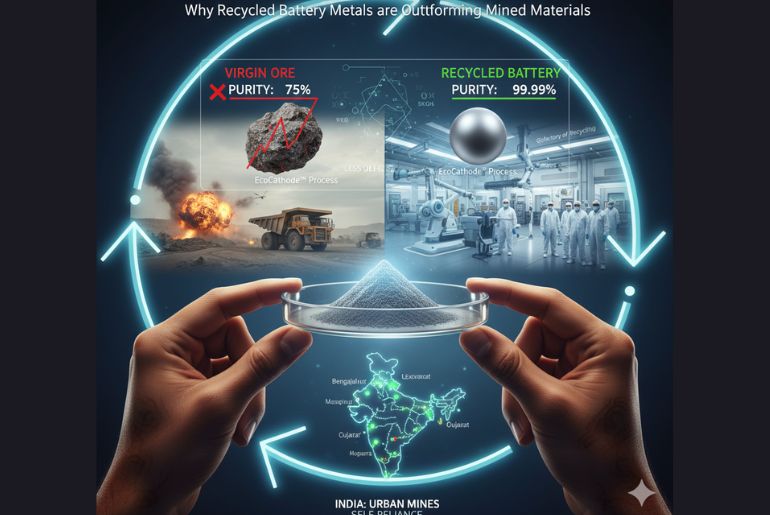
How is it possible for a used material to be better than a fresh one? The answer lies in the EcoCathode™ process, a proprietary hydrometallurgical technique pioneered by firms like Altilium.
Traditional mining is a messy business. When you extract nickel from a mine in Indonesia or lithium from a flat in Chile, you are dealing with the chaos of nature. Virgin ore is filled with geological variability and trace impurities that are incredibly difficult to strip away completely.
In contrast, the EcoCathode process starts with a Recycled Battery that was already a highly engineered, standardized product. By using advanced acid-leaching and chemical re-engineering, the process recovers over 95% of the critical metals. Because the “feedstock” (the old battery) is already refined, the resulting cathode material can be “grown” in a lab-controlled environment with a level of precision that mining companies can only dream of. Every gram of material from a Recycled Battery is engineered to be exactly like the last.
India: The Rising Giant of Circularity
While Europe and the US are leading in lab research, India is quickly becoming the global testing ground for the Recycled Battery at scale. In late 2024 and 2025, the Indian government implemented the Battery Waste Management Amendment Rules 2025, which have fundamentally changed the “informal” scrap landscape.
Historically, battery recycling in India was done in small, unregulated backyards. Today, companies like Lohum Cleantech and Attero are building “Gigafactories of Recycling.” India’s unique environment—a massive population of two-wheelers and three-wheelers—creates a constant stream of feedstock. By 2026, industry experts predict that a significant portion of India’s demand for critical minerals will be met by a domestic Recycled Battery supply.
For India, this isn’t just about sustainability; it’s about Aatmanirbharta (Self-Reliance). Since India lacks large natural deposits of lithium and cobalt, every Recycled Battery serves as an “urban mine.” This allows India to build its EV future without being entirely dependent on Chinese or African Supply Chains.
The ESG Power Play: EU and US Standards
In the Western world, the push for the Recycled Battery is driven by the strict new ESG (Environmental, Social, and Governance) scores. Under the EU Battery Regulation of 2025, every new battery sold in Europe must declare its carbon footprint and contain a mandatory minimum percentage of Recycled Battery content by 2030.
The “Purity Paradox” makes this transition easy for manufacturers. If using a Recycled Battery improves your car’s range and slashes your CO2 emissions by up to 80% compared to mining, why wouldn’t you switch?
In the US, the Inflation Reduction Act (IRA) provides massive tax incentives for batteries that are processed domestically. Because it is much easier to set up a Recycled Battery plant in Ohio than it is to open a new lithium mine in Nevada, the recycling industry is seeing a “gold rush” of investment.
Why Variability is the Enemy
To a battery scientist, variability is the enemy of safety and performance. When a manufacturer buys virgin nickel, they have to constantly adjust their chemical “recipe” to account for slight differences in the ore’s purity.
When they use material from a Recycled Battery, that variability disappears. The metals recovered from a Recycled Battery are “battery-ready” salts that are chemically identical every time. This consistency allows for:
- Higher Safety: Fewer impurities mean a lower risk of internal short circuits.
- Predictable Life: Users can trust that a battery made with Recycled Battery metals will degrade at a steady, known rate.
- Lower Costs: Standardized inputs mean less time and energy spent on refining and quality control.
The Human Side: From Trash to Treasure
We often think of a Recycled Battery as “waste,” but we need to start seeing it as a “concentrated ore.” A typical lithium mine might have a 1% concentration of lithium. A Recycled Battery, however, is almost 100% “the good stuff.”
In India, this shift is creating a new class of “green-collar” jobs. From the workers collecting old smartphone batteries in Delhi to the chemists in Bengaluru refining high-nickel CAM, the Recycled Battery economy is humanizing the energy transition. It’s moving the “mining” out of remote, ecologically sensitive areas and into the heart of our cities.
Looking Ahead: The 2030 Vision
By 2030, the “Recycled vs. Virgin” debate will likely be over. As the first generation of mass-market EVs reaches the end of its life, the volume of available Recycled Battery feedstock will explode. We will reach a “closed-loop” tipping point where we no longer need to dig new holes in the Earth to power our vehicles.
The Recycled Battery is no longer the “green alternative”—it is the “performance choice.” In a world where every mile of range and every minute of charging time counts, the purity of the Recycled Battery is the ultimate competitive advantage.
Key Performance Comparison (2025/2026 Data)
| Feature | Virgin Mined Material | Recycled Battery Material |
| Crystal Structure | Variable / Natural | Highly Uniform / Engineered |
| Purity Level | High (Requires intense refining) | Ultra-High (Inherited from original CAM) |
| CO2 Footprint | 100% (Baseline) | ~20% (80% Reduction) |
| Battery Cycle Life | Standard | Surpasses Virgin (approx. 10-15% better) |
| Cost Stability | Volatile (Market-linked) | Stable (Contract-linked) |
The alchemy is complete. We have learned how to take the “lead” of our old waste and turn it into the “gold” of our clean energy future. Whether you are in a gigafactory in Nevada or a recycling hub in Maharashtra, the message is the same: the best battery of tomorrow is the Recycled Battery of today.
 Electrify your feed! Click here to join our Whatsapp group and to get the latest updates, expert insights, and innovations driving India’s energy storage revolution.