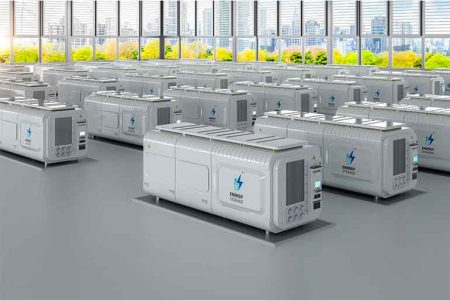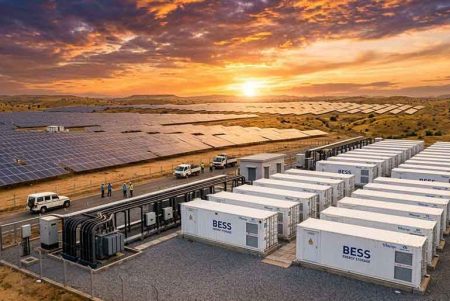
For more than a decade, battery energy storage systems (BESS) have been designed around a simple assumption: batteries must be cooled from the outside. Air flows through racks. Liquid circulates through cold plates. Fans, ducts, and chillers work continuously to pull heat away from tightly packed cells. That assumption is now being challenged. As BESS deployments grow larger, denser, and closer to people—inside cities, basements, substations, and commercial buildings—the limits of traditional cooling are becoming impossible to ignore. Fire incidents, thermal runaway events, and insurance pushback have forced the industry to confront a hard truth: cooling is no longer just a performance problem; it is a safety problem. This is where immersion-cooled BESS enters the picture.
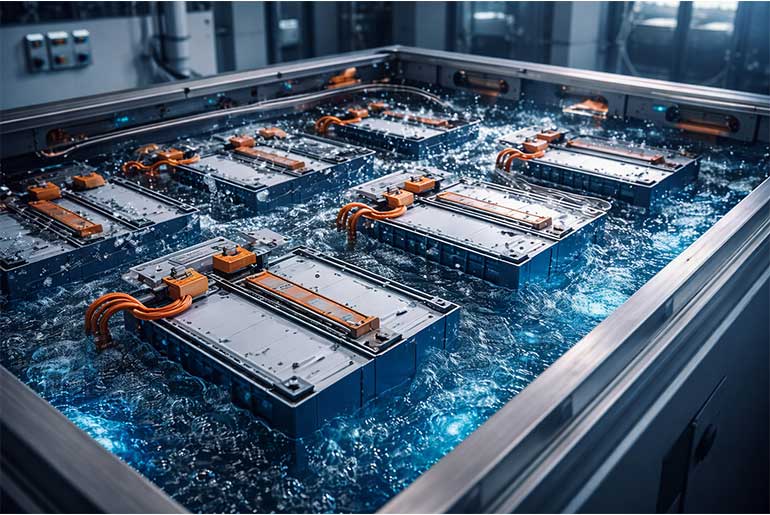
Instead of pushing air or liquid around battery cells, immersion cooling places the entire battery module—cells, busbars, and interconnects—directly into a non-conductive dielectric fluid. The fluid touches every surface, absorbs heat instantly, and fundamentally changes how batteries behave under stress.
What began as a niche idea borrowed from data centres is now emerging as one of the most serious architectural shifts in grid-scale energy storage.
From Air to Liquid: Why Traditional Cooling Is Hitting Its Limits
To understand why immersion-cooled BESS is gaining momentum, it helps to look at the physics of heat transfer.
Air, despite being convenient, is a poor heat conductor. In air-cooled BESS systems, heat must travel from the core of the cell to its surface and then into moving air. This creates thermal lag, hotspots, and uneven temperature distribution—especially during fast charging or high C-rate discharges.
Cold-plate liquid cooling improves matters by circulating coolant close to the cells, but it still relies on indirect contact. Any gap, surface roughness, or imperfect interface introduces contact resistance that limits heat removal.
Immersion cooling removes this bottleneck entirely.
Heat Transfer: Air vs Liquid (Why Immersion Wins)
The implication is striking: forced immersion cooling can be up to 50 times more effective than forced air cooling.
Because the dielectric liquid touches 100% of the cell surface, immersion-cooled BESS eliminates the “core-to-surface” thermal delay common in prismatic and large-format cells. Internal maximum temperature (Tₘₐₓ) stays significantly lower, even during aggressive operating conditions.
This is not incremental improvement. It is a different thermal regime altogether.
Fire Safety Rewritten: The “No-Propagation” Advantage
The greatest fear in any BESS installation is thermal runaway propagation (TRP)—the moment when one failing cell triggers a chain reaction across an entire rack or container.
In air-cooled systems, a single cell failure can reach temperatures of 700°C, radiating heat to neighbouring cells. Once separators melt (typically around 130–150°C), the cascade begins.
Immersion-cooled BESS changes this equation at a fundamental level.
How Immersion Suppresses Thermal Runaway
Dielectric fluids—usually synthetic esters or fluorinated liquids—play three roles at once:
- Heat Diversion- The fluid’s high specific heat capacity absorbs the energy of a failing cell almost instantly. Experimental data from 2025 shows that while a failing cell in an immersion system may reach ~500°C, adjacent cells rarely exceed 50°C—far below critical thresholds.
- Oxygen Exclusion- Fire requires oxygen. Immersion fluids physically displace oxygen from the cell surface. Even if flammable gases are vented, there is no oxidiser present at the source to sustain combustion.
- Venting Management- Most immersion fluids have boiling points above 250°C. When a cell vents, gases bubble through the liquid, where they are cooled and partially condensed before reaching the enclosure headspace. This dramatically reduces flame jets and explosion risk.
The result is something insurers and regulators value deeply: failure without propagation.
The Chemistry of Longevity: Materials Matter More Than Ever
While immersion cooling solves thermal and fire risks, it introduces a new challenge: long-term material compatibility.
A grid-scale BESS is expected to operate for 15–20 years. Submerging electronics in liquid for that long creates a chemically complex environment. The main threat is slow material degradation through swelling, shrinkage, or leaching.
The Gasket and Seal Challenge
Standard BESS gaskets—often EPDM or nitrile rubber—can behave unpredictably when exposed to dielectric fluids.
Fluorinated liquids (legacy Novec-type fluids): Excellent material compatibility, but very expensive.
Synthetic esters (the 2025 industry favourite): Biodegradable, high fire points (>300°C), but chemically polar.
Polar fluids can:
- Cause EPDM to shrink
- Cause silicone gaskets to swell by more than 10%
The Industry Solution
To ensure long-term reliability, engineers are increasingly standardising on:
- FKM (Viton)
- HNBR (Hydrogenated Nitrile Rubber)
These materials retain their compression set and mechanical integrity even after 50,000+ hours of immersion in hot ester fluids.
In an immersion-cooled BESS, materials science is as critical as electrochemistry.
Not Just Cooling: Immersion as a Structural Safety System
By 2025, a quiet but important shift had occurred: immersion cooling stopped being viewed as a thermal upgrade and started being treated as a safety architecture.
This shift is now reflected in regulation.
National Fire Protection Association (NFPA) 855 (2026 Edition)
The upcoming edition of NFPA 855 explicitly recognises engineered solutions such as immersion cooling. For compliant systems, this recognition allows:
- Waivers on the traditional 3-foot (1-metre) spacing between BESS units
- Higher energy density deployments
- Safer installations in urban and indoor environments
- For project developers, this changes site economics entirely.
- The Fluid Penalty Problem—and How Engineers Are Solving It
Early immersion systems faced criticism for adding weight and volume due to large fluid quantities. This was measured using the E/S ratio (Electrolyte or fluid volume per unit of storage).
By 2025, the industry focus had shifted to minimising this penalty.
New Z-pattern and directed-flow architectures allow:
- Thinner fluid channels
- Targeted heat extraction
- Reduced coolant volume without sacrificing safety
The goal for next-generation immersion-cooled BESS is not just better cooling—but cooling efficiency per kilogram of fluid.
Why Immersion-Cooled BESS Is Suddenly Everywhere
The reason immersion cooling is accelerating now is not hype—it is convergence.
- Higher energy densities increase thermal risk
- Urban deployments reduce tolerance for fire incidents
- Insurers demand demonstrable non-propagation
- Regulators want predictable failure modes
In this environment, immersion-cooled BESS offers something rare: a solution that simultaneously improves performance, safety, and siting flexibility.
That is why immersion systems are increasingly being approved for:
- Basements
- High-density commercial buildings
- Data centres
- Urban substations
Locations where traditional rack-and-fan systems are now considered unacceptable risks.
Conclusion: Cooling Is No Longer an Accessory
For years, battery cooling was treated as an auxiliary system—something added after the chemistry was chosen.
That era is over.
In modern grid storage, cooling defines safety, and safety defines where batteries can exist. Immersion-cooled BESS represents a shift from managing heat to engineering failure itself.
By using physics instead of airflow, chemistry instead of suppression systems, and liquid instead of hope, immersion cooling turns the battery enclosure into an active safety component.
In the next phase of energy storage deployment, the question will no longer be:
“How fast can we cool the battery?”
It will be:
“What happens when it fails?”
And increasingly, the most confident answer comes from immersion-cooled BESS.
 Electrify your feed! Click here to join our Whatsapp group and to get the latest updates, expert insights, and innovations driving India’s energy storage revolution.