
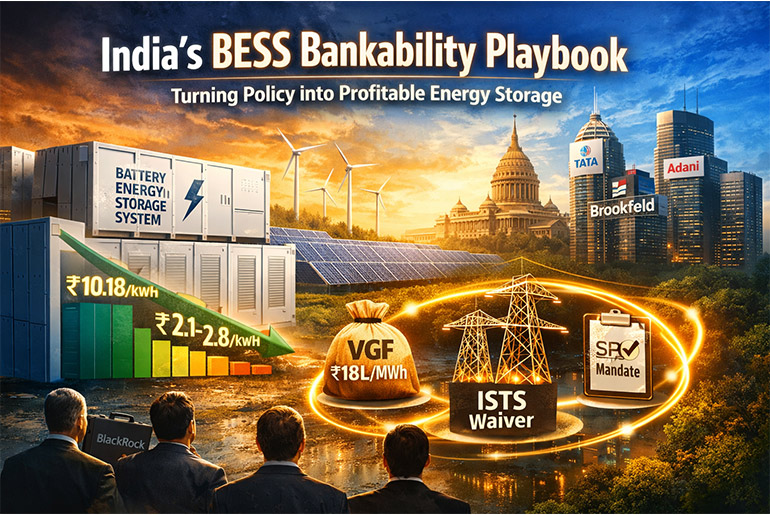
In late 2023, Battery Energy Storage Systems (BESS) in India were widely seen as expensive experiments—technically promising, but financially fragile. Discovered tariffs hovered around ₹10.18/kWh, making storage a tough sell for risk-averse investors and cash-strapped DISCOMs. Fast forward to late 2025, and the story has flipped dramatically. Competitive bids are now landing in the range of ₹2.1–2.8/kWh.
This steep cost correction is not accidental. It is the result of a deliberate, layered policy design that addresses the single biggest obstacle to India’s clean-energy ambition: the storage gap.
As India races toward its 500 GW renewable energy target by 2030, intermittency—solar sleeping at night, wind pausing without notice—has become the system’s weakest link. Grid-scale batteries are no longer optional add-ons; they are the shock absorbers of a renewable-heavy grid. What has changed is bankability.
At the heart of this transformation lies India’s BESS Bankability Playbook—a three-pillar framework built on Viability Gap Funding (VGF), ISTS waivers, and Storage Purchase Obligations (SPOs).
The VGF Safety Net: Turning Risk into Revenue Visibility
If battery storage needed a financial bridge to cross from pilot to scale, Viability Gap Funding (VGF) is that bridge.
Under the Ministry of Power’s BESS-specific VGF framework, the government directly supports project economics by covering up to:
- 40% of total project CapEx, or
- ₹18 lakh per MWh, whichever is lower
Two Tranches, One Clear Signal
- First tranche: 13.2 GWh (already allocated, heavily oversubscribed)
- Second tranche: 30 GWh expansion announced in June 2025, funded via the Power System Development Fund (PSDF)
This expansion was a turning point. It signalled that storage is no longer a pilot programme—it is national infrastructure.
The 85% DISCOM Rule
At least 85% of the stored energy must be offered to DISCOMs under long-term contracts. For investors, this matters enormously:
- Predictable offtake
- Lower merchant risk
- Stronger cash-flow visibility
In simple terms, VGF absorbs early risk so private capital can scale faster. Within India’s BESS Bankability Playbook, VGF functions as the financial stabiliser that makes debt and equity comfortable sharing the table.
The ISTS ‘Golden Ticket’: Unlocking Geography and Scale
Transmission costs can quietly destroy project economics. Recognising this, India extended one of its most powerful renewable incentives to storage: Inter-State Transmission System (ISTS) charge waivers.
But the real genius lies in how the policy differentiates between project types.
Co-Located BESS (Solar/Wind + Storage)
- 100% ISTS waiver for 12 years
- Applicable if commissioned by June 2028
- Ideal for renewable developers integrating storage at the source
This effectively allows developers to move power and time independently—generate when the sun shines, deliver when demand peaks.
Standalone BESS Projects
- Post-June 2025: ISTS charges reintroduced gradually
- 25% increase per year, allowing time for cost absorption and market maturity
The message is clear: build early, integrate smartly, and you’re rewarded. In India’s BESS Bankability Playbook, ISTS waivers act as the infrastructure lever—cutting soft costs and enabling national-scale optimisation.
The Mandate That Changes Everything: Storage Purchase Obligations (SPOs)
Subsidies help. Waivers encourage. But mandates create markets.
India’s introduction of Storage Purchase Obligations (SPOs) does exactly that.
What Is an SPO?
Much like Renewable Purchase Obligations (RPOs), SPOs legally require DISCOMs to procure a minimum percentage of their electricity from energy storage.
The Roadmap
- Gradual escalation
- Target: 4% of total electricity consumption by 2030
This transforms BESS from a “nice-to-have flexibility option” into a statutory requirement.
For investors, this is the holy grail:
- Guaranteed demand
- Regulatory backing
- Long-term contract visibility
Within India’s BESS Bankability Playbook, SPOs are the guaranteed customer—ensuring that assets built today will have buyers tomorrow.
The PLI Synergy: Lowering the Cost Curve from the Inside
While VGF, ISTS, and SPOs address deployment risk, PLI for Advanced Chemistry Cells (ACC) tackles the cost base itself.
By incentivising domestic cell manufacturing, the PLI-ACC scheme:
- Reduces exposure to volatile imports
- Shortens supply chains
- Improves price predictability
As domestic gigafactories ramp up, storage developers gain access to:
- More stable pricing
- Faster procurement cycles
- Better alignment between cell chemistry and grid use-cases
This adds a quiet but powerful fourth layer to India’s BESS Bankability Playbook—cost discipline at the source.
The Policy Trifecta at a Glance
| Policy Lever | What It Does | Why Investors Care |
| VGF | Caps upfront CapEx risk | Improves IRR, eases financing |
| ISTS Waiver | Cuts transmission costs | Boosts project viability |
| SPO | Mandates storage procurement | Guarantees long-term demand |
| PLI-ACC | Lowers domestic cell costs | Reduces volatility & imports |
From Experiments to Assets: What Comes Next
Together, these policies don’t just support storage—they redefine it.
India’s BESS market is no longer a speculative bet on future grid needs. It is becoming a regulated, revenue-backed infrastructure asset class. This is why global capital is paying attention. Names like BlackRock, Brookfield, and large domestic conglomerates such as Tata and Adani are no longer asking if storage makes sense—but how fast they can scale it.
That is the real success of India’s BESS Bankability Playbook. It compresses learning curves, shares early risk, and aligns public goals with private capital.
As renewable penetration deepens and grid flexibility becomes priceless, batteries will sit at the centre of India’s energy system—not as experiments, but as must-have assets powering the next phase of growth.
 Electrify your feed! Click here to join our Whatsapp group and to get the latest updates, expert insights, and innovations driving India’s energy storage revolution.