Imagine standing in the center of a massive solar park in the middle of Rajasthan’s desert on a bright, blistering summer afternoon. The view is incredible. For miles and miles, rows of shiny solar panels tilt toward the blue sky, quietly soaking up the blazing sunlight and turning it into clean electricity. Across India—from the windy plains of Gujarat to the sun-drenched fields of the south—these giant utility-scale solar projects are breaking records every single day.
For a long time, this was exactly the dream. India’s goal was simple: build as many solar panels as possible, cut down on dirty coal, bring down electricity prices, and prove that green energy could be cheap. By any measure, that mission has been a massive success. But if you stay at that solar park just a little longer, a new reality begins to set in.
As the afternoon sun dips below the horizon and dusk takes over, solar power generation quickly drops to zero. But here is the catch: this is the exact moment when millions of families return home, turn on their lights, crank up their air conditioners, and plug in their appliances. Factories are still running, and markets are buzzing. The grid faces a massive spike in demand just as solar power vanishes.
This daily mismatch is causing a huge shift in the industry. The big question is no longer whether we can generate enough green power during the day. The real challenge is making sure that power is available when people actually need it at night. To keep the grid from crashing and to stop wasting clean power, every utility-scale solar projects in India will eventually need energy storage.
The Great Green Boom and the Wall We Just Hit
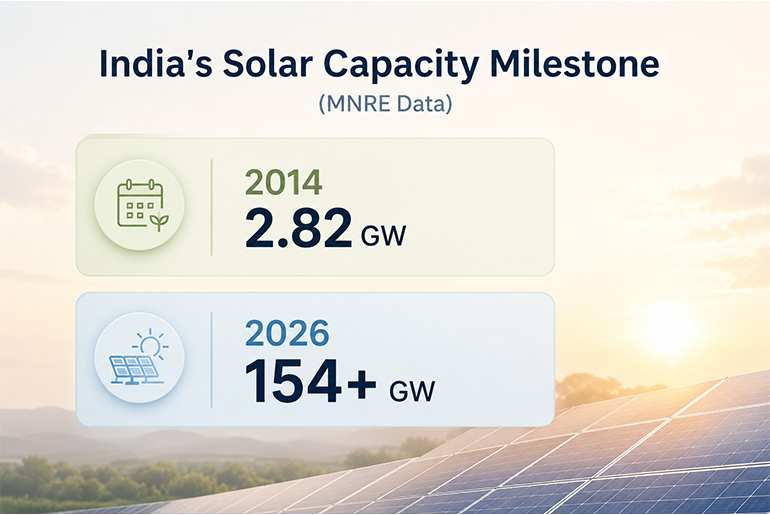
To really understand why every utility-scale solar projects in India will eventually need energy storage, you need to look at how fast things have changed. If you go back to 2014, India had less than 3 GW of solar capacity connected to the grid. Most traditional grid managers looked at solar as a tiny, experimental hobby that could never compete with big, steady coal plants.
Fast forward to April 2026, and official numbers from the Ministry of New and Renewable Energy (MNRE) show that India’s installed solar power has crossed a staggering 154 GW. Solar isn’t a side projects anymore; it is a core pillar of our country’s electricity mix. And since India is aiming for 500 GW of non-fossil fuel capacity by 2030, we have to keep building at a breakneck speed.
How did the India Solar Projects get here so fast? A few big things came together:
- Dirt-Cheap Panels: The cost of solar panels crashed globally, allowing developers to bid incredibly low prices for power.
- Massive Solar Parks: The government set up giant designated zones with ready-to-use land and transmission lines, making it easy for companies to build.
- Big Investments: Huge companies and global funds poured billions of dollars into Indian solar, seeing it as a safe, long-term bet.
But building tons of panels is only the first half of the story. Power grids don’t care about how many panels you have installed; they care about timing. In the old days, coal or hydro plants could turn their generation up or down whenever people flicked a switch. Solar panels can’t do that. They make power when the sun shines, peaking at noon when most people are at work and home energy use is low.
When solar was just a tiny piece of the pie, the grid could handle these ups and downs without breaking a sweat. But now, with solar making up a massive chunk of electricity in major states, grid managers are sweating every day. At noon, there is often too much electricity flooding the lines, threatening to overload the system. A few hours later, that supply falls off a cliff just as everyone turns on their appliances at home.
This is why the old way of doing things is hitting a wall. For years, companies were rewarded simply for adding raw megawatts (MW) to the grid. Moving forward, the real winners will be those who can deliver megawatt-hours (MWh) of steady, reliable power. The era of building simple, standalone solar farms is ending. It is becoming painfully obvious that every utility-scale solar projects in India will eventually need energy storage.
Why Every Utility-Scale Solar Projects in India Will Eventually Need Energy Storage
Let’s look at the hard truth of why running a modern power grid means that every utility-scale solar projects in India will eventually need energy storage. If you keep a solar plant standalone, it is completely rigid. It gives you power when nature allows, take it or leave it. But if you add storage, you turn that unpredictable plant into a reliable powerhouse that can save its energy and sell it whenever the grid is begging for it.
The most painful reason for this change is a problem called “curtailment.” When solar plants produce more electricity than the grid can handle, grid operators have to tell developers to shut down their panels. This means perfectly good, free green energy is thrown away forever. It hurts the environment, and it ruins the developer’s profits. By building storage systems right into the projects, developers can catch that extra midday sun, save it in a digital bank, and stop wasting their hard work.
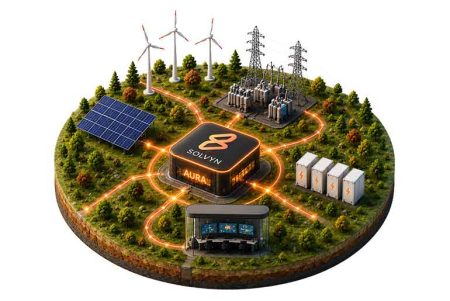
The Storage Lifecycle
Beyond stopping wasted energy, pairing storage with utility-scale solar solves a bunch of massive structural problems at the same time:
Smooth out the Cruel “Duck Curve”
As midday solar floods the grid, it pushes traditional coal plants to scale down to their absolute minimum. But the moment the sun goes down, the demand shoots up like a rocket. This creates a sharp, steep ramp that looks like the belly and neck of a duck. Traditional plants hate this—it strains their heavy machinery to ramp up that fast. Storage eats up the duck’s belly by absorbing power at noon and shaving off the neck by releasing it at night.
Keep the Grid’s Heartbeat Stable
A power grid needs to maintain a perfectly steady frequency to keep electronics and heavy machinery from breaking down. When a cloud passes over a massive solar park, the power output can drop instantly. This causes dangerous bumps in the grid’s heartbeat. Large Battery Energy Storage Systems (BESS) can react in milliseconds—faster than a blink of an eye—injecting power to keep the grid perfectly smooth. Coal plants take hours to respond; batteries take a fraction of a second.
Make a Lot More Money
In the power market, all electricity is not born equal. Power sold at noon when everyone has solar is incredibly cheap. Power sold at 8:00 PM when the whole country is running air conditioners is worth a massive premium. As a developer, if you can hold onto your sun juice and sell it when the country is desperate for it, your profit margins look completely different. This economic reality is why every utility-scale solar project in India will eventually need energy storage.
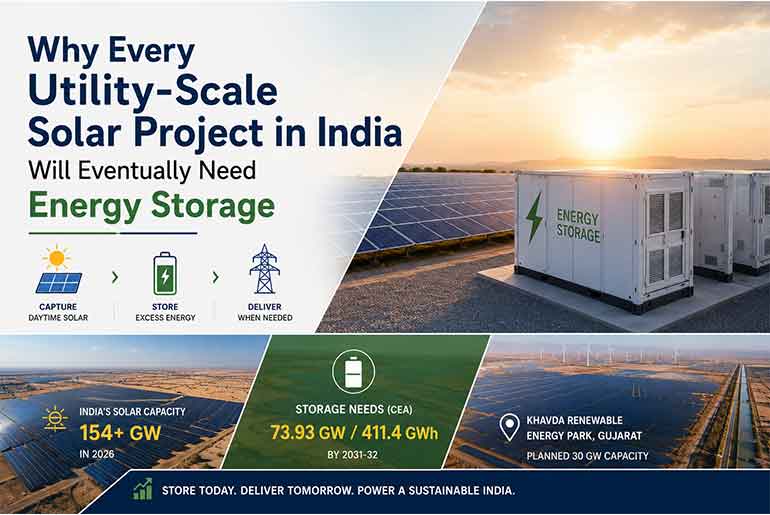
The planners who run India’s energy future see this clear as day. The Central Electricity Authority (CEA) explicitly states that India will need around 16.13 GW of energy storage capacity (with 82.37 GWh of total energy storage delivery) by 2026-27. If you look further down the road to 2031-32, that requirement sky-rockets to 73.93 GW of storage capacity delivering a massive 411.4 GWh of energy.
India’s Projected Storage Requirements (CEA)
- 2026-27: 16.13 GW/82.37 GWh
- 2031-32: 73.93GW/411.4GWh
Batteries are going to do most of the heavy lifting here. The CEA reports that battery installations alone will need to provide over 47 GW of power capacity and 236 GWh of capacity by the early 2030s. These aren’t just wishful guesses made by tech startups; these are the official blueprints guiding the entire Indian power sector.
Real Projects, New Rules, and the Race to Build Gigafactories
If you want to see how this trend is playing out in the real world right now, just look at how government power contracts are changing. The Solar Energy Corporation of India (SECI) and state utilities have stopped putting out simple, vanilla solar tenders. They don’t want just daytime power anymore. Instead, they are forcing the market to change through Firm and Dispatchable Renewable Energy (FDRE) tenders.
These new contracts require developers to blend solar, wind, and storage together so they can promise a smooth, customized stream of electricity that follows exactly what consumers are doing. If a state utility needs power from 6:00 AM to 9:00 AM and then again from 6:00 PM to midnight, the developer has to deliver it, no matter what the weather is doing. Winning these massive contracts without integrated storage is practically impossible, which is another reason why every utility-scale solar project in India will eventually need energy storage.
You can see this shift happening on the ground in India’s most ambitious mega-projects. Take a look at the Khavda Renewable Energy Park being built in the salt flats of Gujarat. It is planned to reach an unbelievable 30 GW of capacity, making it one of the largest green energy hubs on the entire planet. But Khavda isn’t just about massive fields of panels; it is a blueprint for the future of the grid.
To make sure all that power doesn’t crash the system, developers like Adani Green Energy have started installing giant battery setups right next to the solar fields. In 2026, they commissioned a battery energy storage system with a massive 3.37 GWh capacity at Khavda. This is one of the largest battery projects outside of China, and it proves that India’s biggest energy players aren’t waiting around for the future—they are building it today.
Khavda Hybrid Integration Blueprint
- 30 GW Planned Renewable Capacity
- Co-located Multi GWH Battery Storage (BESS)
To back up this massive wave of construction, India is also rushing to build its own supply chains. The government knows that relying entirely on imported battery cells from overseas is dangerous for national security and project budgets. That is why they rolled out the Production Linked Incentive (PLI) scheme for Advanced Chemistry Cells.
This program gives massive cash incentives to companies that build battery gigafactories right here in India. As these factories scale up over the next few years, developers will be able to buy their batteries locally, escaping global trade wars and long shipping delays. Meanwhile, global technology is improving rapidly. Advanced chemistries like Lithium Iron Phosphate (LiFePO4) and brand-new Sodium-ion batteries are getting cheaper and safer by the month, making it easier for local projects to make the leap.
Facing the Hurdles: The Road Isn’t Going to Be Easy
Even though it is clear that every utility-scale solar project in India will eventually need energy storage, getting there is going to take a lot of hard work, money, and problem-solving. This isn’t a magical shift that happens overnight. The industry has to face some real-world headaches to make this transition work:
- High Upfront Costs: Even though battery prices are falling, adding a multi-hour battery system to a solar farm significantly bumps up the initial price tag (CapEx). Getting Indian banks to offer cheap, long-term loans for these new hybrid systems can be tough, as traditional bankers are still learning how to measure the risks of big battery installations.
- Raw Material Scarcity: The global supply chain for key battery materials like lithium, cobalt, and nickel is tightly controlled by just a few countries. Even when India builds its own gigafactories, we will still need to import the raw materials until alternative tech like Sodium-ion becomes mainstream, or until we secure our own mining deals abroad.
- Unfinished Market Rules: For storage to pay off for everyone, our power regulations need to catch up. Right now, the rules don’t always give clear payouts to storage operators for the extra favors they do for the grid, like fixing frequency drops or providing emergency backup. The government is working hard to fix this, but uniform rules across all states take time to iron out.
These challenges are real, but they look exactly like the doubts people had about solar power ten years ago. Back then, critics said solar panels were too weak, too expensive, and would never replace a steady coal plant. Innovation and scale proved those critics completely wrong, and the storage revolution is about to do the exact same thing.
Writing the Next Chapter for Solar Projects in India e
The first chapter of India’s solar journey was all about the rush to capture the sun. We filled empty deserts and barren fields with millions of glittering panels, successfully proving that green energy could be the cheapest power available.
But the next chapter isn’t about just making power—it is about mastering it. The future belongs to smart, integrated energy hubs that can collect the sun’s rays during the day, lock that energy down safely, and unleash it exactly when the country needs it most.
If you are a developer, an investor, or a policymaker in this space, the writing on the wall is plain as day. Building a utility-scale solar project today without planning for storage is like building a car without a fuel tank—it just won’t work in the world we are entering. As the grid fills up and utilities demand steady, predictable, round-the-clock power, it becomes an absolute certainty that every utility-scale solar project in India will eventually need energy storage. The solar boom started with the power of the sun, but its true potential will be unlocked by the power of the battery.
 Electrify your feed! Click here to join our Whatsapp group and to get the latest updates, expert insights, and innovations driving India’s energy storage revolution.