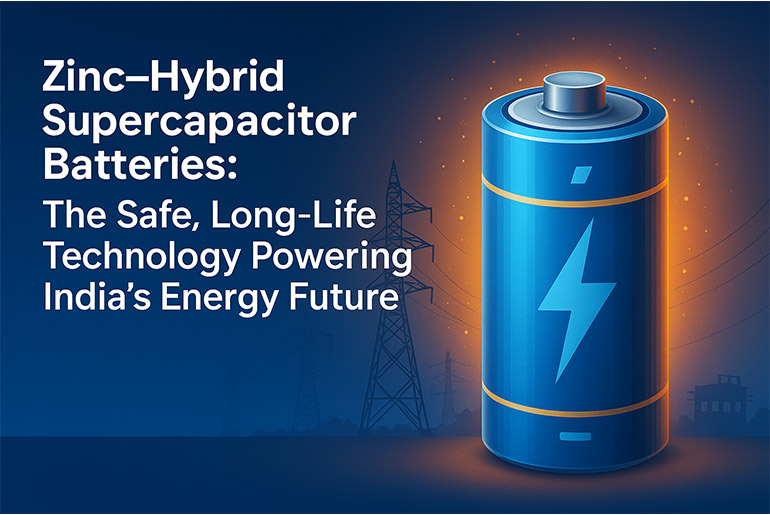
Energy transitions rarely happen overnight. They unfold slowly, shaped by ideas that take time to mature before finally stepping into the spotlight. In India — a country racing toward renewable expansion, electrification, and digital infrastructure — the spotlight has long been on lithium-ion batteries. And rightly so. They power everything from our phones to our factories. But as energy systems evolve and demand more safety, durability, and climate resilience, a new class of storage technology is quietly coming into focus. One that does not try to replace lithium-ion, but instead fills the gaps it cannot. This emerging star is the Zinc–Hybrid Supercapacitor Battery (ZHS) — an intriguing fusion of a battery’s energy-holding ability and a supercapacitor’s instant power delivery.
At first glance, ZHS batteries look modest. They don’t boast extreme energy density, they don’t promise futuristic flying-car fantasies, and they don’t trend on social media like sodium-ion or solid-state innovations. Yet in labs across the United States, Europe, and the UK, researchers are increasingly drawn to this hybrid system because of what it offers: safety, longevity, affordability, and the ability to thrive in climates and conditions where most modern batteries struggle.
A Hybrid Born from Practical Needs
To understand why ZHS batteries matter, the science behind them needs to be explained in simple words.At their fundamental design, these batteries consist of a shampoo, or zinc metal anode, an activated carbon cathode, and a water-based electrolyte. The chemistry allows them to act somewhat like batteries – storing energy through reversible zinc plating and stripping – and also like supercapacitors – allowing for rapid ion movement, along with high bursts of power.
In short, ZHS batteries are capable of 10,000 to 20,000 charge cycles, quick to charge, reliable and work in extreme cold and heat, while eliminating any risk of runaway or fire. Lithium-ion do contain flammable electrolytes, which is inherently dangerous, but these aqueous-based formulation eliminates the risk of explosion, or catastrophic failure.
This is why institutions such as Pacific Northwest National Laboratory (PNNL), Argonne National Laboratory, and Sandia National Laboratories in the US, and ARPA-style research teams in the UK, are deeply invested in ZHS technology. The EU’s Horizon programs have also supported pilots exploring zinc-based energy storage for urban grids and telecom networks. For researchers, ZHS represents a safe, stable, and economically viable pathway into the next chapter of energy storage.
Performance That Solves Real Problems
While lithium-ion batteries remain indispensable, they come with limitations: sensitivity to high temperatures, complex supply chains, risk of fires, and limited cycle life. ZHS batteries step in where these challenges become too costly or dangerous to ignore.
The long life cycle suggests that a ZHS system put in place today can operate well into one to two decades or longer. Their resilience with respect to hot temperatures makes them an ideal option for a country like India, where summer temperatures regularly exceed 45°C and conventional batteries reach their degradation point rapidly under such temperatures. Also, their zinc made chemistry (contrasting with lithium, cobalt or nickel) will result in a lower raw material cost, enabling further disposal (which is already straightforward) and a supply chain less dependent on geopolitically sensitive regions.
While ZHS does not rival lithium-ion in raw energy density, this is rarely a requirement for many real-world applications. In fact, for stationary storage, telecom backup, rural microgrids, data centers, industrial UPS, and EV charging buffers, cycle life, safety, and thermal tolerance matter much more than compact size. And in these scenarios, ZHS batteries shine.
A Technology Designed for the World We Are Actually Living In
One of the most important qualities of ZHS technology is its practicality. It is not designed for “ideal” lab environments — it is built for the unpredictable real world.
In renewable energy parks, ZHS batteries can handle continuous cycling over thousands of days without serious deterioration. In telecom towers spread across deserts, coasts, forests, and cities, they provide stable backup without the fire risks associated with lithium-ion. In rural microgrids, where high heat and low maintenance access are common, ZHS batteries thrive because they are rugged, water-based, and forgiving.
Even EV charging stations — notorious for their intense power needs and load fluctuations — can use ZHS systems as buffer storage to smooth power consumption and prevent strain on the grid. While ZHS batteries are not yet suited for powering EVs themselves, they can play an important role behind-the-scenes in supporting India’s fast-growing charging network.
Industries, too, stand to benefit. From data centers to manufacturing plants, businesses require instantaneous switching, high power bursts, and reliable backup — exactly where ZHS chemistry shines.
Because of India’s climate, energy ambitions, and industrial context, it is a prime candidate for ZHS deployment. India’s heat waves, voltage variability, dusty environment, and unpredictable grid conditions create a variety of challenges to lithium-ion systems, while ZHS batteries hardly notice these conditions as a barrier. India also has a thriving zinc industry, offering a natural upside to developing a domestic supply chain for zinc-based energy storage systems. If India continues to fill in its renewable additions and expands devices like microgrids, rural electrification, smart meters, and storage mandates, ZHS technology could become a strategic asset, helping to enhance the nation’s energy resilience. In addition, research is being conducted globally to understand if zinc-based solutions could provide a greater measure of safety when eliminating fire hazards in crowded cities and industrial areas — a critical safety consideration for India’s energy storage technologies in gigawatts.
Thus, if ZHS technology provides enough of a performance investment and is widely adopted, it may become one of India’s foundational features of energy resilience while also delivering meaningful improvements in fire risk mitigation.
For a country moving as fast as India, ZHS batteries offer something simple yet powerful — a storage solution that is built for our conditions, our challenges, and our future.
Challenges and What Lies Ahead
No technology is perfect. ZHS systems still face barriers before they can become mainstream. Their energy density is lower than lithium-ion, making them less suitable for vehicles or portable consumer electronics. Manufacturing at scale is still limited, with most products in pilot or early commercial stages. Additionally, industry and policymakers need more awareness about the potential of ZHS technology.
But these hurdles are solvable. Better electrolytes, advanced cathode structures, and AI-driven battery management systems are already being researched. Manufacturing will naturally grow as adoption increases. And awareness will rise as more pilot projects demonstrate the reliability and safety ZHS can offer.
Many experts believe that zinc-based energy storage is at the same point lithium-ion was 15 years ago — on the cusp of rapid acceleration.
The Road Ahead
Looking forward, the possibilities are exciting. New electrolyte formulations promise higher efficiency and longer life. AI-based BMS systems could make ZHS batteries smarter, safer, and more predictive. There is potential for India to build zinc-based gigafactories, strengthening its position as a global energy storage leader. Even in mobility, ZHS batteries may eventually find space in low-speed electric vehicles, industrial EVs, and e-rickshaws, where long life and safety matter more than compact size.
What makes ZHS technology particularly compelling is that it doesn’t need to compete with lithium-ion. The energy future will not be dominated by a single chemistry — it will be defined by diversity, each technology serving what it does best. And in this diverse landscape, zinc–hybrid storage stands out as a durable, safe, and affordable alternative where longevity and resilience matter most.
Conclusion
Zinc–Hybrid Supercapacitor Batteries represent a shift toward practical innovation — technology grounded not in hype, but in solving real challenges of safety, climate suitability, cycle life, and cost. They may not be the celebrity of the battery world, but they are the quiet, dependable backbone of a future that prioritizes resilience and reliability.
For India and the world, ZHS batteries offer something rare:
- a storage solution built for long life, harsh conditions, and sustainable scaling — without compromising safety.
This is not a replacement for lithium-ion.
It is the perfect companion to it — filling the gaps, strengthening the grid, and helping the world inch closer to a safer, smarter, cleaner energy future.
 Electrify your feed! Click here to join our Whatsapp group and to get the latest updates, expert insights, and innovations driving India’s energy storage revolution.