The global energy transition is pushing battery technology to its limits. Electric vehicles are demanding longer driving ranges, renewable energy systems need larger storage capacity, and industries across the world are searching for batteries that are lighter, cheaper, and more efficient.
For decades, lithium-ion batteries have powered everything from smartphones to electric cars. While the technology has steadily improved, many scientists believe the traditional lithium-ion design is approaching its physical limits. To go beyond those limits, researchers are now exploring a radically different architecture known as anode-free batteries.
Unlike conventional lithium-ion cells that rely on graphite to store lithium ions, anode-free batteries eliminate the traditional anode entirely. Instead, lithium is deposited directly onto a current collector during charging. This design could unlock significantly higher energy density while reducing material costs and simplifying battery manufacturing.
As global research accelerates, these battries are emerging as one of the most promising next-generation battery technologies, potentially reshaping the future of electric mobility and grid-scale energy storage.
The Limits of Today’s Lithium-Ion Batteries
To understand the potential of anode-free batteries, it is important to first understand how traditional lithium-ion batteries work.
A standard lithium-ion battery contains four primary components:
- Cathode
- Anode
- Electrolyte
- Separator
During charging, lithium ions move from the cathode through the electrolyte and are stored inside the anode. Most lithium-ion batteries use graphite as the anode material, where lithium ions intercalate between layers of carbon atoms.
During discharge, the process reverses and lithium ions travel back to the cathode, releasing energy that powers devices or vehicles.
While this system has proven highly reliable, the graphite anode introduces several limitations. Graphite occupies a large portion of the battery’s internal volume and weight, which restricts how much energy the cell can store. Even with advanced materials and improved manufacturing techniques, graphite-based lithium-ion batteries are gradually approaching their theoretical energy density limits.
This limitation has prompted scientists to rethink one of the most fundamental elements of battery architecture. The question researchers began asking was simple yet radical: what if the anode could be removed entirely?
What Are Anode-Free Batteries?
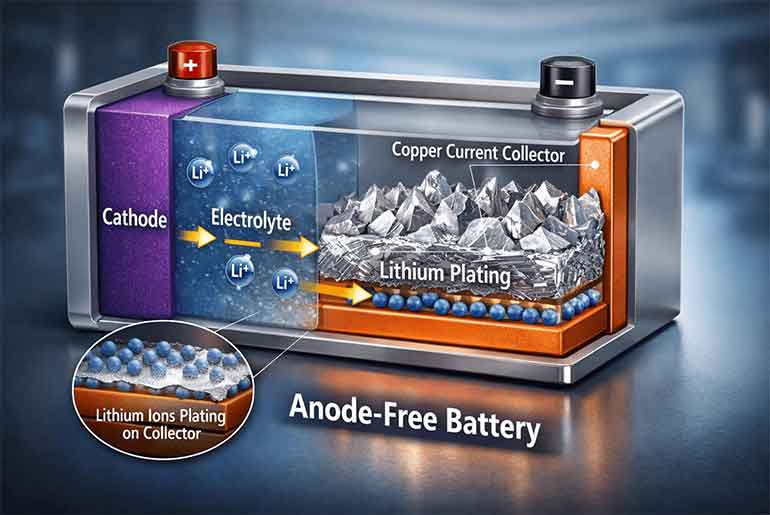
Anode-free batteries represent a new battery architecture that removes the traditional anode material from the cell design. Instead of using graphite or silicon to store lithium ions, these batteries rely on a thin metal current collector—often made of copper.
When the battery charges, lithium ions from the cathode travel through the electrolyte and plate directly onto the current collector, forming a thin layer of metallic lithium. When the battery discharges, the lithium dissolves back into ions and moves back to the cathode.
In simple terms, the anode is created temporarily during charging and disappears during discharge.
This architecture significantly simplifies the internal structure of the battery cell. A traditional lithium-ion battery includes cathode, electrolyte, separator, and a solid anode material. In contrast, anode-free batteries consist of only a cathode, electrolyte, separator, and current collector.
Because there is no permanent anode material occupying space inside the cell, anode-free batteries can potentially store more energy in the same physical volume.
This structural change is why many researchers see anode-free batteries as a potential leap forward in lithium battery design.
Why Anode-Free Batteries Matter
The growing interest in anode-free batteries is driven by several key advantages that could transform battery performance and economics.
Higher Energy Density
One of the most important benefits of anode-free batteries is their potential to significantly increase energy density.
Graphite anodes occupy a large portion of a battery cell’s mass and volume. By removing this component, more space becomes available for active materials that store energy. Researchers estimate that it could increase energy density by 30 to 50 percent compared with conventional lithium-ion batteries.
Higher energy density would directly benefit electric vehicles by enabling longer driving ranges without increasing battery size or weight. It could also improve grid-scale energy storage systems by storing more renewable electricity in a smaller footprint.
Lower Material Costs
Graphite production involves mining, purification, and energy-intensive processing. Eliminating the graphite anode could significantly reduce the amount of raw materials required to manufacture batteries.
Because anode-free batteries remove an entire material layer from the battery cell, they may eventually reduce manufacturing costs and simplify supply chains.
Lighter and Simpler Battery Design
The absence of a solid anode material can also lead to lighter battery cells. This is particularly important for industries such as aviation, drones, and electric transportation where weight plays a critical role.
In theory, it could enable thinner battery cells with simpler manufacturing steps, although this advantage still requires further technological development.
The Engineering Challenges
Despite their promise, anode-free batteries face several technical challenges that researchers must solve before large-scale commercialization becomes possible.
Lithium Plating Stability
The core process behind anode-free batteries is lithium plating. However, lithium does not always deposit evenly on the current collector surface. Instead, it can form irregular structures known as dendrites.
Dendrites are needle-like lithium formations that can grow inside the battery and eventually pierce the separator between electrodes. When this happens, it can cause internal short circuits and safety risks.
Preventing dendrite formation is one of the biggest challenges in developing reliable anode-free batteries.
Limited Cycle Life
Another challenge is cycle life. In many experimental cells, repeated lithium plating and stripping gradually damages the electrode interface.
Over time, some lithium becomes inactive and cannot participate in future charge cycles. This reduces battery capacity and shortens the operational lifespan of anode-free batteries.
Improving cycle stability is therefore a major focus for battery researchers worldwide.
Electrolyte Compatibility
Electrolytes play a crucial role in stabilizing lithium metal surfaces. Advanced electrolyte formulations are being developed to support stable lithium plating while preventing unwanted side reactions.
Innovations in electrolyte chemistry will likely determine how quickly anode-free batteries move from laboratory research to commercial products.
Global Research and Industry Development
Around the world, universities, research institutes, and battery manufacturers are actively studying anode-free batteries.
Researchers are exploring new cathode materials, protective coatings, and advanced electrolytes to improve lithium plating stability. Many of these developments overlap with research into lithium metal and solid-state batteries, which share similar design principles.
In recent years, several battery startups and major manufacturers have announced prototype cells based on anode-free battery architectures. These early demonstrations have shown promising energy density improvements, although long-term durability still requires significant advancement.
Countries such as the United States, China, Japan, and South Korea are investing heavily in next-generation battery research, including anode-free batteries, as part of broader efforts to strengthen energy storage technologies.
The Road to Commercialization
Although laboratory progress is encouraging, commercializing anode-free batteries will require overcoming several engineering and manufacturing challenges.
Large-scale battery production demands highly controlled processes, consistent material quality, and strict safety standards. Achieving stable lithium plating across thousands of charge cycles remains a critical hurdle.
Industry experts believe that this battery may first appear in specialized applications where extremely high energy density is more important than long lifespan. Over time, improvements in materials science and manufacturing could expand their use into electric vehicles and grid storage systems.
The timeline for widespread adoption remains uncertain, but research momentum suggests that this battery could become a significant part of the battery landscape within the next decade.
A New Frontier in Battery Architecture
The global push for electrification and renewable energy is creating unprecedented demand for better batteries. As engineers search for ways to store more energy in smaller, lighter systems, anode-free batteries are emerging as one of the most intriguing solutions.
By eliminating the traditional anode and allowing lithium to plate directly onto a current collector, this architecture challenges decades of conventional battery design. While technical obstacles remain, ongoing research is steadily bringing anode-free batteries closer to practical reality.
If scientists succeed in overcoming stability and durability challenges, anode-free batteries could redefine lithium energy density and unlock a new generation of high-performance energy storage systems for the electrified world ahead.
 Electrify your feed! Click here to join our Whatsapp group and to get the latest updates, expert insights, and innovations driving India’s energy storage revolution.