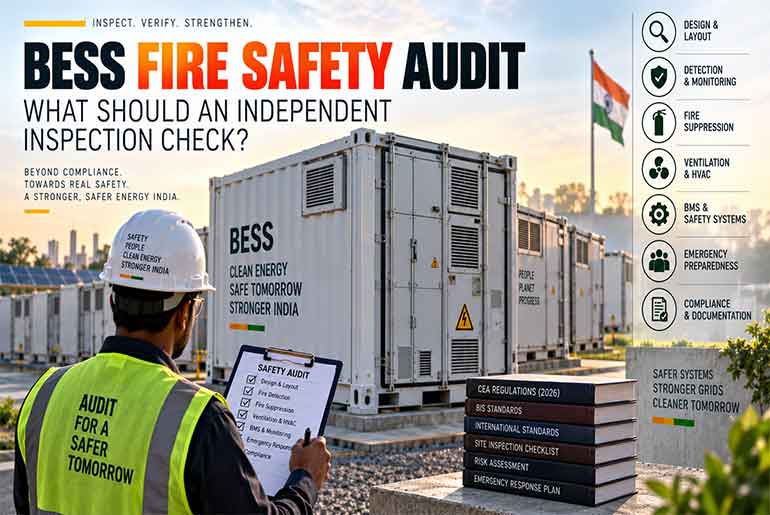
A battery energy storage system can meet its design specifications on paper and still contain serious safety weaknesses in the field. A sensor may be installed but incorrectly positioned. A suppression system may exist but not be tested. A ventilation system may work normally but fail to respond correctly when gases begin accumulating. Emergency procedures may be documented but never drilled. That is why a BESS Fire Safety Audit cannot be treated as a simple checklist exercise.
As India moves toward large-scale deployment of grid-connected battery energy storage, the country is also moving toward a more formal system of independent safety verification. The Central Electricity Authority’s 2026 amendment regulations introduce an explicit requirement for an independent third-party fire-safety audit for applicable BESS installations, with the audit report to be submitted to the Electrical Inspector. The regulations come into force on 1 April 2027.
But there is an important regulatory detail.
The final CEA framework requires the audit and says it will be conducted according to an SOP to be issued by the Authority. CEA had already published a draft SOP in December 2025 for public comments. Therefore, the draft checklist is extremely useful for understanding the direction of India’s audit framework, but it should not be presented as the final operative SOP.
The real question, therefore, is bigger than compliance:
What should a BESS Fire Safety Audit actually prove?
It should establish whether a battery installation can detect abnormal conditions early, prevent thermal runaway from propagating, control fire and gas hazards, protect people and adjacent equipment, and respond effectively when prevention fails.
Why a BESS Fire Safety Audit Is Different
Traditional electrical inspections often focus on equipment condition, electrical protection, earthing, clearances and compliance with prescribed technical requirements.
A BESS introduces another layer of complexity.
The failure can begin at the cell level, progress through a module or rack, release heat and flammable gases, trigger neighbouring cells, and potentially develop into a container-level event. At the same time, the BMS, HVAC, fire detection, ventilation, suppression, PCS and emergency shutdown systems are expected to respond as an integrated safety architecture.
That means an auditor cannot simply ask:
“Is there a fire extinguisher?”
The better questions are:
- What happens when a cell temperature rises abnormally?
- Does the BMS identify the condition?
- Does charging or discharging stop?
- Does the alarm reach the control room?
- Does the affected section isolate?
- Does gas detection activate?
- Does ventilation respond appropriately?
- Can accumulated gases be safely released?
- Does the suppression system activate?
- Can the fire propagate to another enclosure?
- Can emergency responders approach the installation safely?
This is the difference between checking whether a safety device exists and checking whether the safety system works.
India’s Audit Requirement Is Now Part of the Regulatory Architecture
The CEA’s final 2026 amendment creates a dedicated Chapter XA for BESS safety. Among other requirements, it covers BMS monitoring, two-fault-tolerant design, fire and explosion protection, container ventilation, thermal management, hazard detection, automatic fire suppression, emergency shutdown, security and earthing.
Most importantly for this article, Regulation 122(M) requires an independent third-party fire-safety audit for applicable BESS installations. The owner must submit the audit report to the Electrical Inspector at the time of inspection. The same regulation also requires appropriate governments to ensure that fire-safety officials are trained for BESS-specific risks.
The applicability matters.
Regulations 122(A) through 122(M) apply to BESS installations connected at more than 650 V. BESS installations connected at 650 V and below are required to comply with relevant standards under Regulation 122(N).
And because the final regulations become effective on 1 April 2027, the independent-audit obligation should not be described as an already-operative 2026 requirement. It is part of the framework that will take effect from April 2027.
The Draft CEA SOP Gives a Valuable Preview
CEA’s December 2025 draft SOP is particularly significant because it goes beyond a narrow fire-equipment inspection.
The draft framework proposed independent third-party agencies, qualified auditors, pre-commissioning audits, periodic audits and special audits after major upgrades, repairs or fire incidents. It also proposed documentation, corrective-action procedures and an extensive checklist covering the physical installation and operational preparedness.
Again, these are draft provisions, not the final SOP.
But they reveal an important philosophy:
A BESS Fire Safety Audit is intended to examine the entire safety chain, not merely firefighting equipment.
That principle should guide how developers, EPC companies, OEMs, insurers and asset owners think about audits even before the final SOP takes effect.
What Should a BESS Fire Safety Audit Check?
1. Start With the Documents — Not the Battery Container
The first mistake in a weak audit is to walk around the site and inspect equipment without understanding the system that was actually designed.
A serious BESS Fire Safety Audit should begin with documentation.
The auditor should establish:
- BESS technology and chemistry
- total installed energy capacity
- single-line diagrams
- site layout
- battery-container arrangement
- electrical drawings
- fire protection drawings
- ventilation and HVAC design
- BMS architecture
- emergency shutdown philosophy
- hazard mitigation analysis
- fire-risk assessment
- commissioning records
- equipment testing records
- OEM manuals
- O&M manuals
- emergency operating procedures
- previous inspection and maintenance records
- previous incidents and corrective actions
CEA’s draft checklist specifically includes accessible O&M manuals, emergency contacts, emergency operating plans, preventive-maintenance schedules, inspection records, emergency drills and Hazard Mitigation Analysis.
This is important because the documentation tells the auditor what the system is supposed to do; the physical inspection determines whether it actually does it.
2. Verify the Design Against the Installed BESS
A drawing can be compliant while the installed system is not.
The auditor should therefore compare the approved design with the physical site.
This includes checking:
- container locations;
- separation between BESS enclosures;
- distance from buildings;
- access roads;
- emergency access;
- walkways;
- equipment orientation;
- entrances and exits;
- fencing;
- hazard zones;
- ventilation openings;
- fire-service access;
- drainage and spill arrangements.
The final CEA rules require minimum space separation between BESS enclosures and nearby buildings according to relevant standards and battery chemistry.
CEA’s draft audit checklist also specifically asks auditors to verify separation distances and whether large-scale fire testing has been used where required.
That creates an important audit principle:
Distance is not just a civil-layout issue. It is part of the fire-containment strategy.
3. Examine the Battery Container as a Safety Enclosure
The container is not simply a box holding batteries.
It is part of the safety system.
Under the final CEA framework, BESS containers must have explosion protection, forced ventilation and automated louvers for safe release of flammable gases while maintaining internal pressure within safe limits. Ingress protection and applicable requirements for walk-in systems are also addressed.
A BESS Fire Safety Audit should therefore examine:
- enclosure integrity;
- doors and seals;
- ventilation openings;
- automated louvers;
- pressure-relief arrangements;
- ingress protection;
- cable penetrations;
- HVAC interfaces;
- signs of corrosion or damage;
- unauthorised modifications;
- internal obstructions;
- accessibility for emergency response.
An auditor should also ask a less obvious question:
Has anything been added, removed or modified since commissioning that changes the original safety assumptions?
A replacement battery rack, altered ventilation duct, new cable route or software change can alter the behaviour of the overall safety system.
4. Test Thermal Management — Not Just Temperature Readings
Temperature management is central to battery safety.
The final CEA regulations require HVAC and cooling systems for proper thermal management and require mechanisms to limit flammable-material concentration inside BESS enclosures. If mechanical ventilation fails, the system must initiate shutdown to maintain safe flammable-material concentrations.
Therefore, a good BESS Fire Safety Audit should examine both normal and abnormal conditions.
The auditor should verify:
- HVAC capacity;
- temperature uniformity;
- cooling-system condition;
- alarm thresholds;
- high-temperature trips;
- cooling-system failure alarms;
- ventilation failure response;
- automatic shutdown logic;
- ventilation redundancy where applicable;
- maintenance history.
The important question is not:
“Is the container cool?”
It is:
“What happens when the container stops being cool?”
That is where safety engineering begins.
5. Audit the BMS as a Safety System
The BMS is one of the most important layers between abnormal battery behaviour and a larger event.
The final CEA framework requires BESS designs to include monitoring functions and automatic responses, including monitoring of battery parameters and stopping charging/discharging when temperature exceeds manufacturer-recommended values.
A BESS Fire Safety Audit should therefore look at:
- cell/module/rack monitoring architecture;
- temperature sensors;
- voltage monitoring;
- current monitoring;
- alarm thresholds;
- abnormal-condition alarms;
- data logging;
- communication with the control system;
- automatic isolation;
- charge/discharge shutdown;
- alarm escalation;
- historical event logs;
- sensor failures and bypasses.
The auditor should not merely verify that the BMS screen displays a temperature.
The more meaningful question is:
Does an abnormal temperature create the correct chain of actions?
6. Check Detection Before Suppression
Fire suppression is often the most visible component of a BESS safety system.
But detection comes earlier.
The final CEA regulations require hazard detection for smoke, gas, heat and flame, with monitoring, and require automatic fire suppression for every battery container according to the relevant standard.
The draft CEA audit checklist similarly asks auditors to verify detection type, device positioning, testing and monitoring.
A BESS Fire Safety Audit should therefore examine:
- detector technology;
- sensor location;
- detection coverage;
- calibration;
- alarm thresholds;
- communication pathways;
- control-room annunciation;
- testing frequency;
- false-alarm history;
- detector accessibility;
- interaction between detection and shutdown systems.
Detection must also be considered in relation to the failure mechanism.
A system designed only around visible flames may provide little warning during the earlier stages of thermal runaway.
7. Suppression Must Be Audited as a System
One of the most important lessons from BESS incidents is that fire suppression and thermal-runaway control are not necessarily the same thing.
A suppression system can control flames without eliminating the underlying heat source inside damaged cells.
That is why the auditor should investigate:
- suppression technology;
- design basis;
- activation logic;
- manual activation;
- automatic activation;
- nozzle positioning;
- water or agent availability;
- pressure;
- pumps;
- valves;
- alarms;
- maintenance records;
- testing records;
- system accessibility;
- protection against weather and unauthorised access.
CEA’s draft checklist goes further by asking whether the suppression system was designed using fire and explosion testing data.
That is a crucial distinction.
A suppression system should not merely be present. Its design should be connected to the actual hazard behaviour of the BESS.
8. Ask for Fire-Propagation Evidence
This is where a modern BESS Fire Safety Audit becomes much more sophisticated.
The auditor should examine the evidence supporting the installation’s ability to prevent propagation.
Internationally, UL 9540A is used to evaluate thermal-runaway fire propagation through cell, module, unit and installation-level testing. Its sixth edition introduces a more demanding installation-level large-scale fire scenario, including ignition of vented gases and assessment of enclosure, separation and fire-protection performance.
NFPA 855 also increasingly focuses on installation-level fire behaviour and separation between BESS systems.
For an Indian project, these international standards should not automatically be described as Indian law. Their applicability depends on the relevant project, contract, standard, approval or regulatory requirement.
But technically, an auditor should want to understand:
What evidence demonstrates that one failed enclosure will not become several failed enclosures?
That evidence may involve testing, engineering analysis, separation distances, suppression performance and site-specific hazard assessment.
9. Explosion Protection Deserves Its Own Audit
A battery fire is not the only hazard.
Thermal runaway can generate flammable gases. If those gases accumulate and ignite, pressure can develop rapidly.
The final CEA framework specifically addresses explosion protection, forced ventilation, automated louvers and safe release of flammable gases.
Therefore, a BESS Fire Safety Audit should examine:
- gas-detection systems;
- ventilation rates;
- ventilation-failure logic;
- automated louvers;
- pressure relief;
- ignition-source control;
- electrical equipment suitability;
- gas accumulation zones;
- emergency shutdown;
- enclosure integrity;
- deflagration/explosion analysis where applicable.
UL’s current guidance also describes the interaction between BESS fire testing, ventilation and deflagration protection, while NFPA 68 and NFPA 69 address explosion-protection approaches such as pressure relief and combustible-concentration reduction.
This is why a fire-safety audit that ignores gas behaviour is incomplete.
10. Inspect Emergency Shutdowns — Then Prove They Work
An emergency stop button is not a safety strategy by itself.
The auditor needs to understand what happens after the button is pressed.
The final CEA regulations require the affected BESS section to automatically shut down within a preset period when a safety issue or battery anomaly is detected, and require manual emergency-stop mechanisms to be accessible and visible.
A BESS Fire Safety Audit should verify:
- Where are the emergency stops?
- Are they visible?
- Are they accessible?
- What equipment do they isolate?
- Does the PCS disconnect?
- Does battery charging stop?
- Does discharging stop?
- Does the alarm remain active?
- What happens to HVAC?
- What happens to ventilation?
What information reaches the control room?
The difference between a button that exists and a shutdown system that works can be the difference between a controlled event and an escalating one.
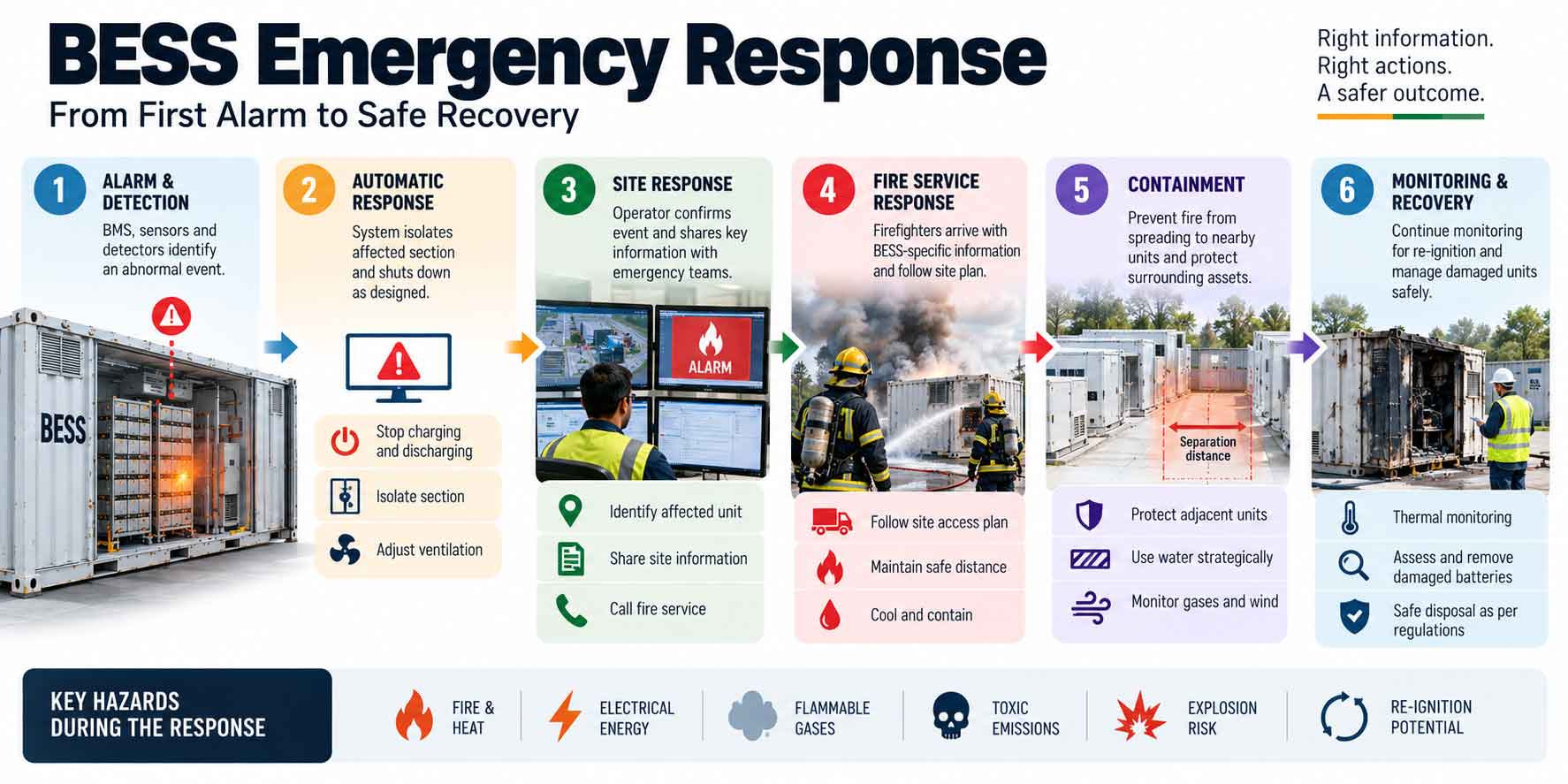
11. Examine the Human Response Layer
The safest BESS in the world can become dangerous if the people responding to an incident do not understand the technology.
The draft CEA SOP proposed emergency operating plans, emergency contacts, consultation with local fire departments and periodic drills.
The CEA has also separately published guidelines for training fire-safety officials specifically for BESS installations.
A BESS Fire Safety Audit should therefore ask:
- Has the local fire service been engaged?
- Does it know the site’s layout?
- Are emergency contacts current?
- Are evacuation routes marked?
- Are emergency procedures available?
- Have drills been conducted?
- Do operators understand thermal runaway?
- Do personnel know when not to enter a container?
- Are gas hazards understood?
- Are isolation procedures documented?
This is particularly important because BESS incidents can involve delayed reignition, toxic gases, stored electrical energy and difficult access conditions.
12. Check the Site Around the Battery
Fire risk does not stop at the container wall.
The surrounding site matters.
The draft CEA checklist specifically calls for inspection of vegetation, combustible debris, flammable material, scrap accumulation, walkways, passages and staircases.
The auditor should also look for:
- blocked access;
- accumulated waste;
- combustible storage;
- damaged fencing;
- poor housekeeping;
- waterlogging;
- damaged cables;
- unauthorised construction;
- inaccessible firefighting equipment;
- compromised emergency routes.
This may sound basic.
But large industrial incidents often become more complicated because several small deficiencies interact.
The Audit Should Also Examine Change Management
One of the most overlooked areas in BESS safety is what changed after commissioning.
Battery systems are not static assets.
During their operating life, a project may experience:
- battery replacement;
- rack replacement;
- software updates;
- BMS firmware changes;
- HVAC modifications;
- PCS replacement;
- cable modifications;
- container relocation;
- fire-system upgrades;
- capacity augmentation;
- changes in operating strategy.
A robust BESS Fire Safety Audit should therefore ask whether every safety-relevant modification was assessed.
A system that passed an original safety assessment may no longer behave exactly as assessed if its hardware, software, chemistry, layout or operating envelope has changed.
That is why the draft CEA SOP proposed a special fire-safety audit after major upgrades or repairs or following a fire incident.
What Should the Final Audit Report Actually Say?
A weak audit report says:
Compliant / Non-compliant.
A useful audit report tells the owner:
What is wrong, why it matters, how serious it is, what evidence supports the finding, and what needs to happen next.
CEA’s draft SOP proposes that audit reports identify available provisions, observations and non-conformities, recommendations with deadlines and additional safety improvements.
For a mature BESS safety programme, findings should ideally distinguish between:
Critical
An immediate condition capable of creating severe fire, explosion, electrical or life-safety risk.
Major
A significant deficiency that weakens a key safety barrier and requires defined corrective action.
Minor
A deficiency that does not immediately compromise the principal safety architecture but should be corrected.
Observation
An improvement opportunity or condition requiring monitoring.
The precise classification methodology should follow the final applicable SOP or governing standard rather than an internally invented grading system.
The Most Important Question: Does the Safety Chain Work?
A BESS Fire Safety Audit should ultimately connect the individual safety layers.
Consider a hypothetical sequence:
Cell temperature rises → BMS detects abnormality → alarm activates → charging/discharging stops → affected section isolates → gas detection activates → ventilation responds → fire protection activates if required → control room receives the alarm → emergency personnel follow the response plan.
If every component works independently but the communication between them fails, the installation still has a safety weakness.
This is why system integration is perhaps the most important concept in a modern BESS Fire Safety Audit.
The auditor should not only inspect components.
The auditor should test the relationships between components.
India’s Audit Framework Is Moving From Paper Compliance to System Assurance
The significance of India’s emerging BESS audit framework goes beyond another regulatory checkbox.
India’s BESS market is moving from individual demonstration projects toward larger installations connected directly to the electricity system. As project sizes grow, the consequences of a failure can extend beyond the battery enclosure to neighbouring equipment, workers, emergency responders and potentially the wider facility.
The CEA’s 2026 regulations recognise this by combining requirements for detection, suppression, ventilation, explosion protection, emergency shutdown, separation, security, earthing and independent auditing.
At the same time, the existence of a regulatory requirement does not automatically mean that the complete testing and certification ecosystem is already mature.
That distinction matters.
The BESS Fire Safety Audit is one layer of assurance. It does not replace product testing, thermal-runaway testing, commissioning tests, engineering analysis, maintenance, operator training or emergency planning.
It brings those pieces together and asks a more difficult question:
Does the installed BESS remain safe under the conditions in which it is actually being operated?
What Developers Should Prepare Before the Auditor Arrives
For developers and asset owners, the smartest approach is not to wait for an audit.
A project should maintain a living safety dossier containing:
- approved drawings;
- equipment specifications;
- BMS documentation;
- fire-system documentation;
- testing certificates;
- commissioning records;
- thermal-management records;
- fire and explosion assessments;
- emergency plans;
- training records;
- maintenance logs;
- alarm histories;
- incident records;
- corrective-action registers;
- modification records;
- previous audit reports.
This turns the BESS Fire Safety Audit from a once-in-several-years inspection into part of the asset’s continuous safety-management system.
And that is ultimately the direction India needs to move toward.
The Bigger Lesson for India’s BESS Industry
The most important development in India’s BESS safety journey may not be the requirement to install another detector, suppression system or alarm.
It is the emergence of independent verification.
A manufacturer can demonstrate that its equipment works.
An EPC can demonstrate that it followed the design.
An owner can demonstrate that maintenance was performed.
But an independent audit asks whether these pieces still form a coherent safety system after they have been assembled, commissioned and operated in the real world.
That is the real value of a BESS Fire Safety Audit.
As India’s regulatory framework moves toward implementation from April 2027, the industry has an opportunity to move beyond compliance paperwork and toward measurable safety assurance. The draft CEA audit framework already points in that direction, with its emphasis on documentation, site layout, detection, suppression, ventilation, emergency preparedness, testing and corrective action.
The final test of BESS safety will not be whether a project can produce a thick compliance file.
It will be whether, when a battery begins to fail, every safety layer responds in the right order, at the right time, and with enough reliability to prevent a local failure from becoming a site-wide emergency.
That is what an independent BESS Fire Safety Audit should ultimately be designed to prove.
 Electrify your feed! Click here to join our Whatsapp group and to get the latest updates, expert insights, and innovations driving India’s energy storage revolution.