
India’s Battery Energy Storage System (BESS) market has quietly moved past the stage of discussions and announcements. In 2026, the shift is clearly visible—projects are no longer just being planned; they are being built, tendered, financed, and in some cases, commissioned. For a long time, India’s renewable story was incomplete. We had massive solar parks and expanding wind capacity, but there was always a gap—generation was growing faster than the ability to manage it. That gap is now being filled by storage, specifically through the massive BESS Projects India 2026 pipeline.
And the numbers reflect this transition. India’s installed BESS capacity is still under 1 GWh, but the pipeline has grown rapidly, crossing 90 GWh of announced projects, as tracked by the nofollowIndia Energy Storage Alliance. A large share of this is already in tendering or early execution stages. This difference between what is installed and what is planned is not a weakness—it simply shows how early India is in this growth curve and how critical BESS Projects India 2026 will be for the decade ahead.
From Policy Push to Real Projects
Until recently, energy storage in India was largely driven by policy intent. That phase is now over. The Government of India has already approved 4,000 MWh of BESS under Viability Gap Funding (VGF), which is helping BESS Projects India 2026 become financially viable. More importantly, central agencies like the Solar Energy Corporation of India have moved from pilot tenders to large-scale procurement.
At the regulatory level, the Central Electricity Regulatory Commission has begun adopting tariffs for renewable projects paired with storage. This is a critical shift. It tells developers and investors that BESS Projects India 2026 are no longer experimental—they are now structured and bankable. At the same time, the Central Electricity Authority has strengthened technical frameworks for integrating storage into the grid. This includes advanced systems like grid-forming inverters, which allow batteries to support grid stability in ways similar to traditional power plants.
States Are Leading the Charge
What stands out in 2026 is how strongly states are pushing storage adoption.
Rajasthan, with its massive solar capacity, is deploying storage to reduce curtailment and stabilize supply. BESS Projects India 2026 running into thousands of MWh are already under development here.
Andhra Pradesh is taking a more cost-focused approach. It has outlined a 3,000 MWh storage plan, with the goal of reducing expensive peak power purchases.
Gujarat is becoming one of the most aggressive players. The state has approved large standalone BESS capacities as well as hybrid renewable-storage projects.
This shows that India’s BESS growth is not being driven by a single authority. It is happening across states, each with its own strategy for BESS Projects India 2026.
Key Projects Defining the Market
Some projects are now shaping how this market will evolve. The Solar Energy Corporation of India has taken the lead with its 1,000 MWh standalone BESS tender, supported by VGF. This is one of the most important signals for the market because it makes it easy for large-scale deployment. At the same time, NTPC Limited is integrating storage into its existing power infrastructure. By adding BESS to renewable and even thermal sites, it is using existing transmission networks more efficiently.
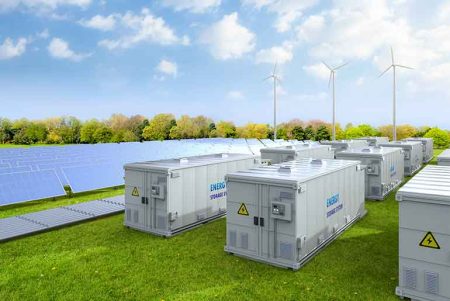
Another important shift is the rise of hybrid projects. Solar and wind are now increasingly being paired with storage to deliver firm and dispatchable power. This is often referred to as Firm and Dispatchable Renewable Energy (FDRE)—and it is becoming the preferred model for utilities managing BESS Projects India 2026.
Where the Money Is Going
The scale of investment tells you how serious this market has become. According to Persistence Market Research, India’s energy storage market is valued at around $3.7 billion in 2026 and is expected to reach $21.8 billion by 2033, growing at nearly 29% annually. This is not just growth on paper. Large renewable-plus-storage projects are already attracting global investors, climate funds, and infrastructure capital. Even standalone BESS Projects India 2026 are now being seen as a separate investment category, not just an add-on to solar or wind.
A Subtle Technology Shift
Lithium-ion batteries, especially LFP, still dominate the market. But 2026 is also seeing early movement toward alternatives. Sodium-ion batteries are beginning to enter discussions, mainly because of their potential advantages in India. Sodium is widely available, which reduces dependence on imports. It also performs better in high temperatures, which is a major factor in the success of BESS Projects India 2026. This change is still in its early stages, but it shows that India is already looking beyond one technology.
The Circular Economy Is Taking Shape
Another important layer that is now emerging is reuse and recycling. With early electric vehicle batteries reaching the end of their first life, there is growing interest in using them for stationary storage. These are called second-life batteries. They are not just an environmental solution—they are also an economic one. Using second-life batteries can reduce BESS Projects India 2026 costs by up to 30%. At the same time, recycling companies are becoming important partners in the ecosystem, turning storage into a circular system.
Why Storage Is No Longer Optional
India’s total installed power capacity has crossed 500 GW, as highlighted by the Ministry of Power India. A large part of this is renewable energy. But renewable energy has a basic limitation—it is not always available when demand is highest. This creates three problems:
- Energy is wasted during peak generation.
- Power becomes expensive during peak demand.
- The grid becomes unstable.
BESS Projects India 2026 solve all three. They allow energy to be stored when it is cheap and used when it is needed. It reduces dependence on thermal power during peak hours and stabilizes the grid. This is why storage is no longer being treated as an optional add-on; it is the core of the system.
The Economics Are Changing
In 2026, the economic answer is starting to shift. When combined with solar, BESS Projects India 2026 are beginning to compete with traditional power sources during peak demand hours. Government support, falling battery costs, and better project design are all contributing to this. In some cases, storage-backed renewable power is becoming cheaper than running new thermal plants for peak supply.
The Real Challenge: Execution
Despite all the progress, one issue remains. India does not have a policy problem anymore. It has an execution problem. BESS Projects India 2026 are still facing delays due to land issues, transmission connectivity, and financing challenges. Some developers are also struggling with aggressive bidding, which affects long-term viability. This gap between plans and execution is the most important thing to watch.
What Lies Ahead
According to the Central Electricity Authority, India will need around 336–346 GWh of energy storage by 2030–2033. This will require large-scale deployment of BESS Projects India 2026, strong integration with renewable projects, and faster execution.
If you step back and look at the bigger picture, this is not just about batteries. India’s power system is being redesigned. The focus is shifting from how much energy we can generate to how effectively we can manage it. And in that system, storage is not just important—it is central. The real question now is not whether BESS Projects India 2026 will grow in India. It is how quickly the market can move from plans to projects—and who will be ready when that shift fully happens.
 Electrify your feed! Click here to join our Whatsapp group and to get the latest updates, expert insights, and innovations driving India’s energy storage revolution.