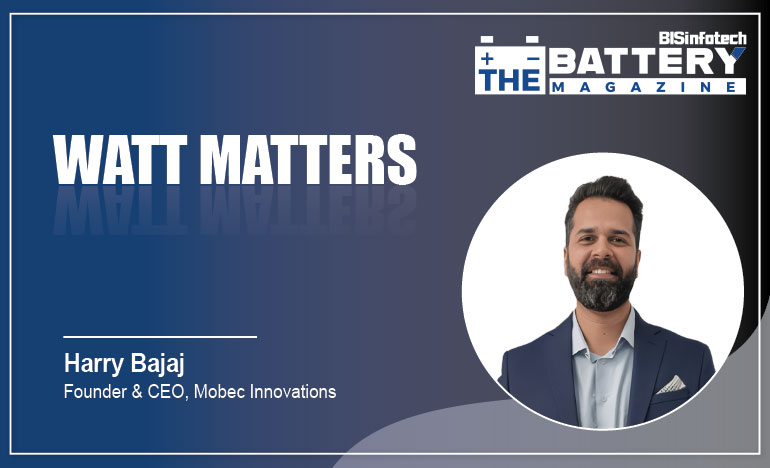
India’s electric vehicle revolution is often celebrated for what it puts on the road, but the ultimate litmus test of its sustainability lies in what happens when those wheels stop turning. As the first massive wave of EV batteries inches toward retirement, the industry is racing to transform a looming environmental hazard into a strategic mineral reserve. The challenge has shifted: it’s no longer just about building the “green” future, but about reclaiming it through sophisticated “urban mining.” In this insightful exchange, Shweta Kumari, Sub-Editor of The Battery Magazine, engages in a thought-provoking discussion with Harry Bajaj, Founder and CEO of Mobec Innovations, to bridge the gap between policy ambition and ground-level reality. Bajaj pulls no punches, dissecting the logistical nightmares of transporting hazardous feedstock across the subcontinent and why the next seven years will be a “make-or-break” period for the sector. From the nuances of EPR compliance to the radical necessity of national geo-tagging for every cell, let’s delve deeper into how Mobec Innovations is orchestrating a circular economy that ensures India’s lithium-ion dreams don’t end in a landfill.
India is rapidly building battery recycling capacity, but large-scale battery waste generation is still evolving. Do you see a gap between capacity creation and actual feedstock availability?
The rapid growth in e-mobility has led to battery waste being increasingly available to recyclers, and this segment is seeing entry of new players almost on an everyday basis. The industry is also growing, as we have received excellent support from the Government, and announcements of various PLI schemes have been encouraging for the sector.
Personally, I don’t see a significant gap between capacity creation and actual raw material/feedstock availability at present. Currently, our plants are running at peak capacity, we have a steady supply of raw material, and a stable client base for our finished products.
However, it is important to note that the real surge in battery waste is expected in the next 5–7 years, when current electric vehicles start reaching their end-of-life cycle. Hence, as an industry, we need to invest now and develop a strong infrastructure to handle this upcoming volume efficiently.
With EPR regulations and policy push in place, how prepared is the ecosystem—collection, logistics, and traceability—to support efficient battery recycling at scale?
In my personal opinion, we are getting there, with the industry gradually moving towards formalization and adoption of standard protocols. Efficient recycling systems are becoming an industry practice.
Both on the supply and demand side, there is a visible shift—companies are increasingly selling to recyclers who are registered and compliant with regulatory guidelines. Similarly, large corporations prefer to work with organized and compliant players like us, as we align with their internal systems and broader ESG goals.
That said, there is still scope for improvement in strengthening collection networks, logistics efficiency, and traceability mechanisms to support large-scale operations across the country.
Can recycling realistically reduce India’s dependence on imported critical minerals, or will it remain a supplementary solution in the near term?
Realistically, recycling will offer supplementary support to India’s demand for critical minerals. As demand for EVs continues to increase and OEMs launch newer and more efficient models, the requirement for critical materials will also rise significantly.
Hence, even on a long-term basis, I believe the recycling industry will only be able to provide limited support in meeting India’s growing demand for these materials. However, it will still play an important role in improving resource efficiency and reducing partial dependence on imports.
What are the biggest technological and economic challenges in achieving high-efficiency, commercially viable battery recycling in India today?
This business is highly capital-intensive, as we are dealing with hazardous and inflammable materials. Every recycler needs to invest significantly in infrastructure to ensure the safety of both the premises and workers.
The process itself requires complex machinery and chemical treatments, as extracted materials need to be properly processed and refined. Both machinery and chemicals are often restricted goods, making sourcing a challenge.
Secondly, the availability and location of end-of-life batteries also pose a challenge. For example, a facility may be located in Delhi while batteries are available in Chennai—leading to high logistical costs, which directly impact profitability. Safe transportation of both raw and processed materials is also critical.
Additionally, this is a highly regulated industry. There are several compliances that need to be strictly adhered to, especially in terms of handling hazardous materials and disposal of waste. Improper disposal can cause significant environmental damage, making compliance both essential and resource-intensive.
Looking ahead, what will define leadership in India’s battery recycling space—technology, scale, partnerships, or policy alignment?
We have come a long way, yet a much longer distance needs to be covered. Even today, a large portion of recycling and material extraction is carried out by the unorganized sector in an environmentally unfriendly manner. These operations need to be brought into the organized and compliant segment.
Secondly, the supply of raw materials is still not very streamlined and needs better alignment with organized players in the sector.
Most importantly, there is a need for a robust system such as geo-tagging of batteries—a national-level mechanism to track batteries reaching end-of-life, along with their journey through dismantling and final disposal.
Finally, the ecosystem needs to evolve into a true circular economy, where extracted minerals are reused in the manufacturing of new batteries. In our view, players who can combine scale, compliance, and sustainable practices will define leadership in this space.
What is the biggest misconception about battery recycling in India today?
The biggest misconception today is that many individuals are still unaware that batteries can be recycled. Even now, a large number of batteries end up in landfills, as people simply dispose of them with regular waste.
Another misconception is that this industry is environmentally unfriendly. In reality, efficient recycling enables the recovery of valuable minerals such as cobalt, lithium, and nickel, which can be reused. If not recycled properly, these materials can cause significant environmental damage.
Increasing awareness and improving collection systems will be key to addressing these misconceptions and strengthening the recycling ecosystem in India.
 Electrify your feed! Click here to join our Whatsapp group and to get the latest updates, expert insights, and innovations driving India’s energy storage revolution.