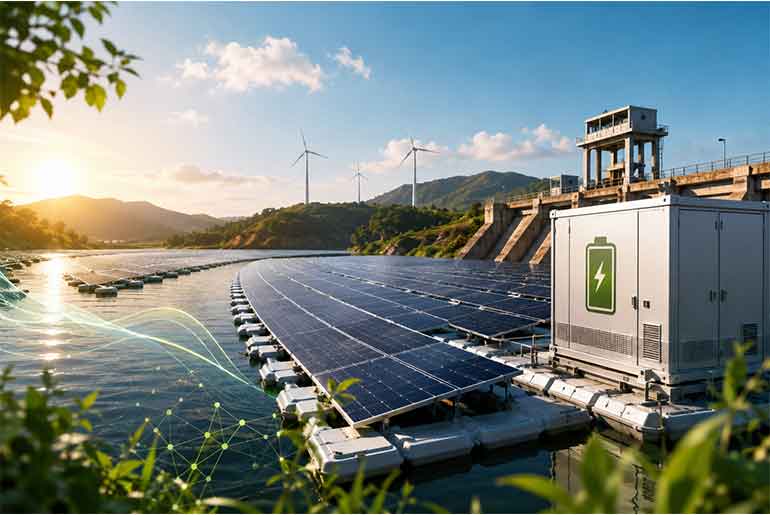
The Union Cabinet, chaired by Prime Minister Narendra Modi, has approved the ₹5,070 crore Pradhan Mantri Surya Sarovar Yojana (PM-SSY) to develop 5,000 MW of floating solar photovoltaic (FSPV) capacity integrated with energy storage systems (ESS) across India.
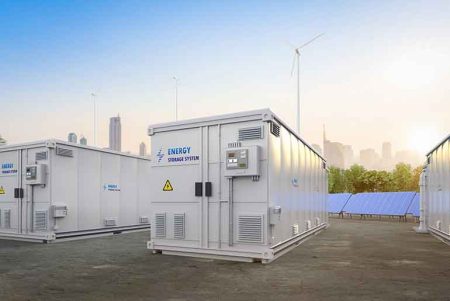
Under the scheme, the proposed 5 GW of floating solar capacity will be equipped with co-located storage providing a minimum duration of two hours, translating into at least 10,000 MWh (10 GWh) of energy storage capacity.
Projects under PM-SSY will be sanctioned from FY 2026-27 to FY 2030-31, while disbursement of financial support will continue until FY 2032-33.
₹1 Crore/MW Central Financial Assistance
A key component of the scheme is Central Financial Assistance (CFA) of ₹1 crore per MW for eligible floating solar projects following their successful commissioning.
The government will additionally provide up to ₹50 lakh per project for feasibility studies and preparatory work, including bathymetry and hydrography assessments, environmental studies and other activities aimed at de-risking project development.
The scheme will cover all States and Union Territories.
India Identifies 102.18 GWp Floating Solar Potential
The Cabinet approval follows an assessment by the National Institute of Solar Energy (NISE), which estimates that India has approximately 102.18 GWp of floating solar potential across reservoirs and other suitable inland water bodies.
PM-SSY is expected to substantially expand India’s relatively nascent floating solar market. The country’s existing floating solar PV capacity currently stands at around 700 MW. The addition envisaged under the scheme — 5,000 MW — would therefore represent a major expansion of the segment.
Floating solar projects can utilise existing reservoirs and industrial ponds for renewable power generation while reducing competition for scarce land resources — one of the significant challenges associated with the large-scale deployment of conventional ground-mounted solar projects.
Storage to Strengthen Grid Reliability
The mandatory integration of energy storage is another significant feature of PM-SSY. With at least 10 GWh of storage planned alongside the floating solar capacity, the projects are expected to improve the ability to manage variable renewable generation and strengthen grid reliability.
The government estimates that projects developed under the scheme could help avoid around 10 million tonnes of CO₂ emissions annually.
PM-SSY is also projected to generate approximately 16,000–17,000 full-time equivalent employment opportunities across the project value chain.
Beyond capacity addition, the scheme is expected to provide a demand push to domestic manufacturing across the floating solar ecosystem, including flotation systems, solar PV cells and modules, and energy storage systems, supporting the government’s Aatmanirbhar Bharat initiative.
The programme is expected to simultaneously advance India’s renewable energy and climate objectives, improve utilisation of reservoirs and other water bodies, strengthen the domestic clean-energy manufacturing ecosystem and reduce the land requirement associated with utility-scale renewable energy development.
 Electrify your feed! Click here to join our Whatsapp group and to get the latest updates, expert insights, and innovations driving India’s energy storage revolution.