Energy Storage Obligation in India has moved from policy notification to active compliance. With the target at 2.5% in FY2026–27, the real test is whether obligated entities can turn a percentage on paper into operating storage assets.
India’s energy-storage story has entered a different phase.
The question is no longer whether the country needs batteries, pumped storage and other flexible resources. That case has already been made by the rapid expansion of renewable generation, rising evening demand and the Central Electricity Authority’s long-term planning.
The harder question is whether India can make storage happen at the speed its electricity system now requires.
That is where the Energy Storage Obligation (ESO) in India becomes important.
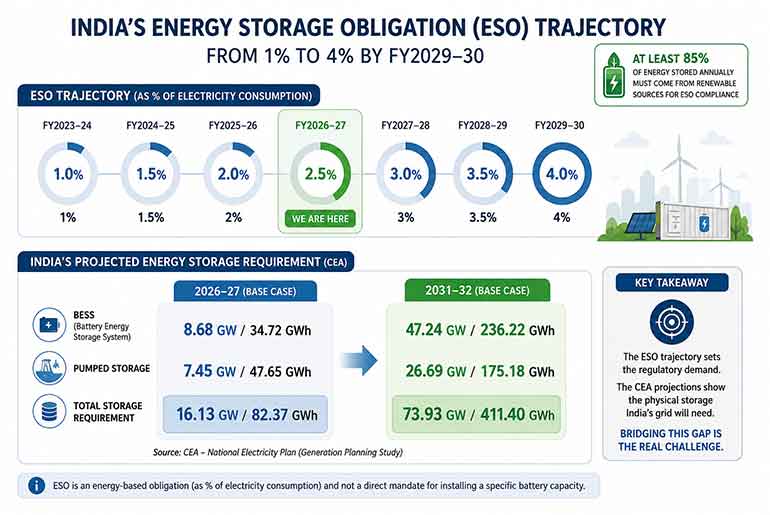
The Ministry of Power introduced the ESO trajectory in July 2022, alongside the Renewable Purchase Obligation framework, with the obligation rising gradually from 1% in FY2023–24 to 4% by FY2029–30. The target for FY2026–27 is now 2.5%.
On paper, this looks like a straightforward regulatory target. On the ground, however, it raises a much more difficult question:
Can a percentage-based obligation create enough actual procurement, financing, construction and commissioning to build the storage fleet India needs?
That is the question the next phase of India’s storage market will have to answer.
From a Renewable Energy Problem to a Storage Delivery Problem
For years, India’s clean-energy conversation was dominated by one question: How quickly can renewable capacity be added? That question remains important. But the power system is increasingly confronting another one.
What happens to renewable electricity when it is generated at the wrong time?
Solar generation peaks during the day, while electricity demand often rises later. Wind generation fluctuates according to weather conditions. A grid with a growing share of variable renewable energy therefore needs resources that can absorb electricity when it is available and deliver it when it is needed.
This is the fundamental reason storage has moved from being an emerging technology to a piece of power-system infrastructure.
The Ministry of Power has also formally recognised Energy Storage Systems as part of the power system, allowing them to function as generation, transmission or distribution elements depending on their application. It subsequently introduced BESS procurement guidelines and the ESO trajectory.
The policy direction is therefore clear.
The implementation question is not.
Energy Storage Obligation in India: What Has Changed in FY2026–27?
The most important fact today is simple:
India is now in the 2.5% ESO year.
The central trajectory is:
Financial Year Energy Storage Obligation
- FY2023–24 1.0%
- FY2024–25 1.5%
- FY2025–26 2.0%
- FY2026–27 2.5%
- FY2027–28 3.0%
- FY2028–29 3.5%
- FY2029–30 4.0%
The obligation is calculated in energy terms as a percentage of electricity consumption, rather than as a requirement to install a particular quantity of battery capacity in MW or MWh. The applicable framework also requires at least 85% of the energy stored annually in the ESS to come from renewable sources for ESO compliance.
This distinction matters enormously. A 2.5% ESO does not mean that an obligated entity must install a battery equal to 2.5% of its electricity demand. It is an energy-based obligation, not a simple battery-capacity mandate. And that is where the policy becomes more interesting.
A 2.5% Obligation Does Not Mean 2.5% Battery Capacity
Imagine an electricity consumer with annual consumption of 10,000 MWh.
A 2.5% energy-storage obligation cannot simply be interpreted as:
“Install a 2.5 MW battery.”
The actual storage requirement depends on how energy is stored and discharged, the duration of the storage system, the applicable procurement arrangement and the regulatory accounting framework.
A 100 MW/100 MWh battery and a 100 MW/400 MWh battery have the same power rating but very different energy-storage capabilities. Likewise, pumped storage and BESS can provide storage through completely different physical systems. This is why the industry needs to stop treating ESO percentages and installed storage capacity as interchangeable numbers. They are not.
That distinction becomes even more important when the ESO trajectory is compared with India’s physical storage requirement.
The Number Behind the Obligation Is Much Bigger Than 4%
The CEA’s National Electricity Plan gives a useful picture of where India’s power system is heading.
Its generation-planning study estimated a total energy-storage requirement of 16.13 GW/82.37 GWh by 2026–27, including 8.68 GW/34.72 GWh of BESS and 7.45 GW/47.65 GWh of pumped storage. By 2031–32, the requirement rises to 73.93 GW/411.4 GWh, including 47.24 GW/236.22 GWh of BESS.
The CEA also examined alternative scenarios rather than treating the base case as a single guaranteed number. Under a higher-demand scenario, for example, BESS requirements could rise to 22.82 GW/91.29 GWh in 2026–27 and 66.78 GW/333.91 GWh in 2031–32.
That is an important distinction. India does not have one fixed storage number.
Its requirement changes with:
- electricity demand,
- renewable penetration,
- BESS costs,
- the pace of pumped-storage development,
- generation additions,
- grid flexibility requirements and
- the way the electricity system evolves.
So the 4% ESO target should not be presented as though it directly translates into a specific number of gigawatt-hours of BESS. It does something different: it creates a regulatory requirement for storage-linked energy procurement. And that can be powerful—but only if the requirement translates into contracts and projects.
The 85% Rule Is What Makes ESO a Renewable-Storage Policy
One of the most important parts of the framework is also one of the easiest to overlook. The ESO is not simply an instruction to put electricity into batteries. At least 85% of the total energy stored in the ESS annually must be procured from renewable energy sources for the obligation to be treated as fulfilled. This gives the obligation a clear policy purpose. Without this condition, a storage system could theoretically charge predominantly from conventional grid electricity and still be presented as fulfilling a storage requirement. The renewable-source condition links storage to the broader clean-energy transition.
In practical terms, it pushes the market toward combinations such as:
- Solar + BESS
- Wind + BESS
- Hybrid renewable + storage
- Renewable power + standalone storage procurement
- and, depending on the technology and project structure, pumped storage charged with renewable electricity.
This is also why ESO should not be treated as a battery-manufacturing policy.
It is fundamentally a power-system policy.
ESO Is Not the Same as RPO—and That Matters
This is one area where the industry’s language can become confusing.
The Energy Storage Obligation was notified alongside India’s Renewable Purchase Obligation trajectory. But ESO should not simply be described as another name for RPO. The distinction is important because RPO asks obligated entities to procure a defined share of electricity from renewable sources, while ESO introduces a storage-linked requirement calculated in energy terms. The framework also provides that the portion of ESO fulfilled through energy stored from renewable sources can be considered toward fulfilment of total RPO.
In other words, the system is not intended to create a simplistic situation where an entity has to procure renewable electricity once for RPO and then procure another completely separate quantity of renewable electricity again for ESO.
State regulators have reflected this relationship in their own regulations.
For example, Maharashtra’s regulatory framework specifies the ESO trajectory and states that energy stored from renewable sources toward ESO can be considered part of total RPO fulfilment.
This is precisely why accounting, metering and verification will become increasingly important as storage deployment grows.
The Real Test Is Happening at the State Level
A central policy notification can establish the trajectory.
But India’s electricity sector is implemented through a complex network of central and state institutions.
State Electricity Regulatory Commissions therefore become critical to translating the national trajectory into actual compliance.
Maharashtra, for instance, has incorporated the ESO trajectory into its regulatory framework, including the 2.5% target for FY2026–27 and 4% target for FY2029–30.
Other state frameworks have similarly incorporated the central trajectory.
This is where the story becomes much more interesting than the headline:
The national obligation exists. But the storage market will ultimately be built through state-level procurement, contracts, tenders, regulations and project execution.
And implementation is not uniform.
The Gap Between an Obligation and an Operating Battery
This is perhaps the most important lesson for India’s storage industry.
A government can announce:
“2.5% storage obligation.”
A regulator can notify:
“2.5% compliance target.”
But neither action, by itself, builds a battery.
A project still needs:
- a procurement contract,
- a revenue model,
- financing,
- land or project infrastructure where required,
- grid connectivity,
- battery supply,
- power-conversion equipment,
- control and energy-management systems,
- construction,
- commissioning,
- and a long-term operating framework.
This is where the Energy Storage Obligation meets the issue we examined in our previous article.
The relationship is straightforward:
ESO can create demand. VGF can help address viability. But neither substitutes for project execution.
This is why the three policy layers need to work together. VGF Solves One Problem. ESO Tries to Solve Another. India’s storage policy architecture is increasingly beginning to resemble a chain. Storage requirement creates the need. ESO creates a regulatory demand signal. Competitive procurement converts that signal into projects. VGF can improve project economics where storage remains difficult to finance. Manufacturing policy supports domestic supply. Grid and market reforms determine how the asset earns revenue once it is operating.
The Ministry of Power has already issued guidelines for BESS procurement and for firm and dispatchable renewable power with storage. It has also introduced procurement frameworks for pumped-storage capacity.
This matters because the Indian storage market is no longer being built through one policy. It is being assembled through multiple mechanisms that address different parts of the same problem.
And This Is Where the 4% Target Faces Its Hardest Question
By FY2029–30, the central ESO trajectory reaches 4%. But should the industry interpret that as sufficient?
There is no simple yes or no.
The CEA’s physical storage requirement shows why. By 2031–32, India could require 236.22 GWh of BESS storage under the base-case generation-planning study. That requirement is driven by the physical needs of the electricity system.
ESO, meanwhile, is an annual energy-based obligation linked to electricity consumption. These are different policy metrics serving related purposes. The danger would be to assume that hitting 4% automatically means the CEA’s storage requirement has been met.
It does not.
The real question is whether the combination of ESO, procurement mechanisms, VGF, storage tenders, market participation and system planning produces enough operating storage capacity to meet India’s actual grid needs.
From Compliance to Contracts: The Missing Middle
This may become the defining issue for India’s storage market over the next few years.
India has already moved beyond the stage where storage is merely discussed as a future technology.
Government agencies and utilities are procuring standalone BESS, renewable-plus-storage systems, firm and dispatchable renewable power and pumped-storage capacity. The Ministry’s own procurement framework now includes guidelines for BESS and firm and dispatchable renewable power with storage.
The CEA also maintains a dedicated database tracking the development and deployment of BESS projects, with updates available through June 2026.
So the next question is not:
“Does India have a storage policy?”
It clearly does.
The next question is:
How much of the policy signal is turning into signed contracts, financial closure, construction and commissioning?
That is the metric the industry should increasingly watch.
What the Battery Industry Should Watch Now
For battery manufacturers, the ESO trajectory is obviously a positive demand signal. But manufacturers should look beyond the headline percentage.
The real opportunity will come from the combination of:
- utility-scale BESS procurement
- solar-plus-storage projects
- RTC and FDRE procurement
- peak-power requirements
- ancillary services
- capacity and flexibility markets
- and long-duration storage.
The market will also increasingly differentiate between systems designed for different applications.
A two-hour BESS designed for evening peak shifting is not necessarily the same product or business case as a longer-duration system designed to provide several hours of renewable firming.
The policy may create the demand signal. The market will decide which technologies win.
For Developers, Bankability Remains the Bigger Question
An obligation can create a buyer. It cannot automatically create a bankable project.
Developers need visibility on:
- contract duration,
- payment security,
- dispatch rights,
- degradation assumptions,
- augmentation requirements,
- availability guarantees,
- round-trip efficiency,
- operating cycles,
- replacement costs,
- transmission access,
- revenue stacking and
- regulatory treatment.
These factors will determine whether a nominal ESO requirement turns into a financially viable storage asset. This is why the evolution of India’s storage market cannot be judged only by how many GWh are tendered. Tendered capacity is not commissioned capacity. And commissioned capacity is not necessarily profitable capacity. The industry’s next phase will be about converting policy certainty into bankable cash flows.
The Opportunity Is Bigger Than Batteries
Another reason we should not frame ESO purely as a BESS mandate is that India’s storage future will not be built with lithium-ion batteries alone.
The CEA’s planning itself includes both pumped-storage projects and BESS in the national storage requirement.
That means the ESO-linked ecosystem could generate opportunities across:
- BESS,
- pumped hydro storage,
- power conversion systems,
- transformers,
- EMS and BMS,
- forecasting,
- energy trading,
- EPC,
- operations and maintenance,
- grid software,
- financing,
- recycling and
- eventually other commercially viable storage technologies.
For India’s battery industry, this is an important distinction.
ESO is not a battery chemistry policy. It is a flexibility policy.
The technologies that can provide that flexibility competitively will ultimately capture the opportunity.
So, Is the Energy Storage Obligation Working?
It is too early to answer that with a simple yes or no.
The policy has already achieved something important: it has put storage inside India’s formal electricity-planning and procurement architecture.
It has also established a rising trajectory rather than leaving storage deployment entirely to voluntary market demand. The Ministry of Power itself describes ESO as a mechanism introduced to promote the development of Energy Storage Systems.
But the harder test is still ahead.
A successful storage obligation ultimately needs to produce:
procurement → contracts → financing → construction → commissioning → operation.
If the chain breaks between any of those stages, the percentage on the regulatory books will not translate into the storage capacity the grid needs.
That is why India’s 2.5% ESO in FY2026–27 should be viewed not as the finish line, but as a checkpoint.
The Next Question Is Not “How Much Storage?”
India has spent years asking how much renewable capacity it can build.
It is now beginning to ask how much flexibility that renewable system needs.
The Energy Storage Obligation is an important part of that transition.
But the real test will be whether the policy can move the market from compliance numbers to physical infrastructure.
- A 1% target was a beginning.
- A 2.5% target is now the reality.
- A 4% target is waiting at the end of the current trajectory.
Yet India’s electricity system is simultaneously moving toward a much larger physical storage requirement, with CEA’s base-case planning pointing to 236.22 GWh of BESS by 2031–32.
That leaves India with a deceptively simple challenge:
Can the country build storage faster than its renewable system creates the need for it?
The answer will not be found in the ESO percentage alone.
It will be found in the projects that reach financial closure, the batteries that are manufactured and installed, the pumped-storage projects that come online, the contracts that provide predictable revenues, and the storage assets that actually deliver electricity when the grid needs it.
That is where the next chapter of India’s storage story will be written.
 Electrify your feed! Click here to join our Whatsapp group and to get the latest updates, expert insights, and innovations driving India’s energy storage revolution.