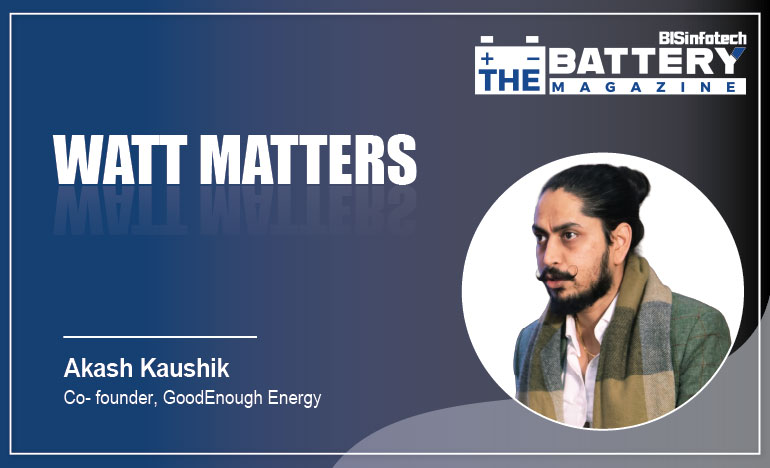
In the industrial heartlands of India, the transition to green energy is a battle between the “brutal” surges of heavy-duty machinery and the delicate stability of the grid. While many see batteries as simple storage boxes, Akash Kaushik, Founder of GoodEnough Energy, sees a thermodynamic challenge that requires aerospace-level precision. From the floor of his ₹450-crore Greater Noida facility, Kaushik is engineering a “diesel killer” designed to thrive in the hostile 48°C Indian summer.
Shweta Kumari, Sub-Editor of The Battery Magazine, engages in a though provoking discussion with Kaushik to peel back the layers of this 20 GWh vision. He highlights how the company is bridging the gap between “import-dependence” and true domestic innovation. To dive into the depths of grid-forming inverters and the “Storage-as-a-Service” model, read on for the full strategic roadmap to 2026.
Beyond the DG Set: You’ve been vocal about decarbonizing heavy industries like steel and cement. How does Good Enough Innovation’s BESS architecture handle the high-surge, “dirty” power demands of these heavy-duty cycles compared to traditional grid-tied solutions?
You know these loads are brutal. The inrush, the harmonics, the voltage sag — they don’t just decrease the life of your equipment, they throw your entire connection into chaos and push the problem back into the grid. Traditional grid‑tied solutions mostly act like a pipe: whatever mess your process creates just flows straight upstream.
My journey starts with thermal sciences and propulsion as an engineer, not through a classic power‑systems track. When I walk into a steel plant or a cement mill, I don’t see “just another industrial consumer.” I see a thermodynamic problem with a very specific electrical signature. Once you look at it that way, you stop trying to band‑aid symptoms and start engineering around the real physics.
So what do we actually do differently? At GoodEnough Energy, we put the intelligence and the buffer right where the chaos is born. Our active front‑end power electronics and BMS manage the ramp rate, the battery takes the surge, and what leaves our system is a clean, predictable load profile your utility and your internal network can live with. In plain terms: your process can stay messy on the inside without turning your grid connection into a war zone.
You’ve probably seen the standard response in this segment: “Just add another DG set.” I’ve sat across from steel plant owners who were running megawatts of diesel as a very expensive stability crutch. It doesn’t fix power quality; it just adds fuel cost, maintenance, and carbon on your books. On recent steel projects where we replaced that crutch with BESS, we saw Contractual DEMAND penalties drop by over 30% in the very first billing cycle. Same furnaces, same production, same grid — different way of handling the physics.
That’s the core point I want you to take away. If you’re in heavy industry, you don’t have to choose between dirty stability and clean chaos. With the right architecture, you get stable power quality, lower penalties, and a pathway off diesel — all at the same time.
The 20 GWh Vision: With the roadmap to scale your Greater Noida facility to 20 GWh by 2027, what does this mean for the “Made in India” supply chain? Are you looking at deeper backward integration into cell manufacturing or focused on the power electronics layer?
We’ve committed about ₹450 crore to this build‑out, and roughly ₹180 crore of that is already in the ground—infrastructure, lines, test beds, integration rigs. That money is not sitting in a PPT; it’s sitting in steel, automation, and people. From where you sit as an OEM, EPC, or developer, that matters because you’re not buying a promise, you’re buying capacity that’s live today and scaling from around 7 GWh towards 20 GWh on a defined timeline.
On cells, let me be blunt with you. CATL, BYD and a few others have a 10–15 year head start and billions sunk into chemistry R&D. Jumping into cell manufacturing today just because a PLI brochure looks attractive would be, in my view, a misallocation of Indian capital. Where projects succeed or fail in the field is not at the cathode; it’s at the integration layer—power electronics, intelligent BMS, and thermal hardware that doesn’t melt down at 48°C ambient. That is the gap we’re choosing to close.
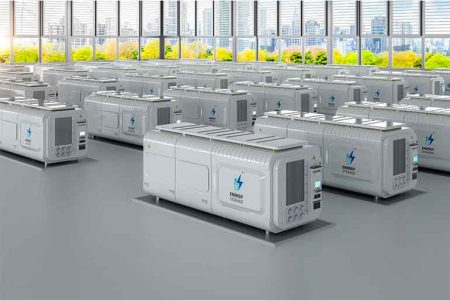
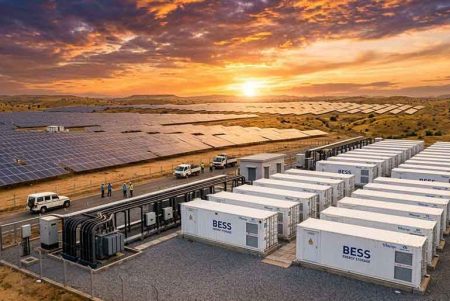
Day to day, that means our Greater Noida facility is already focused on module assembly, pack integration, and containerised systems. We’re shipping a 5 MWh storage solution in a single 20‑foot container, which I can tell you from painful early prototyping wasn’t a trivial density target. The next phase is to pull more of the power conversion stack in‑house and localise aggressively. By the time Indian cell manufacturing under PLI is mature and bankable, my goal is that you can slot those cells into our architecture without redesigning your entire project.
So if you care about “Made in India” in a serious way, not just as a label, the promise we’re making is simple: we’re building the brains and the backbone of the system here—power electronics, BMS, thermal architecture—and scaling them to 20 GWh so you have a domestic platform to build on, regardless of which chemistry wins in the end.
Optimizing the Micro-Scale: In high-capacity storage, heat is the enemy. Could you share some insights into how you’ve optimized the thermal management and pack-level porosity to ensure longevity in the harsh Indian ambient temperatures?
You deploy in Gujarat or Rajasthan summer, and you’re not just hot—you’re hostile. Ambient hits 47-48°C, solar gain adds another 8-10°C inside your container, and lithium-ion above 45°C doesn’t degrade gracefully. The chemistry punishes you. Fast-forward three years, and poor thermal design isn’t just a capacity fade problem; it’s a safety incident waiting to happen.
My aerospace propulsion background taught me this the hard way. You’re always managing concentrated energy density and non-linear failure modes. Same physics in a jet engine as in a BESS pack. So we built thermal management as a deliberate three-layer system, not some off-the-shelf European solution pretending India has the same climate.
- Cell level: Prismatic formats. Better surface-to-volume for heat rejection at scale.
- Module level: Pack porosity and inter-cell spacing engineered and thermal insulation to stop heat propagation between cells—no dead zones, no hotspots creeping up over time.
- System level: Liquid cooling for uniform heat transfer and evacuation. And our BMS doesn’t just react to temperature spikes; it predicts thermal gradients and pre-conditions cells before your demand hits.
I remember walking a Discom engineer through our first deployment data. He kept asking, “Where’s the derating curve?” There wasn’t one. At 45°C ambient, our cycle efficiency was still 94% of nameplate. That’s what proper Indian thermal design buys you—predictable performance when everyone else’s packs start sweating.
You get the point. Heat isn’t a footnote in India; it’s your P&L. Build thermal right from day one, or watch your warranties evaporate.
Grid Stability & CEA Standards: As the grid evolves, so do the rules. How are your systems engineered to meet the latest grid-forming requirements and frequency regulation standards being pushed by the CERC and CEA?
You’re going to see CEA and CERC tighten requirements year after year. I actually welcome that. Stricter standards raise the floor for everyone and quietly remove the players who are just importing boxes and hoping nobody looks too closely at what’s inside. If you’ve invested in real engineering depth, regulation isn’t a burden; it’s a filter that works in your favour.
The big shift you need to care about is simple: grid-following to grid-forming. Grid-following inverters are passengers. They watch voltage and frequency and try to stay in sync. Grid-forming inverters drive the bus—they actively synthesise the waveform and hold it when the system is stressed. Picture a state grid running 60–70% renewables with very little synchronous generation online. In that scenario, grid-forming isn’t a “nice to have,” it’s what stands between a disturbance and a cascade. We designed our power conversion platform(inverter) with grid-forming as the baseline from day one, not as a patch after a new notification.
On frequency regulation, the rule of the game is fast, predictable response. Our systems react to deviations in the 20 millisecond range, which sits comfortably inside CERC’s ancillary services windows. The control stack is built for SCADA and EMS integration from the start, so when POSOCO or a state SLDC asks you for specific ramp profiles or setpoint behaviour, you’re not scrambling with custom one-off fixes.
One moment that really drove this home for me was a consultation round on the draft BESS grid interconnection guidelines. You had utilities, OEMs, regulators in the same room, and you could almost see the divide: people who had actually modelled grid-forming behaviour in weak systems, and people reacting line-by-line to a PDF. My takeaway for you is simple: if you’re not at that table shaping how these standards are written, you’ll spend the next decade reacting to them at site level.
So when you look at our systems through a CEA/CERC lens, what you’re really getting is a grid asset that is built to be a stabiliser, not a passenger—fast frequency response, grid-forming by design, and a communication stack that talks the same language as your control room.
The Tariff Game: With recent SECI and NTPC BESS tenders hitting new price benchmarks, how is Good Enough Innovation positioning its Levelized Cost of Storage (LCOS) to remain competitive while maintaining high-grade safety standards?
You know the game. Developers chase the headline LCOS number on bid day. Utilities sign the contract. Three years in, degradation hits, auxiliary draw eats margins, and suddenly that “low cost” system is a P&L nightmare. The real LCOS isn’t what you quote at auction. It’s what your balance sheet shows after 10–12 years of cycles, O&M, and the occasional safety scare. A system 15% cheaper upfront that degrades 30% faster? That’s not competition. That’s mispriced risk.
I’ve watched this play out overseas. A thermal event doesn’t just torch one asset—it poisons lender appetite and sets regulators back two years. You don’t want that smoke on your sites. Our approach flips the equation. We compete on design efficiency and localised supply chains, not corner-cutting. That ₹180 crore manufacturing investment you keep hearing about? It’s directly shaving landed costs while we pull power electronics vertical. No skimping on cell grade, BMS logic, or fire suppression.
What gives me confidence is how tenders are maturing. SECI and NTPC aren’t just reading spreadsheets anymore. Bankability. Track record. Warranty terms. Performance bonds. They’re asking the right questions now, which rewards the companies that built engineering-first instead of bid-first.
Here’s the field truth I learned from a utility lead who almost went cheap: they modelled two bids side-by-side over 10 years. The “winning” low-ball LCOS ended up 22% more expensive after round-trip efficiency fade and higher O&M. You avoid that math by picking the system that starts with the full lifecycle in mind. That’s where we sit—competitive today, bankable tomorrow, no surprises.
Bottom line for you: stop optimising for the auction room. Optimise for the day your asset hits 6,000 cycles and still delivers. That’s actual cost leadership.
BESS-as-a-Service: We are seeing a shift from CAPEX to OPEX models in energy. Is Good Enough Innovation exploring a “Storage-as-a-Service” model for MSMEs who want to transition but lack the upfront capital?
You’ve probably met this customer yourself: running two or three DG sets, hates the noise, hates the diesel bill, knows it’s bad for business and the air—but when you mention a ₹1.5–2 crore BESS, the conversation dies. Not because the payback isn’t real. Because their balance sheet can’t absorb that kind of upfront risk. That gap between “good idea” and “I can actually sign this PO” is exactly where Storage‑as‑a‑Service has to operate.
So yes, we’re building a Storage‑as‑a‑Service model, and it’s not theory. The core idea is simple: we convert that heavy capex into a monthly service fee tied to energy delivered or peak demand shaved, with performance guarantees on our side. You get the benefit—lower diesel run hours, better power quality, more predictable costs—without loading your balance sheet with a new asset.
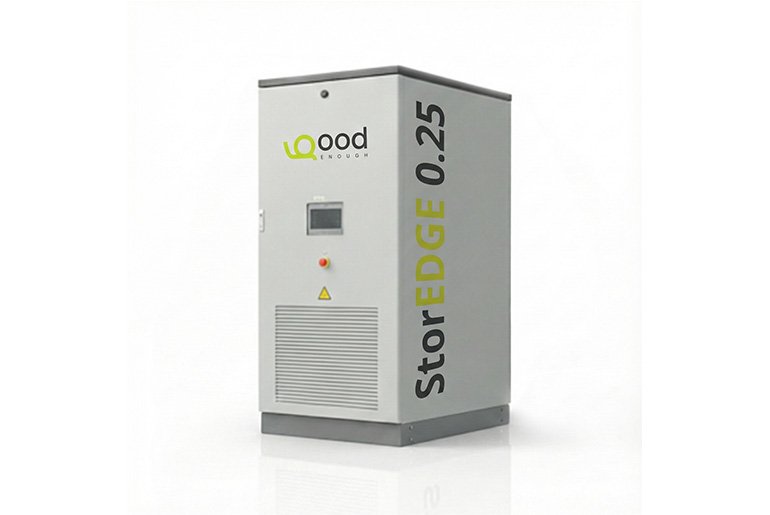
What makes this viable for us is the way we’ve built and deployed our StorEDGE systems. Every unit we put in the field comes with full remote monitoring: real‑time visibility into performance, health, and usage patterns. That data lets us underwrite a service contract with confidence because we’re not guessing how the asset is behaving in Hapur or Vishakhapatnam—we’re watching it. And we already have early MSME partners live on this stack, generating real operating data, not just slideware.
On the financing side, the conversation has moved beyond “Is anyone interested?” We’re actively working with NBFCs and green finance players, and the interest from IREDA and SIDBI in MSME‑focused transition credit lines has gone up precisely because we can point to running installations. From your perspective as an MSME owner, that means two things: you’re not the guinea pig, and the ecosystem around you—technology, financing, and service—is finally starting to line up.
If you’re that MSME trying to choose between another DG set and a new way of doing things, the offer we want on your table is clear: fixed, transparent monthly fees, guaranteed performance, and the ability to shut down a diesel you never wanted to run in the first place. That’s what Storage‑as‑a‑Service should mean in practice, not just as a buzzword.
The Sodium-Ion Horizon: While Li-ion is the current king, the industry is buzzing about Sodium-ion and Solid-state. Given your scale, how “chemistry-agnostic” is your current manufacturing setup? Can your lines pivot as new tech matures?
When you hear “chemistry‑agnostic,” you should immediately ask: At what layer? You can’t just drop any cell into any pack and expect it to behave. What we’ve done is put the real flexibility at the integration layer. Our assembly lines, BMS platform, and thermal systems are designed around the module‑and‑pack interface. As long as a new chemistry arrives in compatible formats—prismatic, pouch, or large‑format cylindrical—we can adapt without tearing the whole system down and starting again. That was a conscious decision, because you know as well as I do the chemistry roadmap won’t sit still for the next decade.
Sodium‑ion is a good example. I’m genuinely bullish on its India case. Sodium is abundant here, easier to source domestically, and its electrochemistry behaves more calmly at high ambient temperatures—no lithium plating, more stable at the 40–50°C band you actually see on Indian sites. The energy density gap versus LFP is real today, but it’s closing. We track CATL, HiNa, and Indian lab work closely. My internal rule is simple: when sodium‑ion hits cost‑per‑kWh parity with LFP at comparable cycle life, you’ll see it inside our systems, not in a slide deck.
On solid‑state, I’ll be straight with you. For meaningful commercial volumes, I see it as a 2030–2035 story. Anyone promising you gigawatt‑hours before that at sensible cost is being optimistic. The good news is we don’t need to redesign our factories for every hype cycle. Because the architecture sits above the cell, when a chemistry is actually ready—sodium, solid‑state, or something we’re not yet talking about—you plug it into an existing, proven integration platform.
You don’t have to bet your project on one chemistry forever. You can lock into a manufacturing partner whose lines and software are built to ride that evolution, instead of being stranded with yesterday’s cell choice.
The 2026 Legacy: If we look back at the Indian energy landscape in December 2026, what specific milestone do you want Good Enough Innovation to be remembered for — is it a capacity number, or a fundamental change in how the Indian grid operates?
Numbers are outcomes, not the point. What I want us remembered for is killing the idea that serious storage engineering is an import game. I studied in France. I know what first-class infrastructure looks like. And I came back because India can build it here—not just assemble imported packs, not just slap a local badge on a container, but engineer the power electronics, BMS, and thermal systems from the ground up for your grid conditions, your climate, your commercial reality.
We’re already proving that on live grids. Not pilots with discoms like BSES, Rajdhani—actual revenue-generating deployments holding frequency, supporting renewables, delivering the outcomes regulators and investors expect. By end-2026, you should see that footprint scaled meaningfully across utilities, C&I, and MSMEs.
The moment that crystallised this for me was walking through our Greater Noida facility with a senior CEA engineer. He stopped at the power electronics test bay and said, “This isn’t Reliance or Tata LFP cell scale. This is what we actually lack.” That’s when I knew we were on the right track—not chasing cell manufacturing headlines, but building the integration depth that makes any cell work reliably in India.
Don’t settle for India as an assembler. Demand the engineering capability that turns storage into a grid stabiliser, diesel killer, and renewable enabler. By December 2026, that’s the GoodEnough Energy you’ll see—not a capacity plaque, but a supply chain that finally lets you build the energy transition without import dependence.
 Electrify your feed! Click here to join our Whatsapp group and to get the latest updates, expert insights, and innovations driving India’s energy storage revolution.