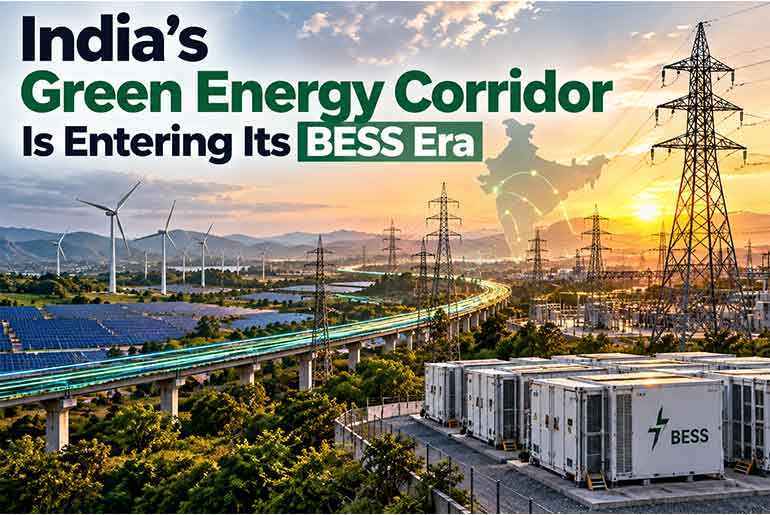
India has spent the last decade learning how to build renewable energy at scale. Solar parks have spread across open landscapes, wind farms have pushed deeper into resource-rich states, and battery storage has slowly moved from an emerging technology to a serious part of power-sector planning. But there is an awkward question sitting underneath all of this growth. What happens when the electricity has nowhere to go?
A solar project can generate power. A wind farm can produce hundreds of megawatts. A battery can store electricity for the evening. Yet none of these assets can deliver their full value if the transmission network around them is unable to move electricity to where it is needed. That is the problem India is now trying to address with the next phase of its Green Energy Corridor.
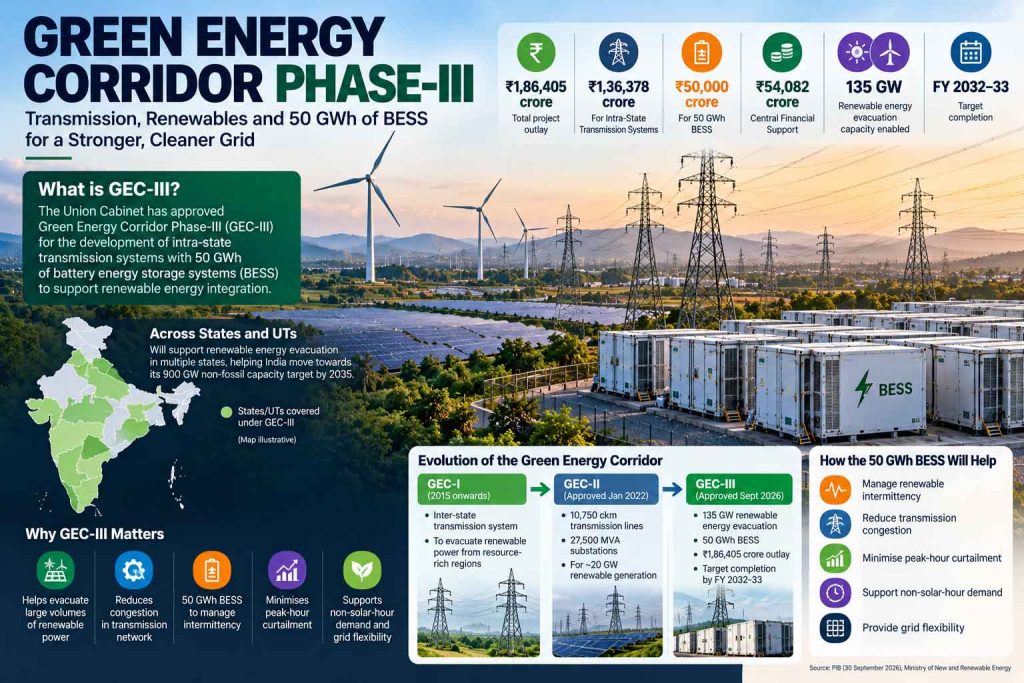
On September 30, 2026, the Union Cabinet approved the Green Energy Corridor Phase-III (GEC-III), with a total project outlay of ₹1,86,405 crore. The programme will strengthen intra-state transmission systems to enable the evacuation of up to 135 GW of renewable energy and, significantly for the battery industry, provide for 50 GWh of Battery Energy Storage Systems (BESS). The programme is targeted for completion by FY2032-33.
At first glance, it looks like another giant transmission programme.
Have we given enough thought to what it actually represents?
The more interesting story is that India is beginning to plan its renewable grid not simply around generation, but around generation, transmission and storage as one system.
The Green Energy Corridor is entering a different phase
The earlier Green Energy Corridor phases were largely about creating the transmission infrastructure needed to evacuate renewable power.
The Ministry of Power said in March 2026 that GEC-I and GEC-II were being implemented in ten states for the evacuation of 44 GW of renewable energy, with 26 GW already integrated at that point. The programme covered Rajasthan, Karnataka, Andhra Pradesh, Himachal Pradesh, Madhya Pradesh, Kerala, Gujarat, Uttar Pradesh, Maharashtra and Tamil Nadu.
Government data released separately showed that, against sanctioned infrastructure of 17,686 circuit kilometres of transmission lines and 47,177 MVA of substations for 44 GW of renewable capacity under the GEC programme, 9,856 circuit kilometres and 24,300 MVA had been commissioned for evacuation of 24 GW.
That history matters.
It tells us that the renewable transition is not simply a race to install more generation. Transmission has to arrive in time, and it has to be commissioned in coordination with generation.
GEC-III therefore arrives at an important moment. The grid is no longer being asked merely to carry more electricity. It is being asked to cope with electricity whose availability changes with sunlight, wind conditions, geography and time of day.
And that changes the nature of the infrastructure required.
Green Energy Corridor meets the battery
The most consequential feature of GEC-III may not be the ₹1,36,378 crore allocated to intra-state transmission.
It may be the ₹50,000 crore provision for 50 GWh of BESS.
The government says these storage systems can be deployed at the renewable-energy developer or generator end, or at another location considered important for grid flexibility. Their stated purposes include addressing renewable intermittency, congestion, peak-hour curtailment and demand during non-solar hours.
That wording is important.
The battery is not being presented simply as a backup device sitting beside a solar plant.
It is being treated as a grid asset.
Imagine a solar-rich region producing enormous amounts of electricity in the afternoon. The sun is strong, generation is high and demand may not be high enough to absorb everything locally. At that moment, transmission capacity becomes precious.
Now imagine the same grid a few hours later.
Solar generation is falling rapidly. Demand is still present, and perhaps rising toward the evening peak.
The problem has changed from where can the electricity go? to where can the electricity come from?
A well-placed BESS can sit between those two moments.
It can absorb electricity when the grid has an excess and discharge when that energy becomes more valuable.
This is why the storage component of the Green Energy Corridor deserves to be read alongside the transmission component rather than separately.
India’s storage requirement is much larger than 50 GWh
There is another number that puts the announcement into perspective.
The 50 GWh under GEC-III should not be mistaken for India’s total BESS requirement.
According to the Ministry of Power, the National Electricity Plan projects BESS requirements of approximately 8.68 GW/34 GWh by 2026-27 and 47.24 GW/236 GWh by 2031-32. The Ministry estimated investment of around ₹3.49 lakh crore for the BESS requirement by 2031-32.
MNRE’s energy-storage overview, drawing on the CEA’s National Electricity Plan, gives a similar picture. It projects total energy-storage requirements of 82.37 GWh in 2026-27, rising to 411.4 GWh in 2031-32. Of the latter, 236.22 GWh is BESS and 175.18 GWh is pumped storage. By 2047, the total storage requirement is projected at 2,380 GWh, including 1,840 GWh from BESS.
So what does the 50 GWh announcement really tell us?
It tells us that GEC-III is one important piece of a much larger storage build-out.
The battery industry should therefore resist looking at 50 GWh as an isolated market number. The larger signal is that storage is increasingly being embedded directly into infrastructure planning.
The question is no longer simply whether India will need batteries.
It is increasingly about where those batteries should sit, what services they should provide and how the grid should operate around them.
Why transmission alone cannot solve the problem
There was a time when adding transmission capacity appeared to be the obvious answer to renewable evacuation.
More renewable generation meant more wires.
But renewable power does not behave like conventional generation.
A thermal plant can be scheduled according to a dispatch plan. Solar generation follows daylight. Wind generation changes with weather conditions. A grid with a growing share of these resources therefore has to manage both location and timing.
The Ministry of Power has already been planning transmission expansion around this reality.
Under the National Electricity Plan, the transmission network at 220 kV and above is projected to expand to 6.48 lakh circuit kilometres, with transformation capacity increasing to 2,345 GVA by 2031-32. Inter-regional transmission capacity is planned to increase from 120 GW in January 2026 to 168 GW by 2032.
These are enormous infrastructure numbers.
But even a larger grid cannot make sunlight appear after sunset.
That is where storage changes the equation.
A transmission line moves electricity across space. A battery can move electricity across time.
India’s future grid needs both.
The real value of BESS may be flexibility
The phrase “energy storage” can sometimes make batteries sound like large containers of electricity.
In a power system, their value is more subtle.
A BESS can charge when electricity is available and discharge when electricity is needed. Depending on its configuration and contractual role, it can also support frequency response, balancing and other grid services.
GEC-III specifically identifies intermittency, congestion, peak-hour curtailment and non-solar-hour demand as reasons for deploying BESS.
Think about congestion.
If a renewable-rich region has more generation than the local network can evacuate at a particular moment, simply building another solar plant does not solve the bottleneck. Electricity still has to travel through the available network.
Storage can create another option.
Instead of sending every unit immediately through a constrained transmission corridor, some electricity can be stored and released later when network conditions permit or when demand is higher.
This does not eliminate the need for transmission.
It can, however, make the overall system more flexible.
That distinction is crucial.
The Green Energy Corridor is therefore not replacing wires with batteries. It is beginning to recognise that wires and batteries solve different parts of the same system problem.
Felix Kadam, Co-Founder and Managing Director of CosPower Engineering Limited, said, “The recent approval of Green Energy Corridor Phase III is a critical milestone in strengthening India’s power infrastructure for the next phase of renewable energy development. The new scheme will provide for the evacuation of up to 135 GW of renewable energy and deployment of 50 GWh of battery storage. This means the emphasis should now extend beyond transmission capacity to ensuring the quality and reliability of power supplied.
With the growing share of energy from solar, wind, battery storage and similar systems, managing voltage fluctuations, reactive power, harmonics and other aspects of power quality will become increasingly important. As renewable generation can vary with weather conditions, power-quality management will need to address these fluctuations and ensure a stable power supply, while also meeting the growing demand from industries, data centres, EVs and other power-electronics-driven applications.
With further reinforcement of the transmission network, adequate storage capacity and proactive power-quality management, India can build a more stable and robust grid that can transmit, store and supply renewable power when needed, supporting the country’s renewable-energy goals.”
The policy architecture is already moving in this direction
The shift is visible beyond GEC-III.
In 2025, the Central Electricity Regulatory Commission introduced solar-hour and non-solar-hour access provisions through the Third Amendment to its Connectivity and General Network Access Regulations. A government response in April 2026 said the framework allows solar projects to align with solar hours while wind and energy storage systems can have round-the-clock access, supporting better utilisation of transmission capacity and hybrid combinations of solar, wind and BESS.
That is a subtle but important change in the way the grid is being conceptualised.
Instead of asking only:
How much transmission capacity does a project need?
the system increasingly has to ask:
How should that capacity be used across different hours and different generation profiles?
A battery becomes valuable precisely because it gives the grid another degree of freedom.
The Green Energy Corridor also creates an industrial opportunity
There is another side to this story, and it belongs squarely in a battery-industry magazine.
A 50 GWh deployment does not mean 50 GWh of cells alone.
It implies demand across the wider storage ecosystem: battery packs, racks, thermal management, power conversion systems, energy-management systems, battery-management systems, transformers, switchgear, protection systems, controls and grid-integration equipment.
It also creates a longer-term requirement for operation, maintenance, monitoring and asset management.
The government itself expects the programme to generate employment in power-sector manufacturing, construction, grid management and the domestic BESS industry.
For Indian manufacturers, however, the opportunity will not simply be about supplying hardware.
Grid-scale storage is different from supplying batteries for mobility applications. Developers and utilities need predictable performance over long operating periods. They need systems capable of responding to grid requirements, meeting contractual guarantees and operating safely at large scale.
That raises the importance of system integration.
A battery cell is only one part of a BESS.
The money tells another story
The Cabinet has allocated ₹1,86,405 crore to the programme.
Of this, ₹1,36,378 crore is for the intra-state transmission system under GEC-III, while ₹50,000 crore is for 50 GWh of BESS. The programme also carries ₹54,082 crore of Central Financial Support, intended to offset intra-state transmission charges and help keep power costs down.
But these numbers should not be read as though the government is simply writing a cheque for the entire infrastructure.
The implementation model matters.
According to the Cabinet decision, greenfield projects under the intra-state transmission component will be implemented through Tariff Based Competitive Bidding, while brownfield upgrades and network-strengthening works will follow a Cost Plus Basis. State Transmission Utilities will serve as the overall implementing agencies, with transmission service providers participating under the Build-Own-Operate-Maintain model for competitively bid projects.
That opens the programme to a broad ecosystem of transmission developers, equipment suppliers and infrastructure companies.
For the BESS industry, the next question is even more interesting:
How will those 50 GWh actually be procured?
The announcement gives the deployment framework and financial envelope. The eventual tenders, technical specifications, performance requirements, contract structures and revenue mechanisms will determine how that capacity translates into actual projects.
That is where the next chapter will be written.
A battery is useful only if the grid knows what to do with it
This may be the most important point of all.
Building BESS capacity is not enough.
A 100 MW/200 MWh battery sitting at the wrong location may have limited value for a particular congestion problem. The same battery, positioned at a strategically important node, could provide a completely different service.
Location matters.
Dispatch rules matter.
Transmission availability matters.
State-level procurement design matters.
And, ultimately, the economics matter.
The government’s decision to allow BESS at the renewable generator end or at another location important for grid flexibility suggests that planners are looking beyond a one-size-fits-all model.
That flexibility could become important as state grids develop very different renewable profiles.
Rajasthan may have enormous solar resources. Gujarat combines solar, wind and industrial demand. Karnataka has substantial renewable generation alongside a different demand profile. Tamil Nadu’s wind resources create another set of balancing requirements.
A national storage number therefore tells only half the story.
The geography of storage may prove just as important as the quantity.
From renewable capacity to renewable usability
For years, India’s clean-energy story could be told through capacity additions.
- How many gigawatts of solar were installed?
- How many gigawatts of wind?
- How much non-fossil capacity was added?
Those numbers still matter.
But the grid ultimately does not consume installed capacity.
It consumes electricity.
And electricity has to be generated at the right moment, transmitted through available infrastructure and delivered where demand exists.
That is why the Green Energy Corridor matters beyond the transmission sector.
It is part of the shift from renewable capacity to renewable usability.
The government has planned for more than 500 GW of non-fossil capacity integration by 2030 and more than 600 GW by 2032 through transmission planning that includes GEC-I and GEC-II. The Cabinet says GEC-III will also contribute toward the longer-term objective of reaching 900 GW of installed non-fossil capacity by 2035.
Those targets are ambitious.
But ambition on the generation side has to be matched by ambition underneath the wires.
The next test is execution
A Cabinet approval is an important beginning.
It is not the same thing as a commissioned transmission line or an operating battery.
The real test for GEC-III will come later, when state transmission utilities begin preparing projects, competitive bids are issued, equipment is ordered, substations are upgraded and BESS systems are deployed.
The experience of the earlier Green Energy Corridor phases makes this particularly relevant.
Government data already shows a significant amount of infrastructure commissioned under the earlier phases, but also a gap between sanctioned and commissioned infrastructure.
The next phase will therefore need coordination across several moving parts.
Transmission cannot arrive years after generation.
Storage cannot be procured without understanding the grid service it is supposed to provide.
And renewable projects cannot be evaluated in isolation from the network that ultimately carries their electricity.
That is a much harder infrastructure problem than simply adding another gigawatt of solar.
But it is also the problem India now has to solve.
The Green Energy Corridor is becoming a grid story
Perhaps that is the simplest way to understand what has changed.
The first generation of India’s renewable-energy infrastructure was largely about building renewable generation.
The next generation is about connecting it.
The generation creates the electricity.
The transmission carries it.
The battery gives the system the ability to shift, balance and manage it.
And the grid has to coordinate all three.
With ₹1,86,405 crore on the table, 135 GW of renewable evacuation capacity in the plan and 50 GWh of BESS deployment, GEC-III is large enough to become a defining piece of India’s renewable-grid architecture through the early 2030s.
Yet its significance may ultimately be measured by something less impressive than a headline number.
Not how many kilometres of transmission lines were sanctioned.
Not how many gigawatt-hours of batteries were announced.
But how much renewable electricity India can actually move, store and deliver when the grid needs it.
Because the future of renewable energy was never going to be decided only by how much India could generate.
It will also be decided by whether the country can build the infrastructure that allows every useful unit of that electricity to find its way to the right place, at the right time.
That is where the next chapter of the Green Energy Corridor begins.
 Electrify your feed! Click here to join our Whatsapp group and to get the latest updates, expert insights, and innovations driving India’s energy storage revolution.