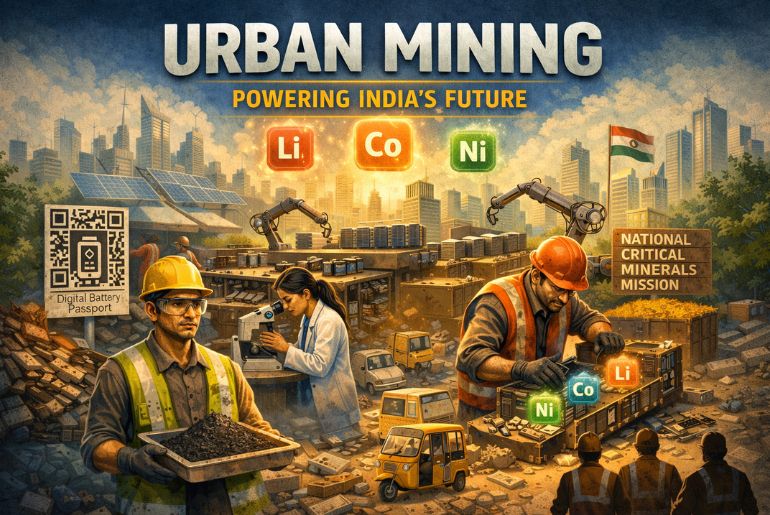
For decades, the word “mining” brought to mind images of deep pits, heavy machinery, and scars on the earth. But in 2025, a new kind of miner is emerging in India. These miners don’t wear headlamps or work underground. Instead, they work in high-tech laboratories and specialized factories in cities like Bengaluru, Pune, and Manesar. They are the pioneers of urban mining, and they are digging through a mountain of “waste” to find the gold of the 21st century: lithium, cobalt, and nickel.
India is currently in the middle of a massive energy shift. We want our streets filled with electric vehicles (EVs) and our grid powered by the sun. But there is a catch. India does not have significant domestic mines for the critical minerals needed to make batteries. We are almost 100% dependent on imports, mostly from China and the Congo. This dependency is a massive risk for our national security and our economy.
However, urban mining is changing the game. By treating every old smartphone, every discarded laptop, and every “end-of-life” EV battery as a rich ore deposit, India is turning its waste problem into a supply chain solution.
The “Black Mass” Revolution: Turning Trash into Treasure
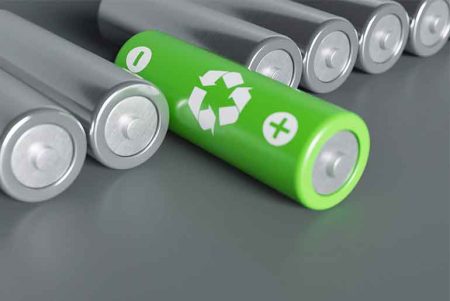
At the heart of urban mining is a substance that looks like soot but is worth its weight in silver: “Black Mass.” When an old battery is safely shredded and processed, it turns into this dark, powdery mixture. To the untrained eye, it’s just dirt. To a battery manufacturer, it is a concentrated mix of lithium, cobalt, and nickel.
In 2025, processing this black mass has become the “new oil” for Indian startups. Using a process called hydrometallurgy – essentially using chemical baths to separate metals—Indian companies can now recover over 95% of the minerals from a dead battery. This is urban mining at its finest. Instead of waiting years for a traditional mine to open, we can “mine” a thousand old e-rickshaws in a single afternoon and have battery-grade minerals ready for a new factory by the weekend.
The Rulebook: How Policy Fixed the Market
For a long time, urban mining was a messy, informal business. Old batteries often ended up in landfills or were broken down in backyards using dangerous methods that poisoned the soil. That changed with the Battery Waste Management Amendment Rules 2025, which became fully operational in February.
These rules introduced a powerful concept: Extended Producer Responsibility (EPR). In simple words, if a company makes or sells a battery in India, they are now legally responsible for where it ends up. They can’t just sell it and forget it. They must ensure it comes back to a registered recycler.
To make this work, every battery now comes with a Digital Battery Passport—a QR code that tracks its journey from the factory to the recycler. This has forced the industry to move away from being a simple “importer” of minerals and toward being a “recycler.” This policy shift is the backbone of urban mining, ensuring that the “ore” (the waste) actually reaches the “miners” (the recyclers).
Mineral Security: Breaking the Import Chains
Why are industry leaders so obsessed with urban mining? Because the global market for minerals is a battlefield. Prices for lithium can jump 500% in a year, and geopolitical tensions can cut off supply overnight.
Urban mining offers India a “sovereign supply.” The minerals we recover from a battery sold in Delhi today will stay in India, powering a new car in 2026, and another in 2032. Unlike oil, which is burned and gone, these minerals can be recycled for perpetuity. A single gram of cobalt can technically live forever in a circular loop. This turns India from a vulnerable buyer into a self-reliant powerhouse.
The Human Side: Creating 100,000 Green Jobs
The most beautiful part of urban mining is the people it employs. It is creating a whole new category of “green-collar” jobs. From the technicians who use AI to sort different battery chemistries to the logistics teams managing the “reverse supply chain,” this industry is expected to create over 100,000 jobs by 2030.
We are seeing a massive transition where informal scrap dealers—the “kabadiwalas” who have kept India’s recycling alive for decades are being trained and brought into the formal economy. Urban mining isn’t just about saving minerals; it’s about upgrading the lives of the people who handle our waste.
From Pits to Power: The Road Ahead
As we look toward the end of the decade, the goal of the National Critical Minerals Mission is clear: meet at least 25% of our mineral needs through recycling. Urban mining is no longer a “side project” for environmentalists; it is a core business strategy for the biggest companies in India.
The next time you see an old, dusty battery sitting in a drawer, don’t see it as trash. See it as a tiny piece of India’s future energy independence. Through urban mining, we are proving that the most valuable mines in the world aren’t in the mountains—they are right here in our pockets and our parking lots.
Summary Table: The Shift in India’s Strategy
Feature |
The Old Way (Linear) |
The New Way (Circular / Urban Mining) |
Source |
Importing raw ore from overseas |
Recovering minerals from “Urban Mines” |
Material |
Burned or buried at end-of-life |
Processed into “Black Mass” for reuse |
Security |
Vulnerable to global price shocks |
Domestic, predictable supply chain |
Law |
No accountability after sale |
Mandatory EPR and QR Code tracking |
Environment |
High carbon footprint from mining |
Low footprint, keeps toxins out of soil |
 Electrify your feed! Click here to join our Whatsapp group and to get the latest updates, expert insights, and innovations driving India’s energy storage revolution.