India’s power planning is moving beyond adding generation to ensuring dependable capacity when the grid needs it most. That shift puts BESS and pumped storage at the centre of the country’s resource-adequacy challenge.
India’s electricity story has traditionally been told in terms of how much power the country can generate.
More coal plants. More solar parks. More wind farms. More transmission. More megawatts.
But as India’s electricity system becomes larger, more renewable and more complex, another question is becoming harder to avoid:
What happens when the power system needs electricity the most?
That is the question behind Resource Adequacy (RA).
And it changes the way India needs to think about energy storage.
A battery is no longer valuable only because it can absorb excess solar power at noon and release it after sunset or whenever we want. A pumped-storage plant is no longer simply another renewable-energy enabler. Increasingly, these assets have to be understood as part of the country’s reliability architecture—resources that must be available when demand is high, renewable generation is uncertain and other generating units may be unavailable.
The scale of that challenge is becoming clearer.
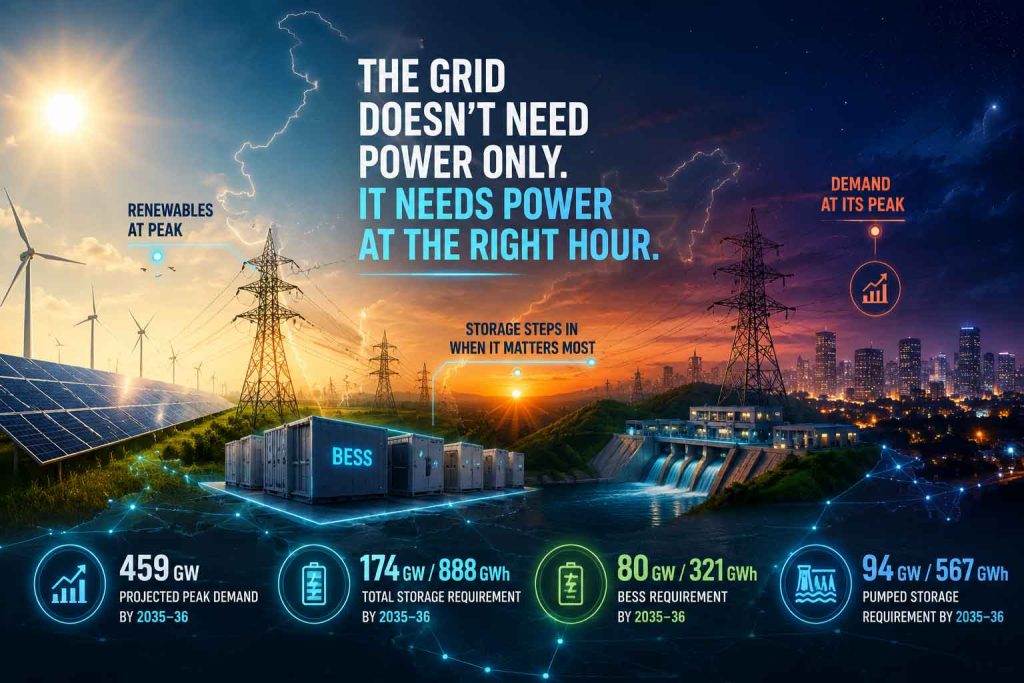
The Central Electricity Authority’s latest planning documents project India’s peak electricity demand to reach about 459 GW by 2035–36, with total electricity requirements reaching about 3,365 billion units. To serve that system, the National Generation Adequacy Plan envisages around 1,121 GW of installed generation capacity and 174 GW/888 GWh of energy-storage capacity by 2035–36.
That storage requirement comprises 80 GW/321 GWh of BESS and 94 GW/567 GWh of pumped-storage projects.
The numbers are enormous. But the more important story lies underneath them:
India is no longer planning storage merely to store electricity. It is planning storage to make the power system dependable.
From Energy Adequacy to Resource Adequacy
There is an important distinction between having enough electricity over a year and having enough resources available during the hours when the system is under maximum stress. A country can generate enormous quantities of electricity annually and still face a capacity problem at a particular hour.
Think about a summer evening.
Solar generation is falling rapidly. Electricity demand is climbing as households, commercial establishments and industries continue consuming power. Some thermal units may be under maintenance. Wind output may not be available at the expected level. Transmission constraints may limit how much electricity can move from one region to another.
The question at that moment is not:
“Did India generate enough electricity this year?”
It is:
“Do we have enough dependable resources available right now?”
That is the logic of resource adequacy.
India formalised this shift through its Resource Adequacy framework. The Ministry of Power’s framework calls for adequate generation, storage and demand-responsive resources to reliably meet expected peak demand. Energy Storage Systems are therefore part of the planning equation rather than an afterthought added after generation planning is completed. This is a fundamental change.
Resource adequacy asks whether the electricity system has enough dependable resources. Energy adequacy asks whether enough electricity is available. They overlap—but they are not the same thing. And that distinction is becoming critical as India’s renewable capacity grows.
India’s Peak-Demand Problem Is Getting Bigger
The CEA’s latest National Generation Adequacy Plan is built around a rapidly expanding demand profile.
Peak electricity demand is projected to reach approximately 459 GW in 2035–36, while total electricity requirements are projected at around 3,365 BU. Peak demand is expected to grow at a CAGR of about 5.58% between 2024–25 and 2035–36, while electricity requirements grow at about 6.41% annually.
This means India’s future power system will not simply be bigger.
It will have to be more flexible.
CEA’s generation planning studies project around 1,121 GW of installed capacity by 2035–36, comprising 509 GW solar, 155 GW wind, 315 GW coal, 78 GW large hydro, 22 GW nuclear, 20 GW gas, 16 GW biomass and 6 GW small hydro.
At first glance, 1,121 GW against a 459 GW peak might appear to provide an enormous cushion. But installed capacity is not the same as capacity available at every hour. A 500 GW solar fleet cannot provide 500 GW at midnight. A wind fleet cannot be assumed to operate at full output during every system peak. A thermal plant may be unavailable because of an outage or maintenance. Hydro availability can vary. And storage itself has a finite duration and operating state.
This is precisely why resource adequacy cannot be reduced to a simple installed-capacity calculation.
The 1,121 GW Number Hides a Much More Complicated Question
India’s projected 2035–36 capacity mix tells us where the electricity system is heading.
- Solar alone is projected at 509 GW.
- Wind is projected at 155 GW.
Together, they would form a huge part of the generation fleet. But the system’s reliability cannot be measured by simply adding these numbers. The question is how much of that capacity can be counted upon during the critical hours.
That brings us to one of the most important concepts in resource adequacy:
Capacity credit.
Capacity credit essentially asks how much dependable contribution a particular resource can make toward meeting system demand during periods of system stress. And this is where storage becomes particularly interesting.
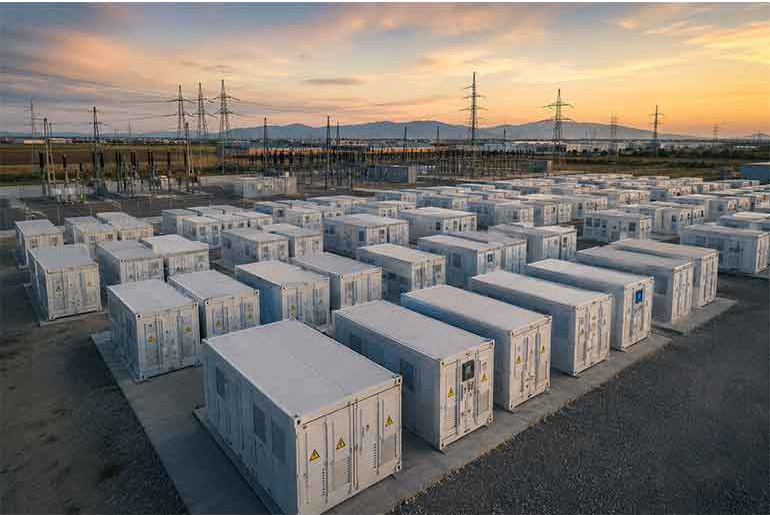
A BESS may not generate electricity in the conventional sense. But if it is adequately charged and available to discharge during the critical period, it can provide capacity when the system needs it. The value therefore lies not merely in the battery’s nameplate rating. It lies in when it can deliver, for how long, and with what level of certainty.
A 100 MW Battery Is Not Simply a 100 MW Reliability Resource
This distinction is easy to miss in the rush to count gigawatts.
Consider two hypothetical BESS projects:
100 MW / 200 MWh
and
100 MW / 400 MWh.
Both are rated at 100 MW.
But the second can sustain that output for twice as long under the relevant operating assumptions.
Now introduce another variable.
What if the battery has already discharged significantly before the system’s most critical hour?
Its theoretical 100 MW output does not automatically mean that the system can count on 100 MW of energy at that moment.
This is why the adequacy value of storage depends on more than MW.
It involves:
- duration,
- state of charge,
- charging availability,
- efficiency,
- degradation,
- dispatch requirements,
- cycling constraints,
- location and
- the specific hours used for adequacy assessment.
In other words:
A storage asset has to be available when reliability is being tested—not merely exist on the asset register.
That is one of the most important distinctions India’s growing BESS market will have to understand.
India’s Storage Requirement Is No Longer a Future Footnote
The scale of the requirement makes the point starkly. CEA’s 2026 generation-adequacy planning envisages 174 GW/888 GWh of energy storage by 2035–36. Of this, BESS accounts for 80 GW/321 GWh, while pumped-storage projects account for 94 GW/567 GWh. The composition itself tells us something. India is not betting its reliability future on one storage technology. Instead, the planning architecture recognises that different storage technologies can serve different system needs. BESS can respond quickly and can be deployed relatively flexibly.
Pumped storage can provide large quantities of stored energy over longer durations and can support system flexibility at scale.
The future grid therefore does not require a simplistic “BESS versus PSP” answer.
It needs an appropriate combination.
The CEA’s latest planning also indicates that storage durations of roughly four to six hours become increasingly important as renewable penetration rises, reinforcing the need to think about storage in terms of duration as well as power rating.
But Here Is the Uncomfortable Part: How Much Is Actually Being Built?
This is where the story becomes more interesting than the headline requirement.
As of 31 January 2026, the government reported that:
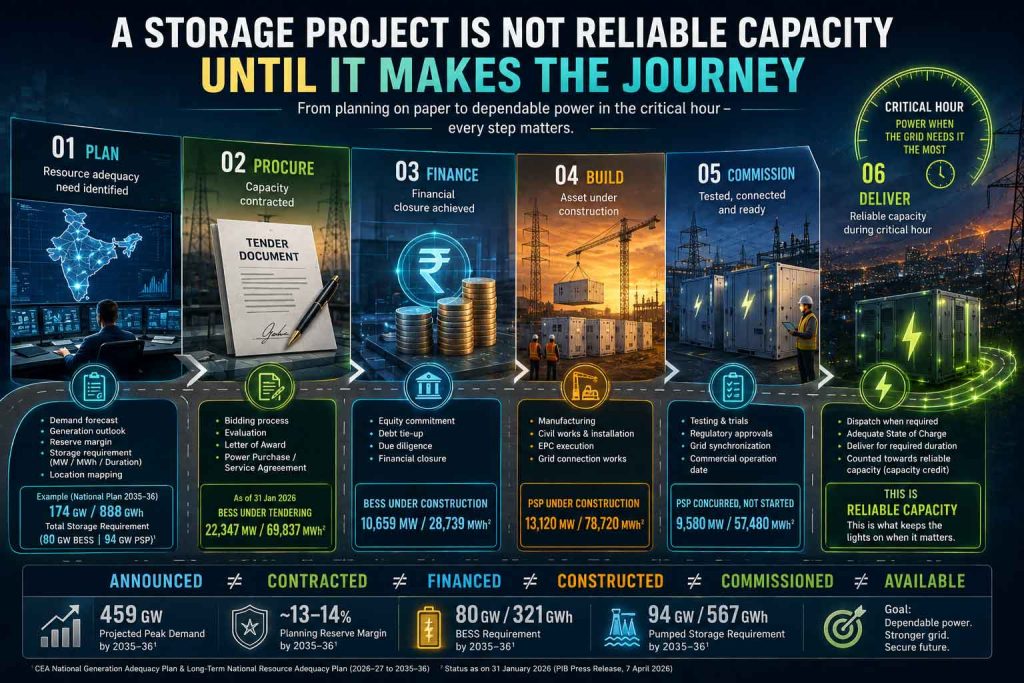
- 10,658.94 MW / 28,739.32 MWh of BESS was under construction.
- 22,347.15 MW / 69,836.70 MWh of BESS was at the tendering stage.
- 13,120 MW / 78,720 MWh of PSP was under construction.
- Another 9,580 MW / 57,480 MWh of PSP had been concurred but had not yet entered construction.
That is substantial progress.
But it is also a reminder that planning requirement and physical deployment are two different numbers. A 80 GW BESS requirement by 2035–36 cannot be compared directly with 10.66 GW under construction and then treated as a simple “gap”.
Why?
Because the 80 GW figure is a future planning requirement, while the 10.66 GW figure is a current project-status snapshot. Projects will move from tendering to award, construction and commissioning, while additional projects will be identified as demand forecasts and system requirements evolve.
But the comparison does reveal something important:
The scale-up cannot be left until the end of the planning period.
Storage projects have procurement, financing, land, grid-connection, manufacturing, construction and commissioning timelines. Pumped-storage projects can take even longer because of site development, environmental clearances, civil works and transmission requirements. The adequacy problem therefore has a time dimension.
A project that is needed in 2030 cannot help the grid if it is still waiting for construction approval in 2030.
This Is Where Resource Adequacy Becomes a Project-Execution Story
For years, power-sector planning could largely be read through capacity additions.
Now, the industry has to follow another chain:
Requirement → Procurement → Contract → Financial Closure → Construction → Commissioning → Availability
Every stage matters.
A tender does not equal a commissioned BESS. A signed contract does not equal grid availability. A commissioned BESS does not automatically equal dependable capacity unless its operating conditions allow it to deliver when required. This is why India’s resource-adequacy story should not be judged by announced gigawatts alone.
The industry needs to know:
- How much has been contracted?
- How much has achieved financial closure?
- How much is under construction?
- How much is commissioned?
- How much is actually available during system-stress hours?
That is the much harder—and much more useful—set of questions.
ESO Creates Demand. Resource Adequacy Defines What the Grid Needs.
This is where India’s policy architecture starts to make sense as a system rather than a collection of disconnected schemes. The Energy Storage Obligation creates a regulatory demand signal for storage. But ESO by itself does not tell the grid exactly what type, duration or location of storage will provide the greatest reliability value.
Resource adequacy approaches the problem differently. It asks what resources are needed to meet demand reliably. That creates a natural link to the previous article in our series on Energy Storage Obligation in India.
The policy question therefore moves from:
“How much storage must be procured?”
to:
“What storage must be available, where, and when?”
That is a much more sophisticated market signal. It also means the future BESS market could increasingly be shaped by system requirements rather than only by a generic storage target.
VGF Can Improve Viability. RA Can Improve Visibility.
VGF addresses a different problem.
A storage project may be technically useful but financially difficult because its revenue streams are not yet sufficient to support the investment.
VGF can help narrow that viability gap.
Resource adequacy, meanwhile, provides a planning framework for determining whether the system actually needs that capacity.
The distinction matters.
- RA answers: “Do we need the resource?”
- VGF helps answer: “Can the project become financially viable?”
- Procurement answers: “Who will buy it?”
- Construction answers: “Can it actually be delivered?”
And only commissioning answers the final question:
“Is the capacity there when the grid needs it?”
India’s storage ecosystem is therefore becoming less about a single policy and more about whether these mechanisms work together.
Planning Reserve Margin: Why India Cannot Plan to the Last Megawatt
Another concept that deserves attention is the Planning Reserve Margin (PRM). A power system cannot safely plan to exactly match forecast peak demand because demand forecasts are uncertain and generating units can fail or be unavailable. The system therefore needs a reserve above expected peak demand. The Resource Adequacy framework incorporates this principle into long-term planning, while CEA’s national planning work assesses the reserve requirements needed to maintain reliability.
This matters enormously when India’s peak approaches 459 GW. The objective is not to build 459 GW and stop. The system needs enough dependable resources to cover uncertainty and unexpected events. And storage can contribute to that reserve—but only if its capacity and duration are correctly valued. This is why capacity credit and PRM are not abstract planning terms for BESS developers. They will increasingly influence how storage is procured and paid for.
BESS Versus Pumped Storage Is the Wrong Question
The market often frames the discussion as a technology contest.
- Which is cheaper?
- Which is better?
- Which will dominate?
Resource adequacy suggests a different question:
Which technology is best suited to which reliability requirement?
BESS has obvious advantages in response speed, modularity and deployment flexibility.
PSP offers large-scale storage and long-duration capability, but development can be site-specific and construction-intensive.
A four-hour BESS may be highly useful for shifting solar energy into evening peaks. A much longer-duration resource may become more valuable where the system faces extended periods of low renewable output.
And neither technology operates in isolation. India’s future adequacy mix will also include thermal generation, hydro, nuclear, renewable generation, transmission and demand-side resources.
The CEA’s 2035–36 plan itself retains substantial coal capacity alongside the rapid expansion of non-fossil resources and storage.
So the transition is not:
“Replace everything with batteries.”
It is:
“Build a portfolio of resources that can reliably serve a much larger and more variable power system.”
The State-Level Story May Be Even More Important
Resource adequacy is ultimately experienced at the utility and state level.
CEA’s resource-adequacy database now includes plans covering states and distribution utilities including Gujarat, Maharashtra, Delhi, Andhra Pradesh, Tamil Nadu, Madhya Pradesh, Goa, Telangana, Kerala, Karnataka, Rajasthan, Punjab, Uttar Pradesh and others.
This matters because India’s peak-demand problem is not identical everywhere. A state with large solar capacity may face one type of evening flexibility requirement. A state with high industrial demand may face another. A coastal state with strong wind penetration may have a different generation profile. A distribution utility with limited contracted capacity may have a different adequacy challenge again. The result is likely to be a more differentiated storage market. There may not be one Indian BESS requirement.
There may be a series of state-, utility-, region- and application-specific requirements that together form India’s national storage market.
The Next Battle May Be Over Duration, Not Just Capacity
India’s storage conversation has largely been dominated by MW and MWh. The next stage will have to become more sophisticated.
A 100 MW/200 MWh system and a 100 MW/600 MWh system cannot be treated as identical resources.
As the renewable share rises, the system may increasingly need storage that can bridge longer periods of mismatch between generation and demand.
This is why the CEA’s planning is important: it does not simply ask how many storage projects India should build. It considers the broader generation mix, demand profile and reliability requirements.
For developers, this means the future market may reward the right duration at the right location, rather than simply the lowest battery tariff.
For manufacturers, it could influence cell selection, system architecture, augmentation strategy and warranty assumptions.
For financiers, it changes the question from:
“What is the cost per MWh?”
to:
“What reliability service does this MWh provide, and who pays for it?”
India’s Storage Market Is Moving From Energy Arbitrage to Reliability Value
This could become one of the biggest structural changes in the industry.
Early BESS discussions often focused on:
charge when electricity is cheap → discharge when electricity is expensive.
That remains important.
But the power system increasingly needs storage for:
- peak shaving,
- renewable shifting,
- balancing,
- ancillary services,
- capacity adequacy,
- grid flexibility,
- firm and dispatchable renewable power,
- and potentially multiple revenue streams.
India’s national energy-storage framework explicitly recognises market-based products including energy arbitrage, capacity value, ancillary services and firming renewable power.
That means storage is gradually moving from being simply an energy-shifting asset to a multi-service grid asset.
And that has major implications for its economics.
The Biggest Risk Is Not That India Will Under-Plan Storage
India is already planning enormous quantities of storage. The bigger risk is that planning, procurement and execution move at different speeds. A requirement can be identified today. A tender can be issued tomorrow but a project may still need years before it becomes an operating asset. Meanwhile, electricity demand continues to rise and renewable capacity continues to be added.
Peak-demand patterns change.
Battery costs change.
Technology changes.
And the storage duration the grid needs may change as well.
This means India’s resource-adequacy planning cannot be a document that sits unchanged for ten years.
It has to remain a living planning process.
CEA’s establishment of an Integrated Resource Planning function and its expanding collection of state-level resource-adequacy studies show that this institutional architecture is already becoming more detailed.
So, Is India Building Enough Storage?
The honest answer today is:
India is building storage—but it is too early to say that the future adequacy requirement is secured.
The pipeline is significant.
BESS projects of 10.66 GW/28.74 GWh were under construction as of 31 January 2026, while another 22.35 GW/69.84 GWh was at the tendering stage. PSP projects of 13.12 GW/78.72 GWh were under construction, with another 9.58 GW/57.48 GWh concurred but not yet under construction.
At the same time, the CEA’s planning horizon points toward 80 GW/321 GWh of BESS and 94 GW/567 GWh of PSP by 2035–36.
Those numbers demonstrate both sides of India’s storage story.
The market is moving but the requirement is moving too and the real measure of success will not be the size of the announcement pipeline.
It will be the amount of dependable capacity that reaches the grid.
The Real Storage Test Is the Critical Hour
This is perhaps the simplest way to understand India’s next energy-storage challenge. India does not need a battery merely because it has a battery. It needs a battery that can answer the grid’s call at the right moment.
- If solar output collapses after sunset while demand rises, can the BESS discharge?
- If the peak lasts longer than expected, does it have enough duration?
- If another generating unit trips, can the storage respond?
- If the battery has already cycled earlier in the day, does it still have sufficient state of charge?
- If renewable generation is lower than forecast, can the system compensate?
- If several resources fail simultaneously, does India have enough reserve?
These are the questions that turn energy storage into resource adequacy.
And these are the questions India’s BESS industry will increasingly have to answer.
From Storage Ambition to Storage Reliability
India’s energy-storage policy has evolved rapidly.
The country now has a framework for storage procurement, an Energy Storage Obligation, financial support mechanisms, BESS bidding guidelines, pumped-storage policies and resource-adequacy planning. The Ministry of Power’s own energy-storage framework lists resource adequacy, procurement, connectivity and technology-agnostic ESS bidding among the measures needed to build a viable storage ecosystem.
But the next phase requires something harder than announcing another target.
It requires coordination.
Storage has to be planned alongside generation. Generation has to be planned alongside transmission. Transmission has to arrive when the generation and storage assets need it. Procurement has to produce bankable contracts. Financing has to support construction. And the completed assets have to be available when the grid is under stress. That is the real meaning of resource adequacy. India Doesn’t Just Need More Storage. It Needs Countable Storage.
The country’s future electricity system is going to be enormous.
By 2035–36, CEA expects peak demand to approach 459 GW, total installed capacity to reach around 1,121 GW, and energy storage to reach 174 GW/888 GWh.
But the most important number may not be any of these.
It may be the amount of capacity that can actually be counted on when the system is under pressure.
That is the real shift in India’s storage story.
The first phase was about proving that storage was necessary. The next phase was about making storage financially viable. The current policy phase is about creating demand. Now resource adequacy is asking the hardest question of all:
Can India build storage that the grid can actually rely on?
The answer will not come from the number of gigawatts announced.
It will come from projects that reach financial closure, get built, connect to the grid, maintain the required state of charge, deliver for the required duration and remain available through the hours that matter most.
For India’s storage industry, the future is therefore not simply about how much storage the country builds.
It is about how much reliable capacity that storage can deliver when India needs it most.
And that may ultimately be the number that matters.
 Electrify your feed! Click here to join our Whatsapp group and to get the latest updates, expert insights, and innovations driving India’s energy storage revolution.