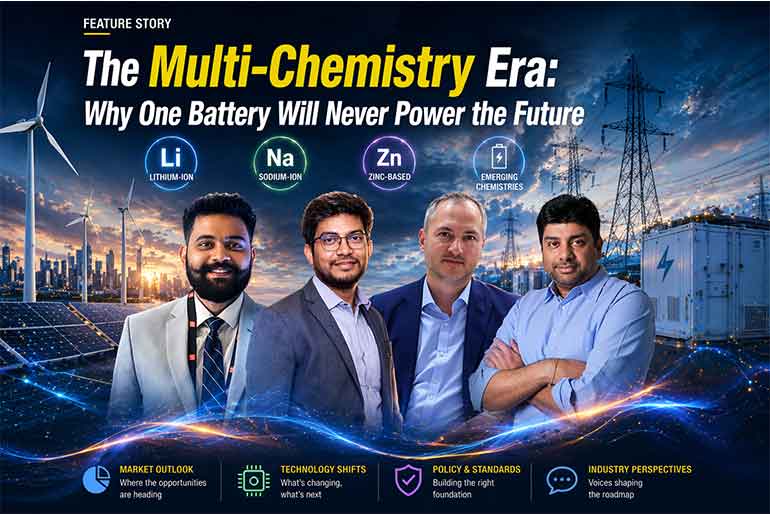
The global battery industry is entering a defining era—one that will not be led by a single technology, but by a multi-chemistry ecosystem designed for diverse applications.
Industry leaders including Stefan Albrecht (BASF Battery Materials), Satish Chandra (XAVolt Energy), and Pratik Kamdar (Neuron Energy), Sumit Mehetre ( Sudeep Advanced Materials Private Limited) strongly emphasize a critical shift: there is no one perfect battery for all needs. Instead, the future lies in deploying the right chemistry for the right application—whether it is lithium-ion for electric vehicles, sodium-ion for cost-sensitive segments, or zinc-based systems for safer and more sustainable stationary storage.
As battery demand accelerates globally and India positions itself as a major energy storage hub, factors like cost, safety, raw material availability, and scalability are reshaping the competitive landscape. From EVs to grid storage and industrial applications, each segment demands a tailored solution.
What makes this story powerful is not just the data—but the clarity of insight from industry experts shaping this transformation.
If you want to understand how the battery industry is moving beyond “one solution fits all” and into a smarter, diversified future—this is a must-read for every energy leader.
The battery industry is increasingly exploring multiple chemistries beyond traditional lithium-ion. Do you believe the future will be dominated by a single technology, or will a multi-chemistry ecosystem emerge to serve different applications?
Stefan Albrecht, Director of Sales Management Asia Pacific & North America at BASF Battery Materials, said, “The transition to renewable energy and electric mobility cannot be achieved with a single battery chemistry. A multi‑chemistry ecosystem will continue to evolve, as different applications require different performance profiles in terms of energy density, power, safety, lifetime and cost. In our view, lithium-ion technology will remain the dominant system for the foreseeable future, supported by a broad range of cathode active materials (CAM) optimized for specific use cases.
- Overall, we expect multiple chemistries to coexist. Each technology serves distinct application needs, and BASF’s broad CAM portfolio enables us to deliver customized solutions across automotive, heavy duty mobility, stationary energy storage for residential and industrial use as in data centers, robotics and many other battery powered applications.”
Satish Chandra, Founder, XAVolt Energy said, “The battery industry is entering a phase where scale is no longer the only challenge, fit-for-purpose design is. As applications diversify across electric mobility, grid storage, and industrial energy systems, it is increasingly clear that no single battery chemistry can optimally serve all needs.
A single dominant technology is unlikely. Instead, we are moving toward a multi-chemistry ecosystem, where different battery types coexist and compete based on application requirements.
Historically, industries tend to converge on a standard—like internal combustion engines in mobility. But energy storage is fundamentally different. The requirements of a two-wheeler, a power grid, and a data centre are too diverse for one chemistry to efficiently address.
The future will therefore be defined by specialization, not standardization.”
Pratik Kamdar, Co-Founder & CEO of Neuron Energy, said, “From what I see across the industry, the future of batteries will be shaped by a multi-chemistry ecosystem rather than a single dominant technology. Different applications, such as electric mobility, grid storage, and industrial energy systems, have very different requirements for performance, safety, lifecycle, and cost. Because of this, each battery chemistry will likely evolve to serve a specific role rather than compete to replace one another. Market trends are already reflecting this shift. Global battery shipments reached around 1,545 GWh in 2024, up nearly 28.5% year-on-year, driven by the expansion of electric mobility and large-scale energy storage deployments. Additionally, stationary energy storage is expected to exceed 200 GWh annually by 2030, indicating a growing demand beyond just mobility. As these sectors scale simultaneously, the need for multiple battery chemistries becomes much more evident.”
Sumit Mehetre Head – Group Marketing and Business Development – APAC Sudeep Advanced Materials Private Limited, said “ The Perspective: We are definitively moving away from a “Universal Battery” era toward a multichemistry ecosystem. The trade-off between energy density, safety, and cost is a zero-sum game, meaning no single chemistry can optimally serve every application. Market Reality: Right now, the global market is overwhelmingly focused on Lithium Iron Phosphate (LFP) for massmarket EVs and energy storage. From our vantage point—engaging with over 35+ global customers—most of current commercial discussions are anchored in LFP. However, the ecosystem is expanding. OEMs and cell manufacturers are actively planning for a future where chemistries are application-specific, matching the exact molecular properties to the end-use requirement.”
How do you see the roles of lithium-ion, sodium-ion, zinc-based batteries, and other emerging chemistries evolving across EVs, grid storage, and industrial energy applications?
Stefan Albrecht, Director of Sales Management Asia Pacific & North America at BASF Battery Materials, said, “
- In our view, the lithium-ion battery will continue to dominate the market, also driven by further developments in the lithium-ion battery field like solid state batteries. We therefore do not see any major technological change away from lithium-ion batteries in the foreseeable future.
- Sodium‑ion batteries can complement lithium‑ion systems, particularly in stationary storage or very cold climates, but their lower energy density limits their use in mainstream EVs.
- Grid storage will continue to rely mainly on LFP (Lithium Iron Phosphate), where weight and size play a subordinate role. Industrial applications will use a mix of chemistries depending on power and energy requirements – for example, LMO (Lithium Manganese Oxide)-based materials for high‑power stationary systems or high‑nickel CAM for portable tools.
- In EVs, several lithium-ion chemistries will continue to coexist, addressing different needs. For the high-performance segment, high-nickel materials like NCM (Nickel Cobalt Manganese) and NCA (Nickel Cobalt Aluminum) are still expected to dominate the EV market due to their superiority with regards to energy density and certain performance criteria, allowing for longer ranges and top specifications for respective car models.
- Due to the low material cost and good cycle stability, LFP is well suited for the entry level segment, where cars typically have smaller batteries and material cost needs to be low. LMFP (Lithium Manganese Iron Phosphate) potentially adds options at the lower end of the energy‑density range.
- Between nickel‑rich CAM and LFP, manganese‑rich materials and LMO blends offer cost‑efficient alternatives. BASF provides such solutions alongside its strong portfolio of high‑ and ultra‑high‑nickel CAM and high‑voltage LCO (Lithium Cobalt Oxide).
- Regarding zinc‑based batteries, the technology today serves very small formats such as hearing aids or specific military uses. They are not expected to become relevant for large‑scale energy storage applications or electric vehicles.”
Satish Chandra, Founder, XAVolt Energy said, “Electric Vehicles (EVs)
Lithium-ion will continue to dominate EVs, but within it, segmentation will deepen:
- LFP (Lithium Iron Phosphate): Mass-market vehicles due to cost and safety advantages
- NMC: Premium segment requiring higher energy density
Sodium-ion is likely to emerge in entry-level EVs, especially two- and three-wheelers, where affordability matters more than range.
Grid Storage
Grid storage will see the highest diversification:
- Sodium-ion/Sodium-sulfur: Strong contender for short- to medium-duration storage due to low cost
- Zinc-based batteries: Attractive for their safety, durability, and ease of recycling
In this segment, energy density becomes secondary, while cost, lifecycle, and safety take precedence.
Industrial Energy Applications
Industrial systems—factories, telecom infrastructure, microgrids—will prioritize:
- Reliability
- Safety
- Low operational complexity
Here, zinc-based and sodium-based batteries could outperform lithium-ion, particularly in stationary deployments.”
Pratik Kamdar, Co-Founder & CEO of Neuron Energy, said, “Across India’s energy ecosystem, battery chemistries will evolve according to application needs. Lithium-ion will remain dominant in EVs, especially as India targets 30% EV penetration by 2030 and continues expanding domestic cell manufacturing under the Production Linked Incentive scheme. Sodium-ion (SIB) and zinc-based systems will play significant roles in stationary storage and low-cost EVs due to their cost efficiency and safety. The future landscape is diversifying, with SIBs handling low-cost EVs and large-scale grid storage, while Zn-based and emerging chemistries provide long-duration stationary solutions.”
Sumit Mehetre Head – Group Marketing and Business Development – APAC Sudeep Advanced Materials Private Limited, said “
The Evolution & The “Universal Bridge” of Iron Phosphate
We see these chemistries occupying specific “economic layers” based on their core scientific strengths. However, to understand their evolution, we must first look at the molecular foundation that connects the two most dominant non-toxic chemistries: the polyanion framework. At the heart of both Lithium Iron Phosphate (LiFePO4 or LFP) and Sodium Iron Phosphate (NaFePO4 or NFP) is a single, critical precursor: Anhydrous Iron Phosphate (FePO4 or FP). The purity, morphology, and structural integrity of this FP precursor dictate the electrochemical success of the final battery, regardless of whether a lithium or sodium ion is later introduced. Here is how these chemistries are evolving from that shared foundation:
- Lithium-ion (LFP): The Established Foundation
- The Science: In LFP, the Li+ ion has a relatively small ionic radius (approximately 0.76 Å). When synthesized with a high-quality FP precursor, it forms a highly stable 1D olivine crystal structure. This allows the small lithium ions to intercalate and de-intercalate rapidly with minimal volume expansion (less than 5%) during charging and discharging.
- The Application: Because of this structural stability, LFP is practically immune to thermal runaway and offers an exceptional cycle life. It will continue to completely dominate mass mobility, heavy-duty commercial applications, and baseline stationary storage.
- Sodium-ion (NFP): The Immediate Next Frontier
- The Science: Sodium-ion chemistry is emerging as the ultimate cost-effective solution, utilizing the exact same polyanion framework as LFP. However, transitioning from LFP to NFP isn’t as simple as swapping ions; it requires profound changes at the precursor level.
- The Technical Nuance: The sodium ion (Na+) has a significantly larger ionic radius (approximately 1.02 Å) than lithium. Because of this size difference, its diffusion kinetics are naturally more sluggish. Furthermore, when synthesizing NFP, the material naturally prefers to form a thermodynamically stable but electrochemically inactive phase called “maricite.” To force it into the electrochemically active “olivine” phase, the base Iron Phosphate (FePO4) precursor must be flawless.
- The Engineering Solution: To accommodate the larger Na+ ions without lattice collapse, the FP precursor used for NFP must be engineered with a highly customized particle morphology at the nanoscale. It requires optimized porosity to shorten the diffusion paths and strict defect control to maintain structural integrity under strain.
- The Application & Readiness: NFP is the ideal chemistry for 2-wheelers, 3-wheelers, and grid applications where cost-per-cycle trumps energy density. While most of our current interactions with our 35+ partners remains squarely on LFP. Operating one of the only proven ex-China Iron Phosphate manufacturing, we will ensure that the exact moment the market transitions to requesting FP samples for NFP chemistry, our precursor architecture will already be engineered to handle the kinetic demands of sodium.
- Zinc-based Batteries: The Stationary Alternative
- The Science: Moving away from intercalation chemistries, Zinc-ion and Zinc-bromine flow batteries utilize water-based (aqueous) electrolytes rather than volatile organic solvents. This makes them fundamentally non-flammable.
- The Application: While their energy density is too low and their weight too high for EVs, their ultra-safe profile and 10+ hour discharge capabilities make them uniquely suited for long-duration, utility-scale grid storage where footprint and weight are secondary to safety and longevity.”
With growing concerns around cost, safety, and raw material supply chains, which battery chemistries do you believe will offer the most sustainable and scalable solutions in the coming decade?
Stefan Albrecht, Director of Sales Management Asia Pacific & North America at BASF Battery Materials, said, “Nickel‑rich NCM offers one of the most sustainable and scalable pathways for the coming decade. Its supply chain is globally diversified across Europe, Korea, Japan and other regions, reducing dependence on any single market. In addition, the higher metal value of NCM makes recycling economically attractive, enabling closed‑loop systems that can significantly enhance sustainability as large volumes of EV batteries reach end of life.”
Satish Chandra, Founder, XAVolt Energy said, “Sustainability and scalability will be determined by three key factors:
- Raw Material Availability
- Sodium and zinc are abundant and widely distributed, reducing geopolitical risk
- Lithium, cobalt, and nickel face supply concentration and extraction challenges
- Safety and Environmental Impact
- Chemistries like LFP, sodium-ion, and zinc-based systems offer improved safety profiles
- Reduced fire risk and easier recyclability make them more suitable for large-scale deployment
- Cost Trajectory
The next wave of adoption will be driven by cost per kWh over lifecycle, not just upfront performance.
Alternative chemistries—particularly sodium-ion, Sodium Sulfur, and zinc-based—are well-positioned to drive costs down for stationary storage.”
Pratik Kamdar, Co-Founder & CEO of Neuron Energy, said, “The real shift in the battery industry is moving from choosing the ‘best battery’ to choosing the ‘right battery for the application.’” What this really means is that sustainability in the coming decade will depend on how well the industry builds a balanced ecosystem rather than relying on one chemistry to solve every challenge. As electric mobility and energy storage scale, existing battery technologies will continue to support this growth, particularly in markets like India, where battery demand is projected to reach around 115 GWh by 2030, driven by rising EV adoption and renewable energy integration. At the same time, supply chain pressures and raw material dependencies are pushing the industry to actively explore alternatives such as sodium-ion and other emerging chemistries that use more abundant resources. From my perspective, the most scalable path forward is one where established battery platforms continue to expand while newer chemistries gradually strengthen the ecosystem through domestic manufacturing, recycling capabilities, and more resilient supply chains.”
Sumit Mehetre Head – Group Marketing and Business Development – APAC Sudeep Advanced Materials Private Limited, said “
The Analysis: True scalability requires two things: decoupling from geopolitically sensitive minerals (like Cobalt and Nickel) and diversifying the geographic supply chain. However, a chemistry cannot claim to be truly sustainable if its manufacturing process is environmentally destructive.
The Sustainability Paradox of Traditional LFP:
While the polyanion frameworks of phosphate-based chemistries (LFP and NFP) are theoretically the most scalable because Iron and Phosphorus are globally abundant, the legacy manufacturing processes are fundamentally flawed. Historically, the industry has relied on sulfate-based chemistry to produce the base Iron Phosphate (FePO4). This traditional route utilizes Ferrous Sulfate (FeSO4) and generates massive quantities of high-salt wastewater—often producing up to 14 to 18 tones of sodium sulfate (Na2SO4) or ammonium sulfate effluent for every single ton of Iron Phosphate produced. Treating this liquid discharge is highly energy-intensive and ecologically damaging. We cannot build a “green” electric future on top of a highly polluting industrial base.
Sustainable Pathways & The “Green” Chemistry Shift:
- Green Iron Phosphate: The most scalable solution in the coming decade will be phosphate chemistries synthesized via non-sulfate, zero-effluent routes. At Sudeep Advanced Materials, we have pioneered a proprietary Green Iron Phosphate chemistry. By utilizing advanced synthesis techniques that bypass the sulfate route entirely, we operate a closedloop system that drastically cuts water consumption and eliminates the massive effluent discharge. This molecular efficiency is what makes our precursor truly sustainable from cradle to cell.
- Next-Gen Energy Density (LMFP): For applications requiring higher energy without sacrificing the safety of the phosphate framework, the industry is looking toward Manganese Derivatives (like LMFP). Adding manganese increases the operating voltage, thereby boosting the energy density by up to 15-20%. Because our Green FP process provides a highly controlled structural foundation, we are actively conducting R&D to seamlessly integrate these manganese derivatives.
Supply Chain Resilience:
Sustainability also means supply chain security. Currently, the precursor market is heavily consolidated, posing a massive bottleneck for global cell manufacturers. To achieve true global scale, the industry desperately needs proven, high-capacity manufacturing outside of China. Establishing a commercially viable, ex-China supply of high-purity, environmentally clean Iron Phosphate is a formidable barrier to entry. However, as we are proving with our new large-scale facility in Dahej—and validating through active engagements with over 30 global customers—it is not just a theoretical concept; it is actively happening today.”
India is actively promoting domestic cell manufacturing and battery innovation. Which battery technologies present the most promising opportunity for India to build a globally competitive battery ecosystem?
Stefan Albrecht, Director of Sales Management Asia Pacific & North America at BASF Battery Materials, said, “In our view, NCM offers the strongest opportunity to build a globally competitive battery ecosystem, given its high energy density, strong performance and attractive recycling potential.”
Satish Chandra, Founder, XAVolt Energy said, “India has a strategic opportunity to build a differentiated battery ecosystem, rather than replicating existing lithium-ion supply chains.
The most promising areas include:
- Sodium-sulfur Batteries
- Independence from lithium imports
- Strong fit for grid storage and affordable mobility
- Alignment with India’s resource profile
- Zinc-Based Batteries
- Safe, non-toxic, and recyclable
- Ideal for rural electrification, telecom, and backup systems
- LFP Manufacturing
- Proven technology with relatively stable material requirements
- Suitable for scaling domestic EV adoption
India’s real opportunity lies in application-driven innovation, supported by:
- Strong recycling infrastructure
- Localized supply chains
- Integration of batteries into broader energy systems”
Pratik Kamdar, Co-Founder & CEO of Neuron Energy, said, “India’s biggest opportunity lies in scaling battery technologies that support both EV growth and renewable energy integration. Government analysis indicates that India’s advanced battery demand could reach around 1,100 GWh by 2030, creating a major domestic manufacturing opportunity. At the same time, separate assessments suggest the country’s battery storage potential alone could reach about 600 GWh by 2030, driven by electric mobility and grid storage needs. Lithium-ion technologies—especially LFP—will likely dominate near-term deployment, but India is also well positioned to invest in emerging chemistries such as sodium-ion to strengthen supply chain resilience and reduce reliance on imported materials.”
Sumit Mehetre Head – Group Marketing and Business Development – APAC Sudeep Advanced Materials Private Limited, said “
The Strategy: India’s greatest opportunity lies not just in cell assembly, but in Mid-stream
Chemical Manufacturing.
The Precursor Advantage: India has a historic strength in high-purity pharmaceutical and specialty chemical synthesis. By leveraging this to manufacture Advanced Chemistry Cell (ACC) precursors—specifically Iron Phosphate and emerging Manganese derivatives—India can become the de facto alternative supply chain for the world. When global customers look for supply chain de-risking (“China Plus One”), they are looking for proven performance and scale. By bridging the gap in the mid-stream with domestic megafacilities, Sudeep Advanced materials is being the building block for the domestic LFP boom while simultaneously conducting research and development of the specialized FePO4 precursors required for the global Sodium-ion shift.”
Looking ahead to 2030, what kind of battery chemistry mix do you expect to dominate the global and Indian energy storage markets?
Stefan Albrecht, Director of Sales Management Asia Pacific & North America at BASF Battery Materials, said, “In the EV sector, we anticipate a high global share of LFP, largely driven by its strong adoption in China, the world’s largest EV market. At the same time, NCM chemistries will remain the preferred choice in Europe and North America due to their higher energy‑density requirements. Considering that China also deploys NCM to a certain extent, a global LFP:NCM ratio of around 60:40 appears reasonable by 2030. For stationary energy storage systems in residential use, LFP is expected to meet nearly 100% of global demand by the end of the decade.”
Satish Chandra, Founder, XAVolt Energy said, “By 2030, the global battery landscape will not be defined by a single dominant chemistry, but by a well-segmented portfolio of technologies, each optimized for specific use cases across mobility, grid storage, and industrial energy.
A realistic global mix could evolve as follows:
- Lithium-ion (LFP + NMC): ~45–55%
Continuing to dominate electric vehicles and short-duration storage due to maturity, energy density, and established supply chains. - Sodium-ion: ~15–20%
Rapidly scaling in grid storage and cost-sensitive mobility segments, particularly in emerging markets. - Sodium-sulfur (NaS & next-gen variants): ~10–15%
Emerging as a critical solution for long-duration energy storage (10+ hours), especially for renewable-heavy grids. With high operating efficiency and strong suitability for stationary infrastructure, sodium-sulfur is well-positioned to bridge the gap between lithium-ion and flow batteries.
Companies like Xavolt Energy are exploring advanced sodium-sulfur architectures – particularly with innovations such as gel or safer electrolyte systems – to make this chemistry more adaptable, modular, and commercially viable in the Indian context. - Zinc-based and other aqueous batteries: ~10–15%
Gaining traction in stationary and industrial applications due to superior safety, low cost, and recyclability.
By 2030, the winners in the battery space will not be defined by a single breakthrough chemistry, but by how intelligently different chemistries are deployed together.
Technologies like sodium-sulfur – once considered niche – are now becoming central to solving one of the hardest problems in energy: reliable, affordable, long-duration storage at scale. And that is where the next wave of value will be created.”
Pratik Kamdar, Co-Founder & CEO of Neuron Energy, said, “By 2030, lithium‑ion will still constitute the bulk of global EV and high‑performance storage markets due to cost decline and infrastructure maturity. Sodium‑ion will grow in the cost‑sensitive and stationary storage segments, supported by large-scale manufacturing upscaling in Asia. Other technologies, such as solid‑state, may begin to penetrate niches as performance and cost criteria align. In India, projected battery demand by 2030 could reach ~218 GWh, emphasising Li‑ion, and sodium‑ion will play complementary roles, especially where local materials reduce supply risk.”
Sumit Mehetre Head – Group Marketing and Business Development – APAC Sudeep Advanced Materials Private Limited, said “
The 2030 Forecast: The Ambition vs. The Bottleneck
If we look purely at OEM demand and the fundamental science of safety and cost, we are heading toward a “Phosphate-First” market. However, any 2030 forecast must be grounded in the harsh reality of today’s supply chain: the LFP ecosystem is currently overwhelmingly consolidated in China.
Because of this, the global transition to LFP and LMFP will be gated entirely by how quickly the West and India can stand up independent, mid-stream chemical manufacturing. Taking this bottleneck into account, here is our realistic projection for 2030:
| Segment | Global Chemistry Mix (2030) | India Chemistry Mix (2030) | Primary Commercial Driver |
| LFP / LMFP | 40% | 45% | Safety, heat resistance, and IRA/PLI compliance |
| NMC / Hi-Nickel | 40% | 40% | Legacy infrastructure & premium range |
| NFP (Sodium-ion) | 10% | 5% | Ultra-low cost (2W/3W & micro-grids) |
| Solid-State / Other | 10% | 10% | Niche innovation / aerospace |
Commercial Analysis & Assumptions:
- The Global Split (NMC vs. LFP): Globally, NMC will hold onto a significant share (around 40%) simply because the Western supply chain (particularly in Europe) has already invested heavily in Nickel-based infrastructure. LFP’s growth to 40% globally would be facilitated through policies like the US Inflation Reduction Act (IRA) successfully incentivize the rapid creation of an ex-China supply chain. If the mid-stream bottleneck is not resolved, LFP adoption in the West may stall.
- The Indian Reality (Phosphate Dominance): India’s mix will look vastly different. Given the high ambient temperatures, LFP is a technical necessity, not just a cost choice. Furthermore, India is not burdened by legacy NMC gigafactories, allowing us to leapfrog directly to an LFP/NFP ecosystem.
The Catalyst for the Phosphate Shift:
The single greatest hurdle to achieving this 2030 mix is the availability of battery-grade precursors outside of China. You cannot build a localized LFP cell without localized mid stream manufacturing of pCAM’s and other critical components. This is exactly why establishing proven, high-capacity, and environmentally clean ex-China supply chains—as we are currently executing and validating with global cell manufacturers—is the key to the entire energy transition.
Concluding Thought: In the next decade, the “winner” won’t just be a specific chemistry, but the geopolitical resilience and purity of the process behind it. Whether a cell uses Lithium, Sodium, or incorporates Manganese for extra voltage, the underlying precursor dictates both the performance and the supply chain security. Companies that can master this molecular precision at a global scale, independently, will be the quiet engines driving the true energy transition”
 Electrify your feed! Click here to join our Whatsapp group and to get the latest updates, expert insights, and innovations driving India’s energy storage revolution.